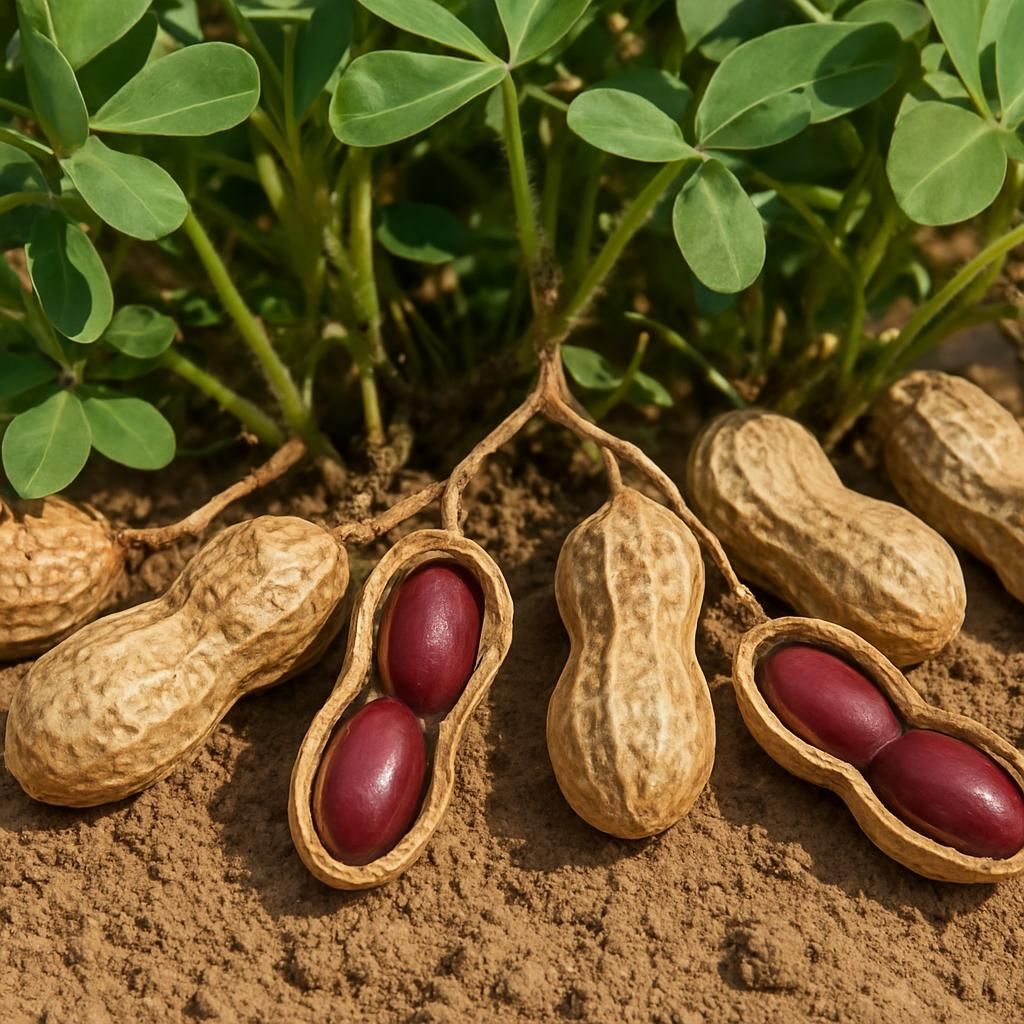
Introduction to Peanut (Tennessee Red)
Tennessee Red peanuts are a heritage Virginia-type cultivar valued by home gardeners and small-scale commercial growers alike for their striking deep-red seed coats, large kernels, and sweet, full-bodied flavor. Originating from traditional Southern U.S. breeding lines, this variety matures in approximately 120–130 days and produces high-quality nuts suitable for roasting, boiling, or raw consumption. Because peanuts are legumes that fix atmospheric nitrogen, they improve soil fertility for subsequent crops while requiring relatively modest external nitrogen inputs.
Successful cultivation hinges on warm soil temperatures, well-drained sandy loam, and careful attention to pegging—the unique process in which flowers pollinate above ground yet develop pods underground. Tennessee Red plants form an upright to semi-spreading canopy reaching 18–24 inches in height, making them suitable for both raised-bed and field-scale production. With proper management, growers can expect 2,500–4,000 pounds of dry, in-shell peanuts per acre under optimal conditions.
This definitive guide synthesizes university extension research and practical field experience into a single, actionable resource covering every stage from soil testing through post-harvest storage.
Botanical Profile of Peanut (Tennessee Red)
Peanut (Tennessee Red) belongs to the Fabaceae family and is botanically classified as Arachis hypogaea. The plant is an annual herbaceous legume that exhibits a unique reproductive strategy known as geocarpy. After self-pollination, the fertilized ovary elongates into a “peg” that penetrates the soil surface to form pods containing one to three seeds.
Tennessee Red plants produce alternate, pinnately compound leaves with four leaflets and small yellow-orange flowers that emerge from the leaf axils. The cultivar is distinguished by its large, elongated pods and deep mahogany-red seed coats that retain color even after roasting. Roots develop extensive nitrogen-fixing nodules in symbiosis with Bradyrhizobium bacteria, contributing 50–150 pounds of nitrogen per acre to the soil.
Soil, pH, and Climate Requirements for Peanut (Tennessee Red)
Peanuts thrive in warm climates with a frost-free period of at least 120 days. Ideal daytime temperatures range from 80–90 °F during flowering and pegging; nighttime temperatures should remain above 60 °F. The crop is highly sensitive to waterlogging, so excellent drainage is essential. A well-prepared seedbed with loose, friable soil facilitates peg penetration and pod development.
| Parameter | Ideal Range | Notes |
|---|---|---|
| Soil Type | Sandy loam to loamy sand | Promotes drainage and peg penetration |
| Soil pH | 5.8–6.5 | Avoid lime applications above pH 6.8 |
| Organic Matter | 1.5–3.0 % | Improves moisture retention without compaction |
| Soil Temperature at Planting | 65–70 °F (3-inch depth) | Critical for uniform germination |
| Frost-Free Days | 120–140 | Required for full pod maturity |
| Annual Rainfall | 20–40 inches (well-distributed) | Supplemental irrigation recommended |
| Daytime Temperature | 80–95 °F during pegging | Maximizes pod set and kernel fill |
Step-by-Step Planting & Propagation
- Site Selection & Soil Testing: Choose a location with full sun and previous non-legume history. Conduct a soil test 4–6 weeks before planting; adjust pH with agricultural lime if below 5.8.
- Seed Preparation: Use certified, treated seed of Tennessee Red. Inoculate with peanut-specific Bradyrhizobium if peanuts have not been grown in the field within the past three years.
- Seedbed Preparation: Till to a depth of 6–8 inches and create raised beds 30–36 inches wide for improved drainage. Remove clods and crop residue that could impede pegging.
- Planting Window: Sow when soil temperature at 3-inch depth consistently reaches 65 °F, typically mid-April to mid-May in USDA zones 7–9.
- Seeding Rate & Depth: Plant seeds 1.5–2 inches deep, spaced 6–8 inches apart in rows 30–36 inches apart. Aim for a final stand of 4–5 plants per linear foot.
- Irrigation at Planting: Apply 0.5–0.75 inches of water immediately after seeding to ensure even moisture for germination.
Care & Maintenance regimes for Peanut (Tennessee Red)
Consistent moisture, balanced fertility, and timely cultivation are the pillars of high-yielding Tennessee Red production. Avoid excessive nitrogen; the crop obtains most of its nitrogen through biological fixation.
| Growth Stage | Irrigation Schedule | Fertilizer Application | Pruning / Cultivation Notes |
|---|---|---|---|
| Pre-plant / Planting | 0.5–0.75 in immediately after seeding | 0–20–40 (N-P-K) banded 2 in below seed | None; focus on weed control |
| Vegetative (V1–V5) | 0.75–1.0 in per week if rainfall <0.5 in | Side-dress 0–15–30 at 30–40 days | Shallow cultivation to 2 in depth |
| Flowering & Pegging | Maintain 1.0–1.25 in per week | Foliar boron (0.3 lb B/acre) at early bloom | Avoid deep tillage; preserve pegging zone |
| Pod Fill | 1.25–1.5 in per week; reduce 2 weeks before harvest | None; excess N delays maturity | Hand-weed or use shielded herbicide applications |
| Pre-harvest | Withhold irrigation 10–14 days prior | None | None |
Pests, Diseases & Organic Management
Tennessee Red peanuts face pressure from several insect pests and soil-borne diseases. Integrated pest management (IPM) emphasizes cultural practices, beneficial insects, and targeted organic sprays.
Major Pests
- Aphids transmit viruses and excrete honeydew that promotes sooty mold.
- Cutworms sever young seedlings at the soil line; use collars or Bacillus thuringiensis (Bt) sprays.
- Thrips damage foliage and vector tomato spotted wilt virus.
- Spider mites appear under hot, dry conditions; predatory mites and overhead irrigation help suppress populations.
Key Diseases
- Leaf spot diseases (early and late) cause defoliation; rotate with non-host crops and apply copper-based fungicides at first symptoms.
- Southern blight (Sclerotium rolfsii) produces white mycelium and sclerotia at the crown; improve drainage and bury crop residue.
- Root-knot nematodes stunt roots and reduce pod set; use resistant cover crops such as sorghum-sudangrass and maintain 3-year rotations.
Scout weekly, employ yellow sticky traps, and release beneficial insects such as lady beetles and lacewings. When thresholds are exceeded, rotate modes of action to prevent resistance.
Harvesting, Curing & Optimal Storage
Harvest when 70–80 % of pods show internal hull darkening and kernels reach physiological maturity (approximately 120–130 days after planting). Use a peanut digger to lift plants, shake off soil, and invert windrows for 3–5 days of field curing. Target kernel moisture of 10–12 % before combining.
Cure pods in forced-air dryers at 95 °F until moisture reaches 8–10 %. Store in breathable burlap or mesh bags at 35–40 °F and 60–70 % relative humidity. Monitor for Storage Beetles and maintain sanitation to preserve quality for up to 12 months.
Companion Planting for Peanut (Tennessee Red)
Strategic companions improve biodiversity, deter pests, and optimize space. Pair Tennessee Red with Corn for nitrogen scavenging and physical support, and interplant with Okra to attract beneficial predators. Aromatic herbs such as Thai Basil repel thrips and aphids. Avoid planting near Potato or Tomato to reduce shared disease pressure. Incorporate Clover as a living mulch between rows to suppress weeds and add organic matter.
Learn how weather resilience strategies improve peanut yields on small farms.