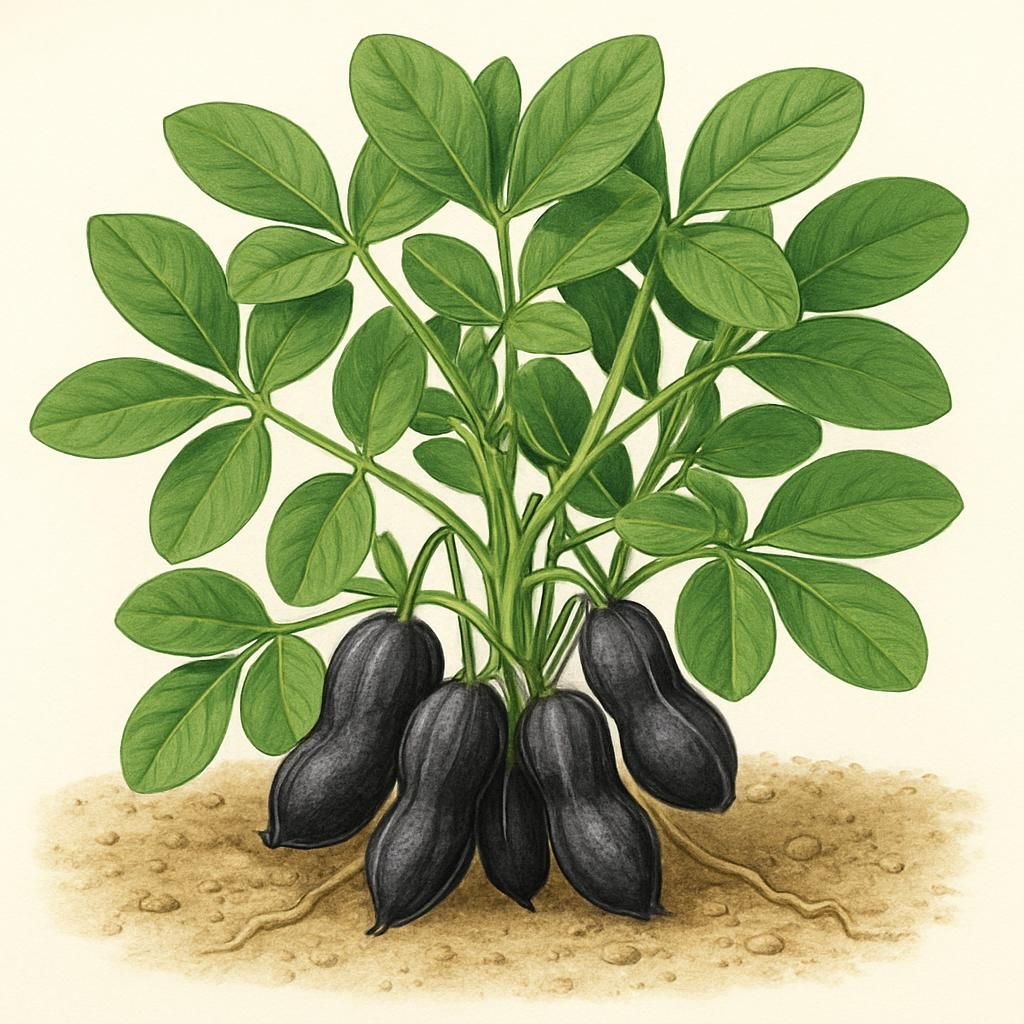
Introduction to Peanut (Schronce’s Deep Black)
Schronce’s Deep Black is an open-pollinated heirloom peanut (Arachis hypogaea) selected for its striking dark seed coats and superior flavor profile. The variety produces medium-sized pods containing two to three kernels with deep purple-black skins that retain color even after roasting. Growers value the cultivar both for specialty markets and home gardens because of its drought tolerance once established and its ability to fix atmospheric nitrogen, improving soil fertility for subsequent crops.
Originating from small-farm selections in the southeastern United States, Schronce’s Deep Black matures in approximately 120–130 days and performs well in both conventional and organic systems. Its compact growth habit (18–24 inches tall) makes it suitable for raised beds, market gardens, and larger commercial plantings. Because the variety is day-length sensitive, it flowers most profusely under long summer days typical of USDA zones 7–10.
Botanical Profile of Peanut (Schronce’s Deep Black)
Peanuts belong to the Fabaceae family and are unique among legumes because their pods develop underground. The plant produces yellow, pea-like flowers above ground that, after pollination, elongate into “pegs” that penetrate the soil to form pods. Schronce’s Deep Black exhibits a bunch-type growth habit with a moderate number of branches and dark-green, pinnately compound leaves. The deep pigmentation in the seed coat is due to high concentrations of anthocyanins, compounds linked to elevated antioxidant activity compared with standard tan-skinned varieties.
Soil, pH, and Climate Requirements for Peanut (Schronce’s Deep Black)
Peanuts demand well-drained, sandy-loam soils with good aeration to allow peg penetration and pod development. Heavy clay soils should be amended with composted pine bark or coarse sand. Avoid fields with a history of Sclerotinia stem rot or severe nematode pressure.
| Parameter | Ideal Range | Notes |
|---|---|---|
| Soil Type | Sandy loam to loamy sand | Ensures drainage and peg penetration |
| Soil pH | 5.8 – 6.5 | Slightly acidic; lime if below 5.5 |
| Organic Matter | 2–4 % | Improves moisture retention without compaction |
| Temperature (Day) | 75–90 °F (24–32 °C) | Optimal for flowering and pegging |
| Temperature (Night) | 60–70 °F (15–21 °C) | Avoid prolonged nights below 55 °F |
| Frost-Free Period | Minimum 120 days | Required for full pod maturity |
| Annual Rainfall | 20–40 inches (500–1000 mm) | Supplemental irrigation needed in dry spells |
Step-by-Step Planting & Propagation
- Soil Testing & Amendment: Conduct a soil test 4–6 weeks before planting. Apply lime to raise pH to 6.0 if necessary and incorporate 20–30 lb of well-rotted compost per 100 sq ft.
- Seed Selection & Treatment: Use certified, untreated seed of Schronce’s Deep Black. Inoculate with a peanut-specific Bradyrhizobium strain 30 minutes before planting.
- Timing: Plant when soil temperature at 4-inch depth reaches a consistent 65 °F (18 °C), typically 2–3 weeks after the last spring frost.
- Spacing: Space rows 30–36 inches apart; place seeds 2 inches deep and 6–8 inches within the row for bunch types.
- Irrigation at Planting: Provide 0.5–0.75 inches of water immediately after seeding to ensure uniform emergence.
Care & Maintenance regimes for Peanut (Schronce’s Deep Black)
Consistent moisture during flowering and pegging is critical, while excess water late in the season can promote disease.
| Growth Stage | Water (inches/week) | Fertilizer (N-P-K) | Pruning / Cultivation |
|---|---|---|---|
| Pre-plant | 0 | 0-20-20 at 200 lb/acre | Incorporate cover crop residue |
| Emergence–Flowering | 1.0–1.25 | Side-dress 10 lb N/acre at 30 DAP | Shallow cultivation to control weeds |
| Pegging–Pod Fill | 1.5 | None (rely on fixation) | Hill soil around plants at 45–50 DAP |
| Maturation | 0.75 | None | Cease irrigation 2 weeks before harvest |
Pests, Diseases & Organic Management
Common above-ground pests include thrips, grasshoppers, and cutworms. Below-ground threats are primarily root-knot nematodes and wireworms. Scout weekly and deploy floating row covers until flowering begins. For disease management, rotate with non-host crops such as corn or small grains for at least three years. Apply neem oil or insecticidal soap for soft-bodied insects and maintain good field sanitation to reduce leaf spot diseases.
Harvesting, Curing & Optimal Storage
Harvest when 70–80 % of pods show darkened veining on the interior shell and kernels reach full color. Dig plants carefully, shake off soil, and windrow for 3–5 days to reduce moisture to 20–25 %. Move windrows to a well-ventilated barn or dryer at 90–95 °F with 50–60 % RH until moisture reaches 10 %. Store cured in-shell peanuts at 35–40 °F and 60–70 % RH for up to 12 months. For seed saving, select the largest, darkest pods and keep separate from roasting stock.
Companion Planting for Peanut (Schronce’s Deep Black)
Peanuts benefit from nitrogen contributions to neighboring crops and appreciate the shade and pest deterrence provided by tall companions. Recommended pairings include corn, squash, and cucumber. Aromatic herbs such as thyme and rosemary help repel foliage pests. Avoid planting near onion or garlic families, which can inhibit rhizobia activity. After harvest, leave roots in place to supply residual nitrogen for fall-planted cabbage or lettuce.