Introduction to Peanut (Runner)
Runner peanuts (Arachis hypogaea) are the dominant commercial peanut type in the United States, accounting for the majority of acreage in Georgia, Alabama, and Florida. They produce long, slender pods with two seeds and are prized by processors for their uniform size and high roasting quality. Because the plants are indeterminate and spread along the ground, they require specific management practices that differ from bunch or Spanish types.
Successful production depends on warm soil temperatures, well-drained sandy loam soils, and careful timing of planting and harvest. This guide provides professional-grade, research-based recommendations for commercial and serious home growers.
Botanical Profile of Peanut (Runner)
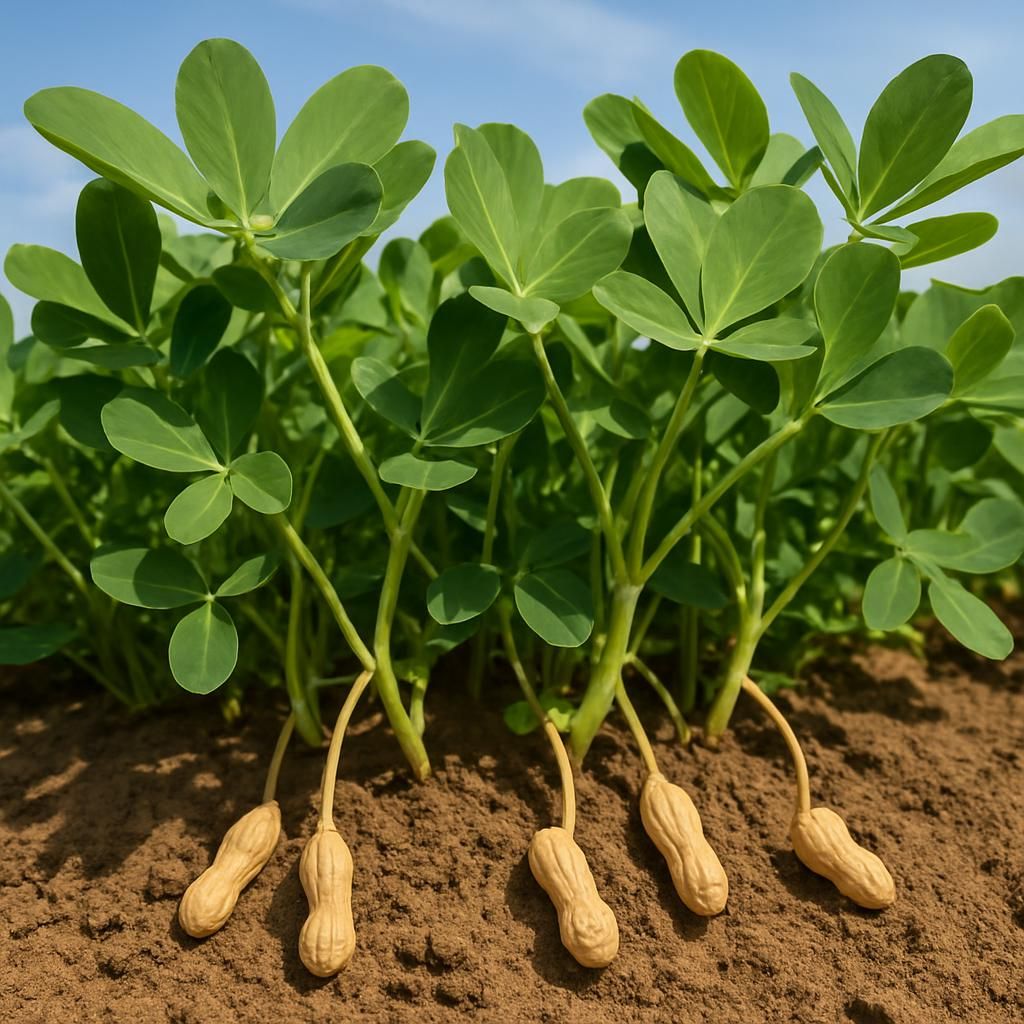
Runner peanuts belong to the Fabaceae family and are unique among legumes because they flower above ground but produce fruit below ground. The plant develops a taproot that can reach 3–4 feet deep, while lateral roots spread extensively in the top 12–18 inches of soil. After self-pollination, the peg (gynophore) elongates and pushes into the soil where the pod develops.
Runner cultivars typically mature in 130–150 days and produce a prostrate growth habit reaching 12–18 inches in height with a spread of 24–36 inches. Leaves are pinnately compound with four leaflets, and flowers are yellow to orange, appearing 30–40 days after planting.
Soil, pH, and Climate Requirements for Peanut (Runner)
Runner peanuts perform best on deep, well-drained sandy loam soils with good aeration. Heavy clay soils restrict peg penetration and increase disease pressure. Soil should be loose to at least 8 inches deep.
| Parameter | Ideal Range | Notes |
|---|---|---|
| Soil Type | Sandy loam to loamy sand | Good drainage and peg penetration required |
| Soil pH | 6.0–6.5 | Below 5.8 reduces calcium uptake |
| Temperature (Soil) | 65–70°F at 4-inch depth | Minimum for planting |
| Air Temperature | 70–90°F daytime | Frost-free period of 140+ days needed |
| Annual Rainfall | 30–50 inches | Supplemental irrigation often required |
| Organic Matter | 1.5–2.5% | Higher levels improve water retention |
Step-by-Step Planting & Propagation
Site Selection & Preparation: Choose a field with full sun and previous crop history free of root-knot nematodes. Perform deep tillage to 10–12 inches followed by disking to create a smooth seedbed.
Soil Testing & Amendment: Test soil 3–4 months before planting. Apply lime to reach pH 6.2–6.5. Incorporate 20–40 lbs P₂O₅ and 60–80 lbs K₂O per acre based on soil test; avoid excess nitrogen.
Seed Selection & Treatment: Use certified seed of adapted runner cultivars such as Georgia-06G or TUFRunner 297. Treat seed with fungicide and inoculate with Bradyrhizobium if peanuts have not been grown in the field for 3+ years.
Planting Window: Plant when soil temperature at 4-inch depth reaches a consistent 65°F, typically mid-April to mid-May in the Southeast.
Seeding Rate & Depth: Space rows 36 inches apart with in-row spacing of 2–3 inches (6–8 seeds per foot). Plant 1.5–2 inches deep. Target final stand of 4–5 plants per foot of row.
Irrigation at Planting: Apply 0.5 inch of water immediately after planting to settle soil around seed.
Care & Maintenance regimes for Peanut (Runner)
Consistent moisture during flowering and pegging is critical. Avoid water stress during the first 60 days after planting.
| Growth Stage | Irrigation Frequency | Fertilizer Application | Pruning / Cultural Practice |
|---|---|---|---|
| Emergence to 30 DAP | 0.5–0.75" every 4–5 days | None (rely on residual) | None |
| 30–60 DAP (Flowering) | 1.0–1.25" weekly | 400–600 lbs gypsum/acre at first bloom | Light cultivation to control weeds |
| 60–90 DAP (Pegging) | 1.25–1.5" weekly | None (calcium critical) | Maintain 2–3 inch soil moisture zone |
| 90–120 DAP (Pod Fill) | 1.5" weekly | None unless leaf analysis indicates | None |
| 120–140 DAP (Maturity) | Reduce to 0.75" | None | Prepare for digging |
Pests, Diseases & Organic Management
Runner peanuts are susceptible to several key pests and diseases. Early scouting and integrated management are essential.
Major Pests
- Thrips: Damage seedlings; use reflective mulch or timely insecticide if populations exceed 5 per terminal.
- Spider mites: Favored by hot, dry conditions; release predatory mites as first line of defense.
- Lesser cornstalk borer: Larvae bore into stems and pods; maintain soil moisture and use approved Bt products.
Major Diseases
- Early leaf spot: Caused by Cercospora arachidicola; rotate with non-host crops and apply approved copper or strobilurin fungicides.
- Southern blight: Sclerotium rolfsii attacks lower stems; use deep burial of crop residue and avoid cultivation after pegging.
- Tomato spotted wilt virus: Thrips-vectored; plant resistant cultivars and avoid early planting.
Organic options include neem-based sprays, beneficial insect releases, and strict 3–4 year crop rotations with corn or cotton.
Harvesting, Curing & Optimal Storage
Runner peanuts reach maturity when 70–80% of pods show darkened inner hull color. Dig when soil is moist to minimize pod loss.
Digging: Use a digger-shaker-inverter to lift plants and invert windrows. Allow 3–5 days of field drying.
Combining: Thresh pods when moisture reaches 18–22%. Avoid excessive cylinder speed to reduce mechanical damage.
Curing: Move to forced-air dryers at 90–95°F with 50–60% relative humidity. Reduce moisture to 10% within 48–72 hours.
Storage: Store in cool (45–55°F), dry conditions at 8–10% moisture. Use aerated bins and monitor for storage beetles.
Companion Planting for Peanut (Runner)
Runner peanuts benefit from specific companion pairings that improve soil health and reduce pest pressure.
Recommended Companions
- Corn: Provides light shade and wind protection; peanuts fix nitrogen for following corn crop.
- Sorghum: Breaks disease cycles and provides habitat for beneficial insects.
- Marigold: Repels nematodes and thrips when planted in borders.
Avoid
- Potato and other solanaceous crops increase shared disease pressure.
- Heavy feeders such as cabbage compete for calcium and moisture.
Rotate peanuts with wheat or cotton in a 3–4 year cycle for optimal soil health and yield stability.