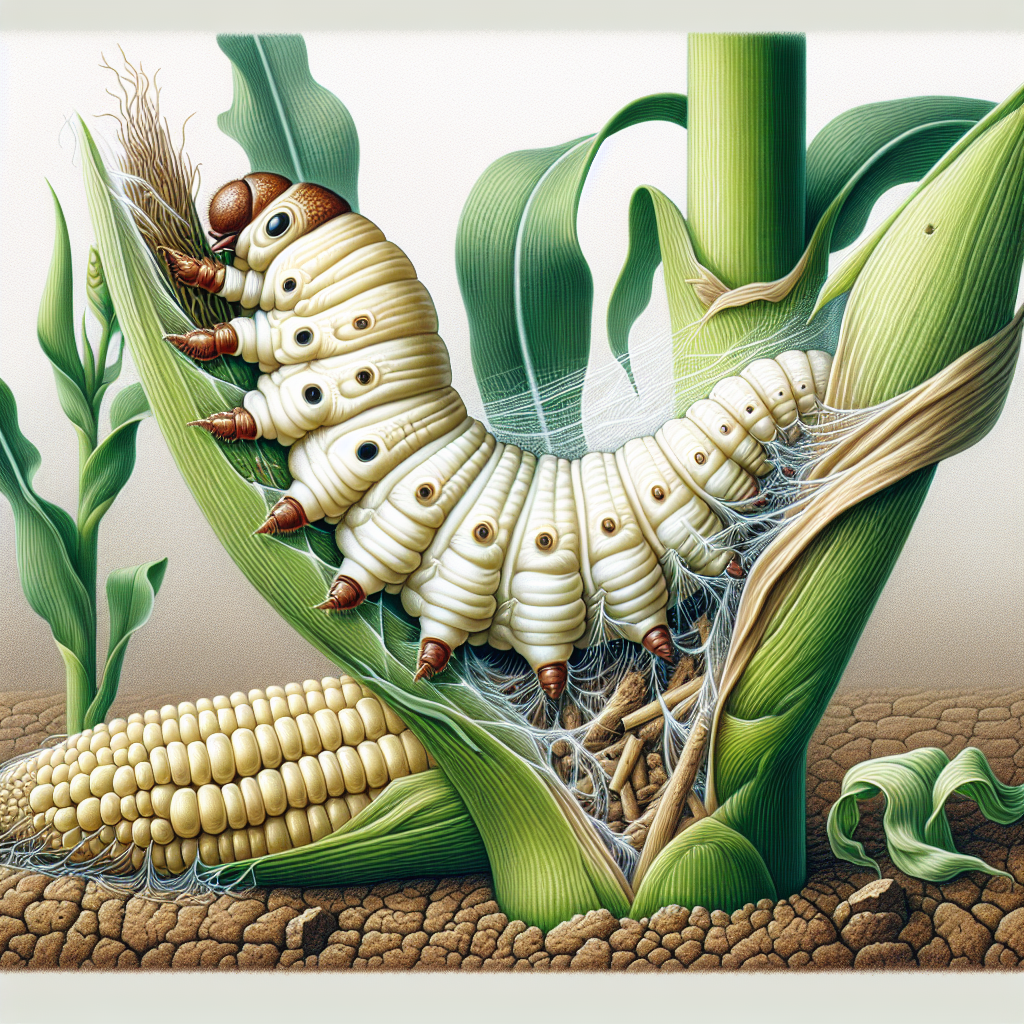
Introduction to Lesser Cornstalk Borer
The lesser cornstalk borer, scientifically known as Elasmopalpus lignosellus (Zeller), ranks among the most insidious pests in corn production, particularly in the southeastern United States, parts of South America, and other subtropical regions. Unlike aboveground chewers like the Corn Earworm or European Corn Borer, this pyralid moth's larvae attack from below, tunneling into the base of young corn plants just above the soil line. This hidden feeding disrupts nutrient and water uptake, leading to rapid wilting and death that mimics drought stress or disease.
First described in the late 19th century, the pest thrives in drought-prone, sandy soils where crops struggle. Infestations can devastate entire fields, with economic losses exceeding millions annually in high-risk areas like Florida, Georgia, and Texas. Small-scale farmers and large operations alike face challenges, as larvae silk-webbing creates silken tunnels that protect them from many sprays. Early detection is critical, as damage appears suddenly after rains following dry spells. This guide equips growers with diagnostic tools, lifecycle insights, organic strategies, and prevention tactics to safeguard yields. For broader pest management, check out Spring Pest Patrol: Organic AI Strategies to Shield Your Crops from Common Invaders.
Identifying Symptoms & Damage
Spotting lesser cornstalk borer damage requires keen observation, as symptoms mimic other issues like root-knot nematodes or seedling damping-off. The hallmark sign is the 'shotgun' pattern: scattered dead seedlings or plants wilting in irregular patches across the field, often after irrigation or rain breaks a drought.
Examine affected plants closely. You'll find a distinctive silken-lined tunnel at the soil line, packed with fine frass (insect waste) resembling sawdust. Larvae, creamy-white with pinkish or greenish tinges and brown heads, measure 1/2 to 3/4 inch long and curl into a C-shape when disturbed. They bore into the mesocotyl (first internode above the root) or lower stalk, girdling vascular tissues. Above-ground symptoms include yellowing lower leaves, stunted growth, and plants 'shepherd's crooking'—bending at the injury site before lodging.
In severe cases, 20-80% stand loss occurs within days. Scout by digging up 20-25 plants per 100 feet of row in suspect areas; if 10% show larval tunnels, action is needed. Differentiate from cutworms, which sever stems cleanly at night, or wireworms, which target roots deeper underground. Cross-section stalks to reveal clean, round borer channels versus irregular cutworm cuts. Use a hand lens for frass ID—borer frass is finer and silk-mixed.
Yield impacts are profound: surviving plants compensate somewhat, but detasseling or barren stalks reduce ear fill by 10-30%. In sweet corn like Silver Queen varieties, cosmetic damage lowers marketability. Timely diagnosis prevents misapplication of ineffective fungicides, saving costs.
Lifecycle and Progression of Lesser Cornstalk Borer
Understanding the lesser cornstalk borer's lifecycle is key to timing interventions. This pest completes 4-7 generations per year in warm climates (60-95°F optima), with overlapping broods complicating control.
Eggs: Tiny (0.5 mm), white, scale-like, laid in clusters of 10-50 on dry soil, plant debris, or leaf litter near crop edges. Females oviposit at dusk after dusk flights; eggs hatch in 2-4 days at 85°F.
Larvae: Six instars over 14-28 days. Young larvae (1st-2nd) web soil particles into protective tubes, scraping mesocotyls. Older larvae bore deeper, feeding 7-14 days before pupating. Peak damage occurs 10-20 days post-planting.
Pupae: Reddish-brown, 1/3-inch long, in soil 1-2 inches deep, lasting 7-10 days.
Adults: Small (1/2-inch wingspan), grayish moths with wing spots resembling bird droppings for camouflage. Drawn to lights, they mate immediately and lay 100-300 eggs over 7-10 days. Flight peaks at night.
Progression ties to crop stage: seedlings V2-V6 (2-6 leaves) are most vulnerable. Overwinter as partially grown larvae in soil, resuming in spring. Multiple generations mean continuous pressure in continuous corn. Monitor with pheromone traps or soil cores for eggs/larvae.
Environmental Triggers & Risk Factors
Lesser cornstalk borer exploits stress. Drought-stressed, poorly emerged seedlings emit volatiles attracting ovipositing moths. Sandy, low-organic soils retain less moisture, exacerbating vulnerability—infestations surge in fields with <1% soil organic matter.
Key triggers: pre-plant dry spells (>2 weeks no rain), followed by irrigation/rain prompting moth flights. High temperatures (85-95°F) accelerate development. Risk soars in reduced tillage (more residue for pupation), double-cropped soybeans after corn, or late-planted fields overlapping generations.
Weeds like pigweed host minor populations; grassy residues shelter pupae. Over-fertilization causing lush tops but weak roots increases susceptibility. In the Southeast, infestations peak July-September. Assess risk via soil type maps and weather history—fields with prior outbreaks need extra vigilance.
Organic Control & Treatment Plans
Organic management emphasizes disruption over eradication, as complete control is unrealistic. Integrate multiple tactics for 70-90% suppression.
Cultural: Plant into moist soil at >88,000 seeds/acre for rapid canopy closure, shading soil. Use trashy middles or cover crops like clover to deter moths. Irrigate early to ensure uniform emergence; avoid stress periods.
Biological: Encourage natural enemies—ground beetles, parasitic wasps (e.g., Trichogramma), and entomopathogenic nematodes (Steinernema riobrave). Apply nematodes (1 billion/acre) at planting or first scouting.
Mechanical: Tillage buries pupae; rotary hoeing at V1-V2 crushes small larvae. Edge vacuuming removes adults.
Approved Inputs: Surround WP (kaolin clay) barriers at planting. BT (Bacillus thuringiensis) kurstaki targets larvae—apply 1-2 lbs/acre with adjuvants when 10% plants infested, repeat 5-7 days. Spinosad (Entrust) at 0.5 oz/acre for outbreaks, but rotate to prevent resistance.
Scouting Plan: Weekly from planting; dig 25 plants/acre. Treat if 15% show damage. Threshold: 1 larva/3 plants. For Corn (crop), combine with varietal resistance.
Treatment timeline: Preventative nematodes + BT at V2; spinosad if thresholds hit. Yields recover 20-40% with timely action.
Preventing Lesser Cornstalk Borer in the Future
Long-term prevention builds resilient systems. Rotate with non-hosts like peanuts or cotton (2-3 years breaks cycle). Use Bt-corn hybrids expressing Cry1Ab for borer resistance, where allowed organically.
Enhance soil health per Soil Health Mastery: 5 Proven Strategies for Small Farms to Build Fertile Ground Without Breaking the Bank—add organics to retain moisture. Plant early into cool, moist soil; use starter fertilizers for vigor. Trap crops (volunteer corn) at edges divert moths.
Monitor forecasts; avoid planting during peak flights. Post-harvest, deep plow (>8 inches) exposes pupae to predators. Scout adjacent fields; buffer zones reduce migration. IPM audits annually track progress—aim for <5% damage.
Crops Most Affected by Lesser Cornstalk Borer
Primarily a corn specialist, attacking sweet corn, field corn, popcorn, and grain sorghum. Seedlings of sudangrass, pasture grasses, and occasionally sugarcane or sorghum suffer. Rare reports on rice, wheat seedlings under stress. Corn varieties like dent corn and sweet corn hybrids face highest risk; forage corn less so due to later harvest. Global distribution favors warm-season grasses in poor soils.