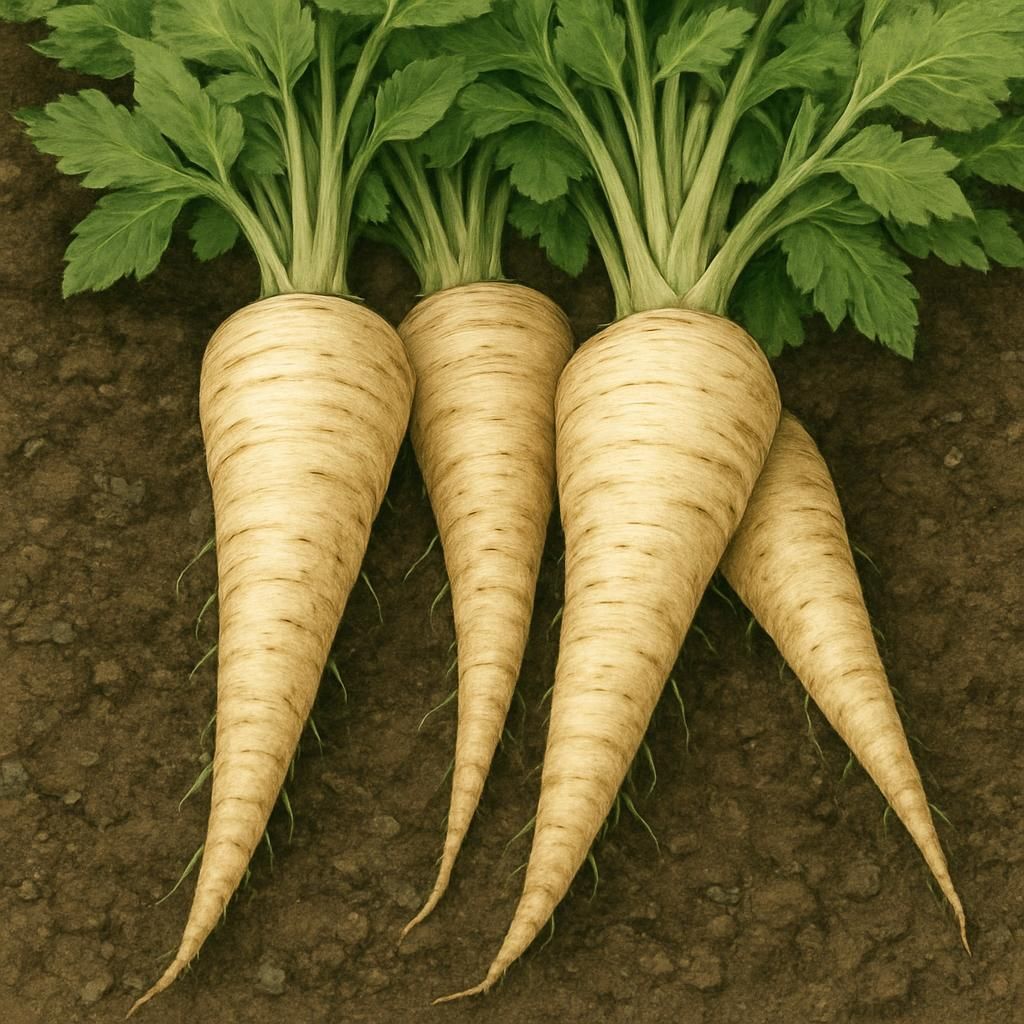
Introduction to Parsnip (Gladiator)
Parsnip (Gladiator) is a modern F1 hybrid bred for uniformity, disease resistance, and high marketable yield. Its smooth, creamy-white roots reach 25–30 cm in length with minimal side branching, making it ideal for both fresh-market sales and long-term winter storage. The variety matures in approximately 120–140 days and maintains excellent eating quality even after several hard frosts.
Because Gladiator tolerates heavy soils better than many open-pollinated types, it has become a staple on small farms seeking dependable root-crop income. When grown correctly, it delivers consistent 2.5–4 kg per square meter under good management.
Botanical Profile of Parsnip (Gladiator)
Gladiator belongs to the Apiaceae family. Like its wild relative, it produces a deep taproot that stores carbohydrates as starch and sugars. The cultivar’s foliage is dark green and finely divided, reaching 40–50 cm in height. Gladiator’s genetic resistance to Parsnip canker and its strong tolerance to powdery mildew set it apart from heritage lines.
The plant is a biennial, grown as an annual for its edible root. Flowers are typical umbels of small yellow blooms that attract beneficial insects when allowed to bolt in the second year.
Soil, pH, and Climate Requirements for Parsnip (Gladiator)
Parsnips require deep, friable soil free of stones to produce straight roots. Gladiator performs best in cool conditions (15–20 °C) but tolerates light frost down to –5 °C.
| Parameter | Ideal Range | Notes |
|---|---|---|
| Soil Type | Sandy loam to loam | Avoid compacted or stony ground |
| Soil pH | 6.0–7.0 | Slightly acidic to neutral |
| Soil Temperature | 10–20 °C | Germination halts above 25 °C |
| Air Temperature | 15–20 °C day / 5–10 °C night | Bolting risk rises above 25 °C |
| Spacing | 10 cm within row, 30 cm rows | Thinning to final spacing critical |
| Depth of Root Zone | Minimum 30 cm | Deep cultivation prevents forking |
Step-by-Step Planting & Propagation
- Site Selection: Choose a sunny, open location that received a legume or brassica crop the previous season.
- Soil Preparation: Loosen soil to 30–40 cm depth. Incorporate well-rotted compost at 5 kg/m². Remove stones and break clods.
- Sowing Window: Direct sow from mid-spring (soil ≥8 °C) through early summer in cool climates. In mild winters, late-summer sowings mature the following spring.
- Seed Treatment: Fresh seed is essential; parsnip seed loses viability after one year. Pre-soak 12–24 h for faster emergence.
- Sowing Depth & Rate: Sow 1–1.5 cm deep, 2–3 seeds per station. Thin to 10 cm when seedlings reach 5 cm.
- Row Orientation: Align rows north-south to maximize light interception and reduce uneven growth.
Care & Maintenance regimes for Parsnip (Gladiator)
Gladiator needs steady moisture and moderate fertility. Excessive nitrogen promotes leaf growth at the expense of root quality.
| Growth Stage | Water Schedule | Fertilizer Schedule | Pruning / Thinning Schedule |
|---|---|---|---|
| Germination (0–21 d) | Keep top 2 cm moist; light daily water | None; seed contains adequate reserves | None |
| Seedling (3–6 wks) | 15–20 mm/week; avoid waterlogging | Side-dress 20 g/m² low-nitrogen organic | Thin to 10 cm when true leaves appear |
| Vegetative (6–12 wks) | 25 mm/week; mulch to retain moisture | 30 g/m² balanced organic (NPK 5-5-8) | Weed weekly; remove damaged leaves |
| Root Swelling (12–18 wks) | 20 mm/week; reduce before harvest | Light potassium boost (wood ash 50 g/m²) | None |
| Overwintering | Minimal; protect crowns with straw | None | Remove dead foliage in late autumn |
Pests, Diseases & Organic Management
Common threats include carrot fly, cutworms, and parsley root aphid. Gladiator’s resistance to canker reduces losses from Alternaria and Phoma species.
Organic controls:
- Use fine insect netting (0.8 mm mesh) from sowing to deter carrot fly.
- Apply Bacillus thuringiensis for cutworm larvae.
- Rotate with alliums or cereals to break nematode cycles.
- Maintain soil pH above 6.0 to suppress clubroot in nearby brassicas.
Harvesting, Curing & Optimal Storage
Harvest when roots reach 2–3 cm crown diameter, typically 120–140 days after sowing. Lift carefully with a fork to avoid breakage. In regions with mild winters, leave roots in the ground and harvest as needed; flavor improves after frost.
Curing: Place roots in a cool (0–2 °C), humid (95 % RH) environment for 7–10 days to heal minor wounds. Long-term storage at 0 °C and 95–98 % RH yields 4–6 months shelf life. Never store near apples or pears; ethylene accelerates softening.
Companion Planting for Parsnip (Gladiator)
Parsnips pair well with onion, leek, and radish. These alliums mask the scent of parsnip foliage from carrot fly. Avoid planting near celery or carrot to limit shared pests. Nasturtium and marigold provide beneficial-insect habitat and deter aphids. Deep-rooted parsnips also improve soil structure for following shallow-rooted crops such as lettuce.
Parsnip canker disease information offers additional background on resistance breeding.
The Hidden Power of Mulching: 8 Organic Strategies to Transform Small Farm Soil explains mulch choices that benefit root crops like Gladiator.