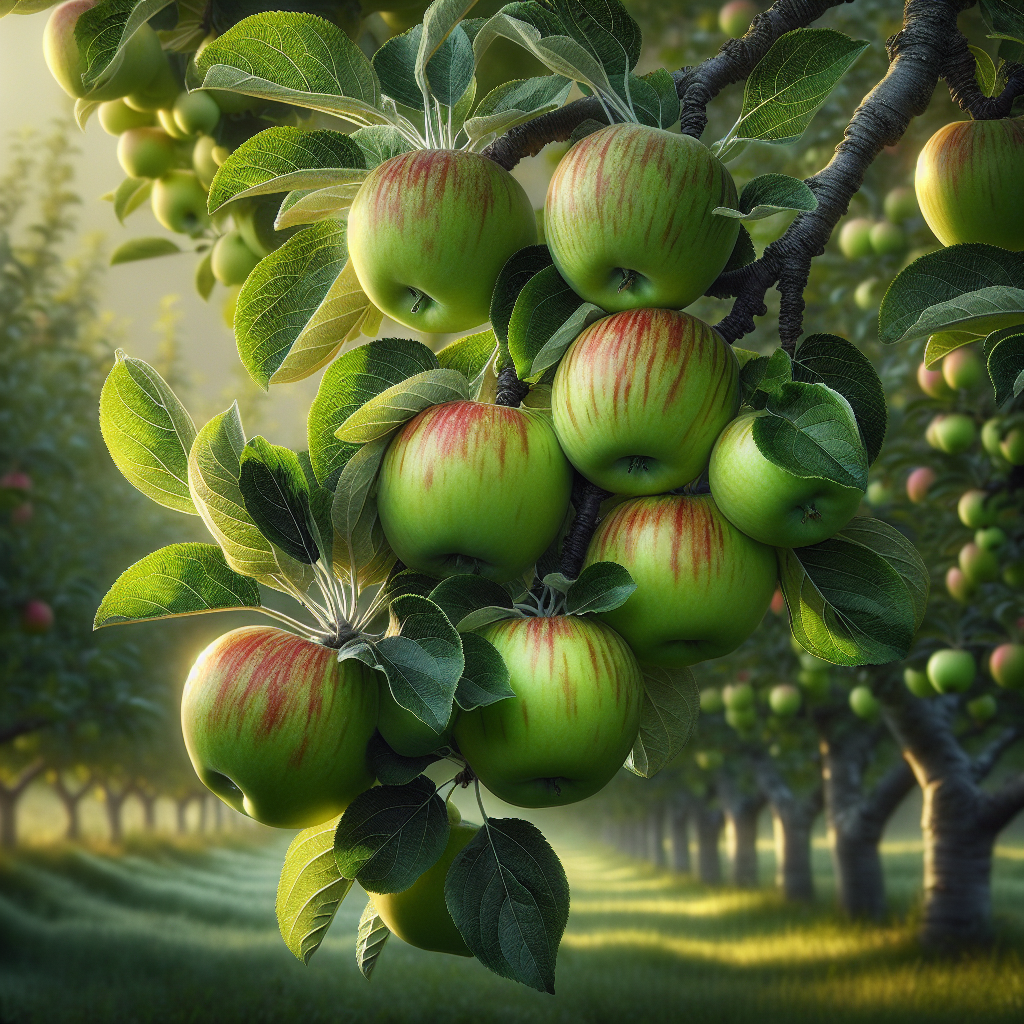
Introduction to Northern Spy Apple
Originating in the northeastern United States in the early 19th century, this heirloom apple developed a loyal following for good reason: it combines high-quality fresh eating with superb cooking performance and long keeping ability. The fruit is typically medium to large, round-conic to somewhat flattened, with greenish-yellow skin washed and striped in red over much of the surface. Its flesh is firm, fine-grained, juicy, and notably bright in flavor, with a balance of sweetness and acidity that deepens after storage.
This cultivar became especially famous in cooler apple-growing districts such as New York, Ontario, and parts of New England. It is also historically valued as a premium pie apple because the flesh holds shape well under heat while still softening evenly. Compared with many modern commercial apples, it is slower to come into bearing and can be more demanding in training and orchard management, but skilled growers often consider the fruit quality worth the wait.
From a production standpoint, this is not usually the first choice for impatient orchardists. Trees are vigorous, often large on standard rootstock, and can be somewhat biennial if cropping is not regulated through thinning. They also require good pollination planning because they are not self-fertile. For general background on orchard culture and apple biology, see our Apple guide.
Botanical Profile of Northern Spy Apple
This cultivar belongs to the species Malus domestica, a deciduous pome fruit tree in the Rosaceae family. Like other apples, it produces fruit from a floral structure in which the edible flesh develops largely from the receptacle surrounding the true ovary. The seeds are enclosed in the central core.
Trees are characteristically vigorous and upright in youth, later becoming broad-spreading with strong scaffold limbs if properly trained. Northern Spy is known for relatively late bloom to mid-late bloom depending on climate, which can offer modest protection against the earliest spring frosts compared with very early-blooming cultivars. However, it is not frost-proof; temperatures below about -2.2°C to -1.1°C (28-30°F) during open bloom can still damage flowers and reduce crop set.
Leaves are medium to dark green, oval, serrated, and borne alternately. Flower buds typically form on spurs and on some terminal or lateral positions depending on training system and previous season growth. Fruiting habit tends to improve with maturity, but young trees often invest heavily in vegetative growth before settling into consistent production.
Fruit maturity is distinctly late season. In many northern climates, harvest falls from late September into October, sometimes after other dessert apples are already off the tree. The flavor profile at harvest is often brisk and somewhat sharp, then mellows in storage while retaining aromatic complexity. This maturing behavior is a defining cultivar trait: growers who pick too early sacrifice sugars and final eating quality, while those who leave fruit too long risk drop, bruising, and bird or wasp injury.
Northern Spy has historically been noted for some resistance to woolly apple aphid, especially when grown on its own roots or certain root systems, though that should not be mistaken for broad pest resistance. Its vigor, fruit quality, and storability are its main strengths; delayed bearing, large tree size on vigorous rootstocks, and some disease susceptibility are its main limitations.
Soil, pH, and Climate Requirements for Northern Spy Apple
This cultivar performs best in deep, well-drained loam or sandy loam with moderate to high organic matter and reliable moisture retention. The ideal rooting depth is at least 60-90 cm (24-36 inches), though deeper is preferable for long-lived trees. Avoid shallow soils over hardpan, heavy clays that stay saturated in spring, and droughty gravelly soils unless irrigation is available.
Target soil pH is 6.0-6.8, with 6.2-6.5 often giving the best balance of nutrient availability. Below pH 5.8, calcium, magnesium, and phosphorus dynamics may become limiting while aluminum toxicity risk rises in some soils. Above pH 7.0, iron, manganese, and zinc deficiencies become more likely, especially on calcareous ground. Conduct a soil test before planting and amend several months ahead if possible. If lime is needed, incorporate it into the full future root zone rather than only the planting hole.
Good internal drainage is critical. Apple roots require oxygen, and standing water for even 48-72 hours during active growth can stress feeder roots. In poorly aerated soil, first symptoms often include weak shoot growth, pale foliage, small leaves, and fruit drop. Chronic waterlogging also predisposes trees to root decline and collar disorders. Ideally, soil should remain evenly moist but not saturated, roughly around 60-80% of field capacity through the main growing season. In practical terms, when squeezed in hand, loamy soil should feel cool and slightly cohesive but not smear like putty or release free water.
This is a cool-temperate cultivar with high winter hardiness and a strong need for winter chill. It is best suited to USDA zones roughly 4-7, depending on rootstock and site. Trees benefit from climates with cold winters, moderate summers, and a long but not excessively hot ripening season. Excessive summer heat can reduce acidity, sunburn exposed fruit, and flatten flavor. Regions with cool nights before harvest tend to produce the best color and aromatic development.
Full sun is essential: a minimum of 8 hours of direct light is advisable, and 10+ hours during the growing season is ideal for fruit color, bud initiation, and disease reduction through faster leaf drying. Air drainage also matters. Plant on gentle slopes or elevated sites where cold air can flow away rather than settle, especially in frost pockets. Avoid windy ridge tops unless windbreaks are established, because strong wind can scar fruit, increase transpiration, and interfere with pollination.
Annual rainfall of 750-1000 mm (30-40 inches) can support good growth if distributed well, but supplemental irrigation is strongly recommended in commercial or serious home orchards. Moisture stress from petal fall through six weeks after bloom can reduce cell division and permanently limit fruit size. Late summer drought can also reduce return bloom for the following year.
Step-by-Step Planting & Propagation
Start with a grafted tree from a reputable nursery. Named apple cultivars do not come true from seed, so seed propagation is unsuitable if the goal is authentic Northern Spy fruit. Trees are typically sold as one-year whips or two-year feathered trees grafted onto standard, semi-dwarf, or dwarf rootstocks. Rootstock choice determines final size, anchorage, precocity, and soil adaptation.
For a home orchard, semi-dwarf rootstocks are often the best compromise because Northern Spy is naturally vigorous. Dwarf systems can work very well but require permanent staking or trellising and more precise irrigation. Standard rootstocks produce long-lived large trees, but harvest and pruning become more labor-intensive.
Plant in early spring while trees are dormant in cold-winter regions, or in late autumn where winters are moderate and soils remain workable. Bare-root trees should be planted before buds break. Keep roots moist at all times before planting; even 15-30 minutes of drying wind and sun can damage fine root tissue.
Site preparation steps:
- Clear perennial weeds in at least a 1-1.5 m (3-5 ft) diameter circle.
- Test soil and correct pH, phosphorus, potassium, calcium, and organic matter in advance.
- If drainage is marginal, plant on a raised berm 20-30 cm (8-12 in) high.
- Lay out pollinizer trees nearby because cross-pollination is necessary.
Planting procedure:
- Dig a hole wide enough to spread roots naturally, usually 2-3 times root spread, but no deeper than the root system.
- Identify the graft union and keep it 5-10 cm (2-4 in) above finished soil level, especially on dwarfing rootstocks.
- Trim only broken or dead roots; do not heavily prune healthy roots.
- Backfill with native soil rather than a rich pocket mix that can impede outward root exploration.
- Water thoroughly to settle soil and eliminate air pockets.
- Mulch with 5-8 cm (2-3 in) of wood chips or shredded bark, keeping mulch 10-15 cm (4-6 in) away from the trunk to prevent rot and vole damage.
Spacing depends on rootstock and training system. Typical spacing ranges from 3-4.5 m (10-15 ft) between dwarf trees, 4.5-6 m (15-20 ft) for semi-dwarf, and 7-9 m (23-30 ft) for standard trees. Northern Spy's vigor means overcrowding quickly reduces light penetration and fruit color.
Pollination is essential. Choose a compatible apple cultivar that blooms at a similar time. Crabapples can also serve as excellent pollen sources if bloom overlap is adequate. Bee activity is the main pollination engine, so avoid spraying insecticides during bloom.
Propagation beyond nursery production is generally by bench grafting, whip-and-tongue grafting, cleft grafting, or budding onto rootstocks. Scion wood should be collected during dormancy from healthy, true-to-type wood. Professional propagators store scions near 0-2°C (32-36°F) under high humidity until grafting.
Care & Maintenance regimes for Northern Spy Apple
Water management should be precise, particularly for the first three years. Young trees generally need the equivalent of 10-20 liters (2.5-5 gallons) per irrigation event 1-3 times weekly depending on soil texture, rainfall, and temperature. The goal is moisture penetrating 20-30 cm (8-12 in) deep for newly planted trees and deeper as roots establish. In mature orchards, aim for approximately 25-40 mm (1-1.5 inches) of water per week during active growth if rainfall is lacking.
Signs of underwatering include dull foliage, reduced shoot extension, small fruit, premature fruit drop, and soil pulling away from the root zone. Signs of overwatering include persistently wet soil, yellowing lower leaves, weak soft growth, sour-smelling soil, algae on the surface, and sudden collapse of feeder roots. Use a probe or dig a small inspection hole rather than relying on surface appearance alone.
Fertilization should be based on leaf analysis and soil tests, but general guidance is to avoid forcing excessive nitrogen, especially in vigorous young Northern Spy trees. Too much nitrogen promotes rank upright shoots, delays fruiting, increases fire blight susceptibility in some conditions, and reduces color development. In non-bearing young trees, modest spring nitrogen may help canopy establishment. In bearing trees, balanced programs emphasizing adequate potassium, calcium, boron, and magnesium are often more valuable than heavy nitrogen feeding.
Calcium deserves special mention because it supports fruit firmness and storage quality. Foliar calcium sprays may be warranted in orchards with low fruit calcium or bitter pit risk, though cultivar susceptibility varies by site, crop load, and rootstock. Maintain even soil moisture to improve calcium transport, since erratic watering disrupts nutrient movement into fruit.
Training and pruning are central to success. Northern Spy responds well to central leader or modified central leader systems. In high-density plantings, tall spindle or slender spindle approaches may be used if vigor is controlled by rootstock and pruning strategy. During the first years, establish 3-5 well-spaced scaffold branches with wide crotch angles of roughly 45-60 degrees. Limb spreaders or ties can help convert upright shoots into fruitful wood.
Dormant pruning should remove dead, diseased, rubbing, and overly upright wood while preserving light distribution. Summer pruning can be useful on excessively vigorous trees to reduce shading and improve fruit bud formation. Do not overprune, as severe cuts stimulate more vegetative vigor and delay cropping. A good target is a canopy where dappled light reaches lower branches and fruiting wood throughout the tree.
Fruit thinning is often necessary. Thin by hand within 2-4 weeks after petal fall, once natural June drop begins to declare the final set. Leave one fruit per cluster and space fruit roughly 15-20 cm (6-8 in) apart along branches. This improves fruit size, color, annual bearing consistency, and limb health. If crop load is left too heavy, Northern Spy may alternate between one large crop and one light crop year.
Weed control around the root zone is especially important in the establishment phase. Maintain a vegetation-free strip at least 60-90 cm (24-36 in) from the trunk. Grass competition can dramatically reduce growth in young trees by capturing water and nitrogen. Mulch helps, but monitor for rodents under winter cover.
In colder regions, protect trunks from winter sunscald and rodent injury using guards or white trunk paint formulated for trees. Deer browsing can devastate young plantings, so fencing is often more reliable than repellents.
For broader orchard floor fertility strategies, growers often integrate compost, cover crops in alleyways, and mulching; our soil health tips offer useful supporting ideas.
Pests, Diseases & Organic Management
Like many heirloom apples, this cultivar requires active monitoring rather than passive hope. Common insect pests include codling moth, apple maggot, plum curculio, aphids, leafrollers, mites, and scale. Common diseases include apple scab, cedar-apple rust, powdery mildew, fire blight, sooty blotch, flyspeck, and various cankers depending on region.
codling moth larvae tunnel into fruit, leaving frass at the entry hole, often near the calyx or stem. apple maggot creates winding brown trails through the flesh. plum curculio causes crescent-shaped egg-laying scars and early fruit drop. Organic management relies on sanitation, monitoring traps, kaolin clay barriers, timely neem or spinosad where permitted and appropriate, and removal of infested dropped fruit.
apple scab is among the most important fungal threats in humid regions. It first appears as olive velvety lesions on leaves and fruit, later becoming dark, corky, and cracked. Good airflow, resistant pollinizers, leaf litter breakdown, and well-timed protective sprays such as sulfur or approved copper products can reduce pressure. Urea sprays on fallen leaves or autumn shredding of leaf litter can accelerate decomposition and reduce overwintering inoculum.
cedar-apple rust causes bright orange leaf lesions and fruit injury where junipers host the alternate stage of the pathogen. If possible, reduce nearby infected juniper hosts, though this is rarely fully practical at landscape scale. Sulfur or other approved fungicides may be needed preventively in high-pressure districts.
fire blight, caused by Erwinia amylovora, is particularly dangerous during warm, wet bloom periods. Symptoms include blackened flower clusters, shepherd's crook shoot tips, and bacterial ooze under conducive conditions. Prune infected wood 20-30 cm (8-12 in) below visible symptoms during dry weather, disinfecting tools between cuts when actively working infected tissues. Avoid excessive nitrogen and heavy winter pruning that trigger lush susceptible shoots.
For organic growers, the strongest program combines prevention: open canopy pruning, sanitation, balanced fertility, removal of mummified fruit, prompt pickup of drops, pheromone or sticky trap monitoring, and bloom-safe pollinator stewardship. Sprays are only one layer of a larger integrated system.
Harvesting, Curing & Optimal Storage
This is a late-harvest apple, and timing matters greatly. Fruit should be picked when background skin color shifts from strong green toward greenish-yellow, seeds darken to brown, starch conversion advances, and the fruit separates from the spur with a gentle upward twist rather than a hard tug. Taste testing remains one of the best practical tools: the flesh should be firm but no longer raw or grassy.
Because flavor improves after harvest, many growers treat this as a storage apple rather than a straight-off-the-tree early dessert apple. Handle fruit gently; bruises become storage rot entry points. Use padded picking bags or hand-pick directly into shallow crates. Never shake fruit from the tree if it is intended for storage.
Sort immediately. Set aside any fruit with punctures, scab cracks, codling damage, bruises, or stem tears for immediate kitchen use, cider, sauce, or drying. Store only sound, dry, unblemished apples.
Unlike some crops, apples do not require curing in the same sense as onions or sweet potatoes, but they do benefit from prompt cooling after harvest. Remove field heat as quickly as possible. Ideal storage conditions are 0-2°C (32-36°F) with 90-95% relative humidity. Under these conditions, Northern Spy can keep for several months, often improving in flavor over the first weeks of storage as acids and sugars come into better balance.
Avoid storing with strong ethylene-sensitive vegetables if quality matters, and maintain airflow to reduce condensation. If household refrigeration is the only option, perforated plastic bags can help maintain humidity without trapping excessive free moisture. Check fruit regularly and remove any softening or decaying apples immediately because one breakdown point can spread rot through a box.
For culinary use, this variety is renowned for pies, tarts, baked apples, sauce with structure, and fresh eating after a period of rest. Its high-quality texture retention under heat is one of the reasons it remains beloved despite being less common in modern supermarket channels.
Companion Planting for Northern Spy Apple
Companion planting around apple trees works best when the goal is orchard function rather than crowding the root zone with random species. The most useful companions are those that support pollinators, attract beneficial insects, improve soil biology, suppress weeds, or reduce pest pressure while staying manageable under partial canopy conditions.
Thyme is an excellent low-growing ground companion near but not against the trunk. It attracts pollinators when in bloom, forms a living mulch in sunny orchard edges, and does not usually compete aggressively when established in the outer drip zone rather than the immediate root crown area.
Yarrow is highly valued for attracting parasitic wasps, hoverflies, and predatory insects. Its deep-rooting habit may also help cycle nutrients from deeper soil layers. Place it where it receives full sun and avoid letting dense clumps shade young tree trunks.
Clover is one of the best orchard floor species between rows or in managed strips. It suppresses erosion, supports bees, and can contribute nitrogen through symbiotic fixation. Keep it mowed low near young trees so it does not compete excessively for water.
Nasturtium can function as a trap and distraction plant for some sap-feeding pests while also supporting pollinators. It is best used on orchard margins or in nearby guild plantings rather than directly over the tree root flare.
Avoid planting heavy feeders or tall dense annuals directly under young trees. The first priority is reducing competition during establishment. Keep the trunk zone clear, then place companions from the outer root zone to the drip line and beyond, where they can support biodiversity without compromising tree vigor.