Introduction to Mustard Seed (Black - Brassica nigra)
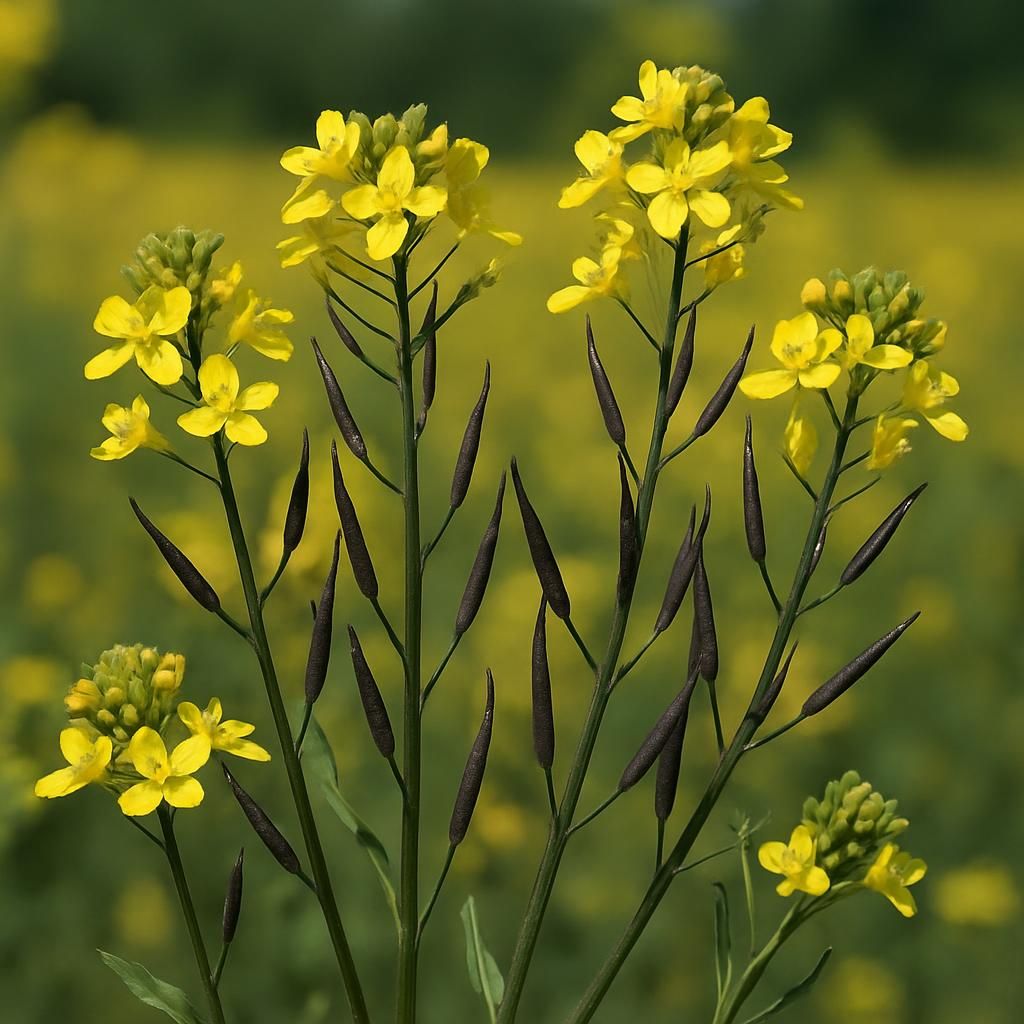
Black mustard (Brassica nigra) is an ancient annual oilseed crop grown for its sharply pungent seeds used in condiments, oils, and pharmaceuticals. It matures quickly in cool seasons and tolerates marginal soils, making it valuable for both small farms and large-scale production. The plant produces bright yellow flowers and pods containing tiny dark seeds rich in sinigrin, the compound responsible for its characteristic heat.
Farmers value black mustard for its dual role as a cash crop and a biofumigant cover crop that suppresses soil-borne pathogens. Its fast growth cycle of 90–110 days from sowing to harvest allows multiple plantings in temperate regions. Seed oil content typically ranges from 30–38 percent, with high erucic acid levels suited for industrial uses.
Global demand for specialty mustards and natural pesticides continues to rise, positioning black mustard as a resilient choice for diversified rotations. This guide delivers professional-grade agronomic advice for successful cultivation from seedbed preparation through storage.
Botanical Profile of Mustard Seed (Black - Brassica nigra)
Brassica nigra belongs to the Brassicaceae family and grows as an erect, branched annual reaching 1–2 meters in height. Leaves are alternate, deeply lobed, and covered with sparse hairs; lower leaves are larger and more petiolate than upper ones. Bright yellow, four-petaled flowers form in terminal racemes and attract numerous pollinators.
Siliques (seed pods) are slender, 2–5 cm long, and contain 10–20 small, round, dark-brown to black seeds. Each seed measures 1–1.5 mm in diameter and contains high concentrations of glucosinolates. The root system is shallow and fibrous, making the crop sensitive to waterlogging yet efficient at nutrient uptake in well-drained profiles.
Black mustard is predominantly self-pollinated but benefits from insect visitation. Genetic diversity exists in seed size, oil content, and glucosinolate profiles, offering breeders material for improved cultivars.
Soil, pH, and Climate Requirements for Mustard Seed (Black - Brassica nigra)
Black mustard performs best on fertile, well-drained loams but adapts to sandy or clay loams with proper management. It tolerates moderate salinity yet suffers under prolonged waterlogging. Soil organic matter should exceed 2 percent to support rapid vegetative growth.
The crop prefers cool temperatures during establishment and flowering. Daytime temperatures of 15–24 °C promote vegetative growth, while 18–22 °C during flowering optimizes seed set. Frost tolerance extends to –4 °C at the rosette stage but declines after stem elongation.
| Parameter | Ideal Range | Notes |
|---|---|---|
| Soil Type | Loam to sandy loam | Avoid heavy clays without drainage |
| Soil pH | 6.0–7.5 | Lime if below 5.8 |
| Organic Matter | >2% | Improves water retention and fertility |
| Temperature (Day) | 15–24 °C | Optimal vegetative growth |
| Temperature (Night) | 5–12 °C | Prevents bolting stress |
| Annual Rainfall | 400–800 mm | Supplemental irrigation in dry spells |
| Frost Tolerance | –4 °C (rosette) | Protect seedlings from hard freezes |
Step-by-Step Planting & Propagation
Select certified seed free of weed contaminants and test germination above 85 percent. Prepare a firm, fine seedbed by disking or rototilling to 10–15 cm depth, followed by rolling to ensure seed-to-soil contact.
Sow in early spring or late summer in temperate climates when soil temperature reaches 7–10 °C. Use a grain drill or broadcast seeder at 4–6 kg/ha for row plantings or 8–10 kg/ha for broadcast stands. Row spacing of 30–45 cm allows mechanical cultivation; drill depth should not exceed 1.5 cm.
After emergence (5–10 days), thin to 15–20 plants per linear meter in rows. For cover-crop use, increase seeding rates to 12–15 kg/ha. Maintain weed-free conditions during the first 30 days to prevent competition.
Care & Maintenance regimes for Mustard Seed (Black - Brassica nigra)
Black mustard requires moderate fertility focused on nitrogen and sulfur. Apply 40–60 kg N/ha at planting and a second sidedress of 20–30 kg N/ha at the 4–6 leaf stage. Sulfur at 15–25 kg/ha enhances glucosinolate production and seed quality.
Irrigation should maintain soil moisture at 50–60 percent field capacity during flowering and pod fill. Overhead systems risk disease; drip or furrow methods are preferred. Cease irrigation two weeks before harvest to encourage uniform drying.
| Growth Stage | Water (mm/week) | Fertilizer (N-P-K) | Pruning/Other Actions |
|---|---|---|---|
| Pre-plant / Sowing | 0 | 40-20-20 + 20 kg S | Incorporate lime if pH <5.8 |
| Seedling (0–3 weeks) | 15–20 | None | Scout for weeds; cultivate if needed |
| Vegetative (3–6 weeks) | 20–25 | 20-0-0 sidedress | Monitor aphids; maintain row middles |
| Flowering / Pod Fill | 25–30 | None | Avoid nitrogen excess to limit lodging |
| Pre-harvest (last 2 wk) | 0 | None | Stop irrigation; desiccate if required |
Pests, Diseases & Organic Management
Common insect pests include aphids, flea beetles, and cutworms. Early-season flea beetle damage is managed with floating row covers or spinosad sprays. Aphid colonies on flowering racemes are suppressed by releasing lady beetles or applying insecticidal soaps.
Diseases such as Alternaria leaf spot, downy mildew, and white mold can reduce yields. Cultural controls include 3–4 year rotations away from other brassicas, destruction of crop residues, and selection of resistant cultivars. Copper-based fungicides provide limited organic suppression when applied at first symptom appearance.
Nematode pressure is generally low, yet root-knot nematodes may increase in sandy soils. Biofumigation with mustard residues after incorporation helps suppress nematode populations.
Harvesting, Curing & Optimal Storage
Harvest when 60–70 percent of pods turn from green to brown and seeds rattle inside. Swathing or direct combining with a low drum speed prevents shattering losses. Target seed moisture of 8–10 percent at combining.
Air-dry seeds to 6–8 percent moisture using forced ambient or 35 °C air. Clean with screens and gravity tables to remove chaff and light seeds. Store in sealed bins or bags at 10–15 °C and <65 percent relative humidity to maintain viability and pungency for 12–24 months.
Companion Planting for Mustard Seed (Black - Brassica nigra)
Black mustard pairs well with onion, garlic, and aromatic herbs such as thyme that deter flea beetles. Avoid planting near other brassicas to reduce shared pest and disease pressure.
Its rapid canopy can serve as a living mulch between slower crops like tomato or pepper. After harvest, mustard residues provide biofumigation benefits when incorporated before establishing lettuce or carrot plantings.
Rapeseed offers a similar oilseed rotation partner, while clover undersown after mustard harvest improves soil nitrogen for subsequent crops.