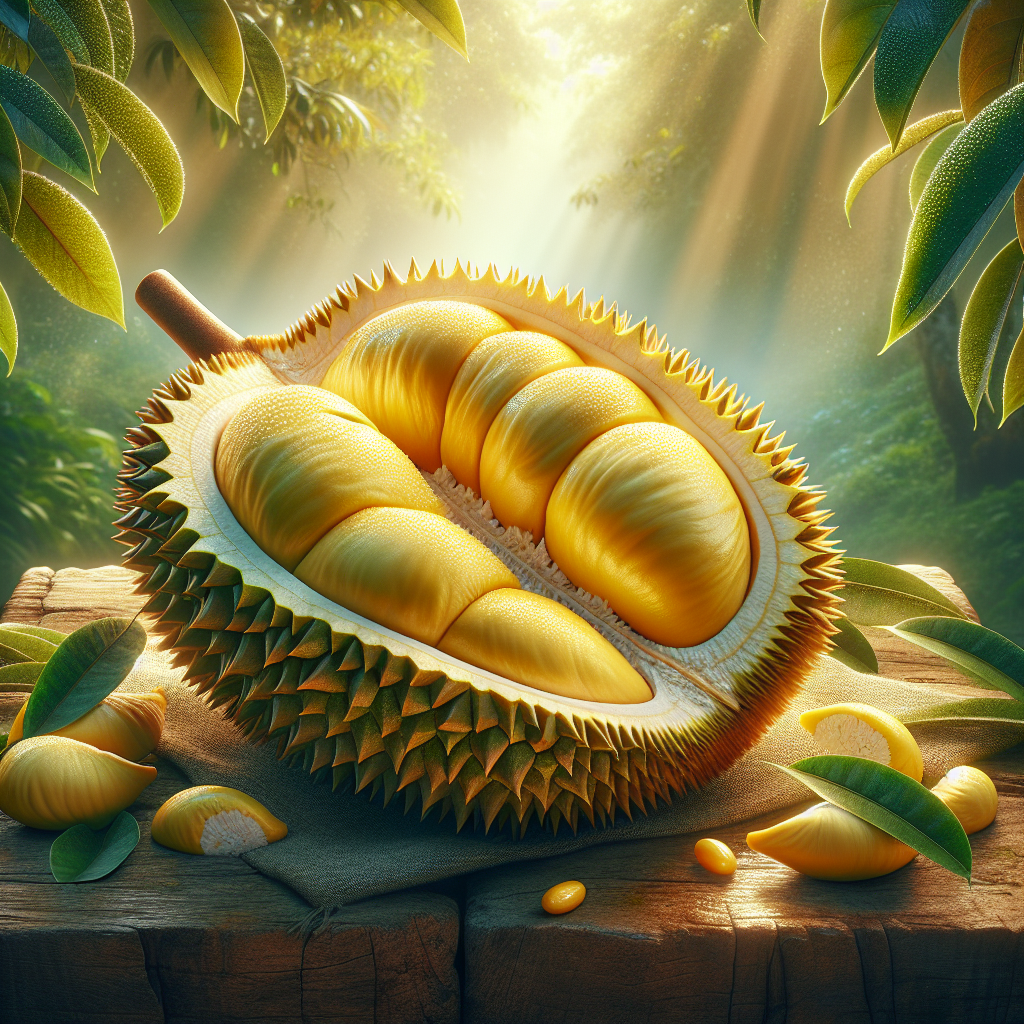
Introduction to Golden Phoenix Durian
The Golden Phoenix Durian (Durio zibethinus 'Golden Phoenix') stands as a pinnacle achievement in durian breeding, blending the legendary aroma and flavor of traditional durians with enhanced visual appeal and market desirability. Originating from selective hybridization in Southeast Asia, this cultivar produces fruits with a striking golden husk that splits cleanly to reveal large, golden-hued arils boasting 40-45% pulp content, Brix levels exceeding 50°, and a buttery texture laced with caramel, vanilla, and roasted nut undertones. Unlike wild durians, Golden Phoenix trees exhibit semi-dwarf stature (15-25 feet at maturity), earlier fruiting (3-4 years from graft), and superior resistance to common stressors, making it ideal for commercial orchards, high-density planting, and even advanced home gardens in suitable climates.
This deep-dive guide equips botanists, agronomists, and growers with evidence-based protocols for Durian (crop) cultivation, drawing from decades of tropical horticultural research. Expect yields of 100-200 fruits per tree annually under optimized conditions, with individual fruits weighing 3-6 kg. For small farms combating pest pressures, explore Why 90% of Small Farms Fail at Pest Management - And 8 Organic Fixes That Actually Work. Mastering Golden Phoenix Durian not only promises premium pricing (often $20-50/kg retail) but also diversifies tropical farm portfolios alongside crops like Mango (crop) or Papaya (crop).
Botanical Profile of Golden Phoenix Durian
Golden Phoenix Durian belongs to the Malvaceae family, genus Durio, and is a grafted selection from elite parentage combining D24 and Chanee varieties for hybrid vigor. Trees develop a sturdy central trunk with dense, lanceolate leaves (8-12 inches long, dark green above, silvery-tomentose below) that persist year-round in equatorial zones. Dioecious by nature, commercial propagation favors monoecious or hermaphroditic grafts to ensure pollination reliability.
Flowers emerge in dense panicles from branch axils during seasonal flushes, featuring creamy-white petals that unfurl nocturnally, exuding a potent sweet fragrance to attract bats and moths—primary pollinators. Fruits mature in 90-120 days post-anthesis, encased in a thick, pyramid-spined rind that transitions from green to brilliant gold at peak ripeness. Internally, 4-6 large locules house kidney-shaped seeds enveloped in thick, golden arils prized for their custardy mouthfeel and minimal bitterness.
Root systems are extensive, with a deep taproot and aggressive lateral spread up to 20 feet, demanding ample space (15-20 ft spacing). Nutrient demands peak during flowering (high K, B) and fruit fill (high N, P, Ca), with micronutrients like Zn and Mn critical for aril quality. Phenological stages align with wet seasons: vegetative flush (Feb-Mar), flowering (Apr-May), fruit set (Jun), and harvest (Sep-Oct) in northern hemisphere tropics.
Soil, pH, and Climate Requirements for Golden Phoenix Durian
Golden Phoenix thrives in deep, well-drained loamy soils rich in organic matter (5-8% OM), with sandy clay loam ideal for root aeration and moisture retention. Avoid heavy clays prone to waterlogging, which invite Phytophthora (disease) and root rot (disease). Optimal pH ranges 5.5-6.8; amend acidic soils (<5.5) with dolomitic lime (2-4 tons/ha) and alkaline (>7.0) with sulfur or peat moss. Conduct soil tests annually, targeting CEC >15 meq/100g, base saturation (Ca 65%, Mg 15%, K 5%), and micronutrients (Zn >1 ppm, B 0.5-1 ppm).
Climatically, this cultivar demands USDA zones 10b-12, with temperatures 75-95°F (24-35°C) daytime and >65°F (18°C) nights. High humidity (70-90%) and rainfall (80-120 inches/year, well-distributed) are non-negotiable; supplement with drip irrigation (20-40 L/tree/day) during dry spells <2 weeks. Wind protection via shelterbelts is essential, as gusts >20 mph scar fruits and dislodge flowers. Elevations <2000 ft minimize chilling risks, though brief dips to 50°F trigger leaf drop. For heatwave resilience, reference Why Summer Heatwaves Are Silently Killing Small Farm Yields - And 7 Organic Strategies to Fight Back—adapt mulching and shade cloth tactics here.
Step-by-Step Planting & Propagation
Propagation: Seedlings are viable but genetically variable; prioritize cleft-grafting scions (4-6 inches, pencil-thick) onto 1-2 year rootstocks (D101 or local robust clones) in the rainy season. Success rates hit 85-95% with 1:1 scion-rootstock cambium alignment, sealed with grafting tape and bagged for 4-6 weeks. Air-layering branches (12-18 inches) yields 90% rooted plants in 8-10 weeks using IBA (2000 ppm). Tissue culture micro-grafts ensure virus-free stock.
Site Prep: Clear land, plow to 2 ft depth, incorporate 20-30 tons/ha FYM + 1 ton/ha rock phosphate. Dig pits 2x2x2 ft, spaced 16x20 ft (150-200 trees/ha), backfill with topsoil + 10 kg compost + 500g TSP + 200g MOP.
Planting: Plant grafts at 6-12 months (3-4 ft tall) during onset of rains. Position graft union 6 inches above soil, stake firmly, mulch 4-6 inches thick (cacao husks or paddy straw). Initial irrigation: 50 L/tree/week, shading 50% for 2-3 months. Prune to single leader, removing basal suckers.
Establishment Year: Fertilize monthly: 100g NPK 15-15-15 + 50g urea/tree, escalating to 2 kg/tree by year-end. Monitor for ants (pest) and mealybugs (pest).
Care & Maintenance regimes for Golden Phoenix Durian
Irrigation: Drip systems deliver 600-1000 mm/year equivalent, with ETc-based scheduling (tensiometers at 30-60 cm depth, maintain 40-60 kPa). Deficit irrigate pre-flowering to synchronize flushes.
Fertilization: Annual program: Year 1-2: 1-3 kg NPK 12-12-17/tree split 6x; Mature: 5-10 kg/tree (40% N, 30% P, 30% K) + 2 kg MgSO4 + foliairs (2% urea + 1% KNO3 biweekly flowering-fruiting). Soil drench ZnSO4 (0.5%) yearly.
Pruning: Annual post-harvest: Remove deadwood, watersprouts, maintain 5-7 main scaffolds at 45° angles. Tip prune terminals to promote bushiness. Desuckering every 2 months.
Weed Control: Mulch perpetually; slash mow interrows, apply glyphosate spot-treat (1-2% basal). Cover crops like Clover (crop) or Pigeon pea (crop) suppress weeds organically.
Pollination Boost: Hand-pollinate 10-20% flowers at dusk using pollen brushes if bat activity wanes; plant attractants like bananas nearby.
Pests, Diseases & Organic Management
Key Pests: Fruit borers (pest), mealybugs (pest), aphids (pest), borers, and squirrels target fruits. Deploy neem oil (2-3%) weekly, Pherotraps for moths, yellow sticky traps (20/ha), and trunk bands. Introduce Trichogramma wasps for eggs.
Diseases: Phytophthora root rot (disease), anthracnose (disease), powdery mildew (disease), and stem cankers. Prevent via drainage, copper oxychloride (0.2%) post-rains, biofungicides (Trichoderma 10g/kg FYM). Remove infected parts, burn.
IPM Protocol: Scout weekly, threshold-based sprays (e.g., 5% leaf infestation triggers). Organic regime: Bt for caterpillars, kaolin clay fruit barriers, beneficials (ladybugs, predatory mites). Rotate modes of action; soil solarization pre-plant.
Harvesting, Curing & Optimal Storage
Harvest at 90-120 DAF when rind yellows, spines soften, and 3-4 segments split (85-90% maturity). Twist or machete-cut clusters, handling 2-3 fruits/operator to avoid bruising. Yield peaks years 7-15.
Curing: Shade-ripen 3-7 days at 77-86°F, 85-90% RH; enhances sweetness 10-15%. Avoid stacking >2 high.
Storage: Fresh: 46-50°F, 85-90% RH (2-4 weeks shelf life). Controlled atmosphere (3% O2, 5-8% CO2) extends to 6 weeks. Pulp freeze at -20°C (12 months). Market as whole or processed (puree, ice cream).
Companion Planting for Golden Phoenix Durian
Leverage polycultures for pest deterrence, nutrient cycling, and microclimate moderation. Understory: Ginger (crop), Turmeric (crop), legumes (Pigeon pea (crop)) fix N, suppress weeds. Repellents: Marigold (crop), Thyme (crop), Nasturtium (crop) deter nematodes (pest) and borers. Shade-tolerants: Thai Basil (crop), pineapples. Intercrop alleys with short-cycle Banana (crop) for windbreaks and income. Avoid legumes near trunks to prevent humidity buildup. For mastery, see Why Companion Planting Feels Like Guesswork for Small Farms - And How AI Makes It Foolproof—principles apply directly.