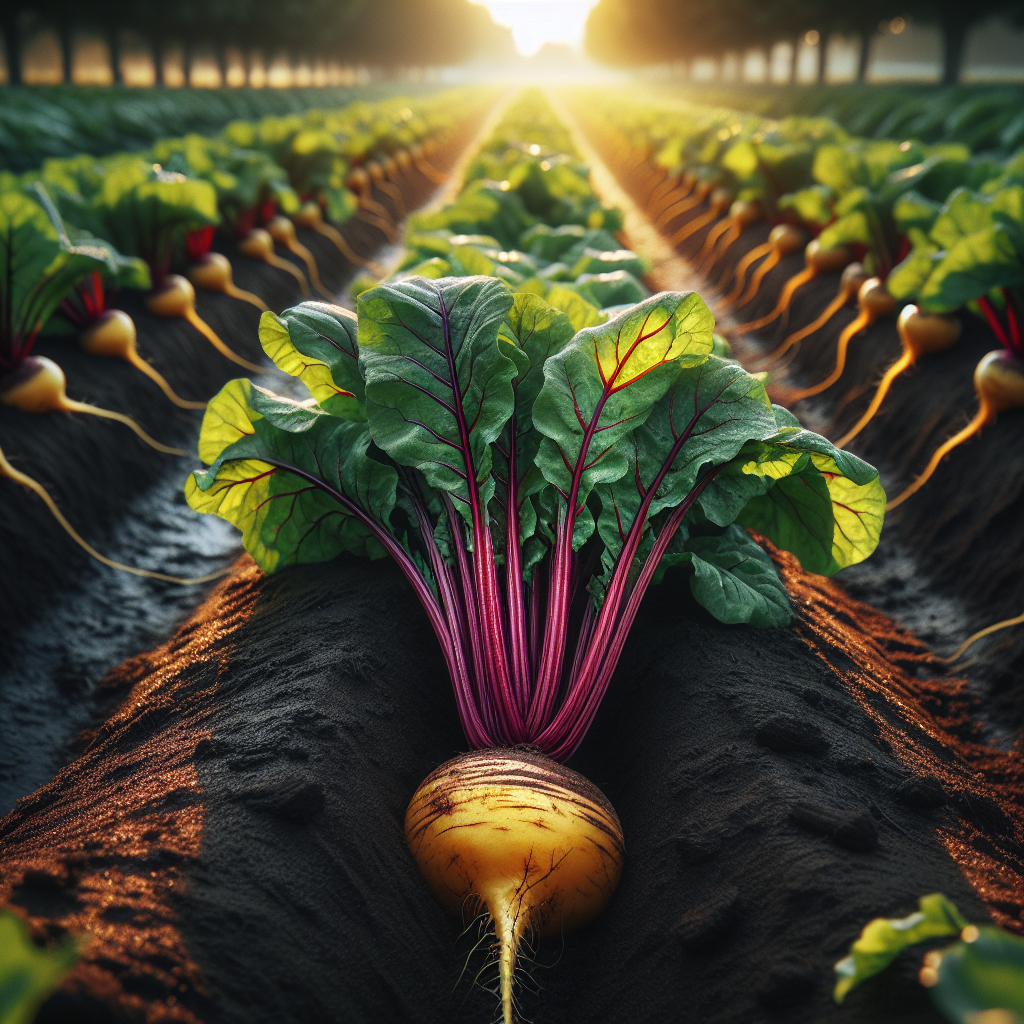
Introduction to Golden Beet
Golden beet is a selection within the beet group grown for its edible swollen root and nutritious tops. Unlike classic red beet types, golden cultivars develop warm yellow, amber, or orange flesh with a sweeter, less geosmin-heavy flavor profile, so many growers and cooks find them milder and more approachable. They also bleed less pigment during harvest and processing, which makes them especially attractive for fresh market bunching, roasting mixes, and storage-root production.
Historically, table beets descend from forms of sea beet domesticated around the Mediterranean and later improved across Europe. Golden forms are more modern in popularity than red beets, but they share the same basic agronomy. Their value is not just culinary: they offer strong market differentiation, attractive bunches with bright green leaves and golden shoulders, and good performance in spring and fall cool-weather windows. For general beet background, see our Beet guide.
Growers should understand one defining fact about this crop: root quality is determined early. Any interruption from crusted soil, drought, crowding, fresh manure, compaction, or erratic fertility can produce misshapen, zoned, woody, or hairy roots. When managed correctly, golden beet is one of the most reliable root crops for home gardens, market gardens, and diversified farms.
Botanical Profile of Golden Beet
Golden beet belongs to the Amaranthaceae family and the species Beta vulgaris, the same species that includes chard, fodder beet, and Sugar Beet. The edible “root” is technically a swollen hypocotyl-root complex rather than a true root alone, which helps explain why uniform soil conditions are so important for round, smooth enlargement.
Key botanical and production traits include:
- Growth habit: biennial by life cycle, usually grown as an annual for its root and leaves.
- Pollination biology: in its second year, if vernalized and allowed to overwinter, it sends up a flowering stalk and produces wind-pollinated seed.
- Seed structure: what growers call a beet seed is commonly a dried fruit cluster containing multiple embryos in many traditional varieties, which is why multiple seedlings can emerge from one “seed.” Some modern strains are monogerm, but multigerm types remain common.
- Leaves: broad, smooth to lightly crinkled, medium to dark green, often with yellow to light orange petioles in golden strains.
- Root form: typically globe to slightly flattened globe, though shape varies by cultivar and spacing.
- Root color: skin usually coppery-gold to orange-tan; flesh bright yellow to deep golden with faint zoning in some lines.
Golden beets generally have lower betalain red pigment expression than red beets, but they still contain yellow-orange betalains and antioxidants. Their reduced staining is a practical postharvest advantage. Popular golden strains often mature in about 50 to 60 days for baby roots and 55 to 70 days for full-size roots, depending on temperature and spacing.
Bolting sensitivity matters. Beet seedlings exposed to prolonged cold after emergence can interpret that stress as a winter period, especially if followed by warming weather. This can trigger premature flowering. Golden beet is therefore best direct-sown once soil is workable and severe cold swings are less likely, or grown for fall harvest where bolting pressure is much lower.
Soil, pH, and Climate Requirements for Golden Beet
Golden beet performs best in deep, loose, stone-free soil with good tilth and moderate but steady fertility. The ideal texture is sandy loam to loam, though clay loam can work if it is well structured and not compacted. Heavy, poorly drained soils increase the risk of forked roots, Scab, slow emergence, and foliar disease.
Target these parameters:
- Soil pH: 6.2 to 7.2 is ideal; acceptable range is roughly 6.0 to 7.5.
- Organic matter: about 3% to 5% is excellent for field production, provided it is fully decomposed.
- Drainage: free-draining but moisture retentive.
- Soil depth: at least 20 to 25 cm of friable soil for uniform root expansion.
Avoid fresh manure before planting. Fresh or incompletely composted manure releases uneven nitrogen, salts, and undecomposed fibers that encourage excessive top growth, root branching, and rough skins. If manure is part of the system, apply it to the preceding crop or several months in advance. Finished compost at moderate rates is safer.
Nutrient management should emphasize balance. Excess nitrogen creates lush foliage at the expense of root quality and can delay bulking. Too little potassium or boron can reduce vigor and internal quality. Beet is moderately sensitive to boron deficiency, which may show up as blackened internal spots, corky tissue, cracked roots, or heart rot-like symptoms in the root center. On known low-boron soils, a carefully calibrated micronutrient program based on soil testing is advisable; overapplication can be toxic, so do not guess.
Golden beet is a classic cool-season crop. Best temperature ranges are:
- Germination: 10 to 29°C, with most even emergence around 15 to 24°C.
- Vegetative growth: 15 to 22°C.
- Root bulking and sugar accumulation: cool days and especially cool nights improve flavor and color.
Seeds can germinate in colder soils, but emergence slows dramatically below about 10°C and seedlings sit vulnerable to crusting and damping issues. Mature plants tolerate light frost, and roots often become sweeter after cool weather. In hot conditions above 27 to 30°C, roots can become more fibrous, growth may stall, and flavor can flatten, especially if water is inconsistent.
Soil moisture should remain consistently in the moderate zone rather than cycling between saturation and drought. As a practical benchmark, the top 5 to 8 cm of soil should feel slightly moist, not dusty and not sticky. If you squeeze a handful from root depth, it should hold together lightly but break apart with a tap. Overwatered beds feel greasy or smear when pressed, and seedlings may yellow, stall, or collapse from oxygen-starved roots. Underwatered beds produce slow growth, strong earthy flavor, tough greens, and roots with concentric stress rings or cracking after rewatering.
Raised beds are especially effective for golden beet where native soil is shallow, compacted, or stony. Fine seedbed preparation is not optional: clods and crusting directly reduce stand quality.
Step-by-Step Planting & Propagation
Golden beet is almost always direct-seeded. Transplanting is possible in cell trays but is generally inferior for root symmetry because any disturbance to the seedling axis can lead to malformed roots.
Prepare the bed thoroughly. Remove stones, break clods, and rake to a fine, level surface. Incorporate finished compost and any preplant amendments based on soil testing. Do not over-fertilize with nitrogen.
Time sowing for cool conditions. In spring, sow 2 to 4 weeks before the last expected frost once soil is workable and not waterlogged. In mild climates, make repeated sowings every 10 to 14 days for a continuous harvest. For the best root quality in many regions, late-summer sowings for fall harvest are superior because temperatures moderate during bulking.
Sow at the proper depth. Place seed clusters 1.25 to 2 cm deep in heavier soils and up to 2.5 cm in lighter soils if the surface dries quickly. Shallower sowing speeds emergence, but seeds must remain in consistent moisture.
Space for intended market size.
- Baby beets: sow densely and thin to 5 to 7.5 cm apart.
- Bunched medium roots: thin to 7.5 to 10 cm apart.
- Large storage roots: thin to 10 to 12 cm apart. Rows are commonly spaced 30 to 45 cm apart in garden and market systems, though bed systems with multiple rows 15 to 20 cm apart are also effective.
Manage emergence carefully. Depending on temperature, seedlings emerge in 5 to 14 days. Surface crusting is a major cause of poor stands. If heavy rain creates a crust, gently break it with a rake or irrigate lightly to soften the surface. Floating row cover can help conserve moisture and protect young plants from Flea beetles and Leafminers.
Thin early and decisively. Because a seed cluster may produce multiple seedlings, thinning is essential. Thin when seedlings are 2.5 to 5 cm tall. Delayed thinning causes prolonged competition and results in elongated tops, undersized roots, and uneven maturity. Thinnings are edible and marketable as baby greens.
Succession sow strategically. For steady harvests, make 3 to 6 sowings over the cool season rather than one oversized planting. In regions with hot summers, pause sowing during peak heat and resume 8 to 10 weeks before first fall frost.
Propagation from saved seed is possible only if roots are carried through winter and replanted for second-year flowering, but this is uncommon in standard production. Because beets cross readily with related beet forms, seed purity requires isolation.
If you want broader crop-rotation context and soil-building ideas around cool-season beds, see soil health strategies.
Care & Maintenance regimes for Golden Beet
Golden beet needs disciplined but not excessive maintenance. The goal is uninterrupted growth from emergence through bulking.
Irrigation is the most important management task after stand establishment. Aim for roughly 2.5 cm of water per week from rain plus irrigation in cool conditions, increasing toward 3.5 cm in sandy soils, raised beds, or windy periods. Rather than shallow daily watering, irrigate deeply enough to moisten the main root zone, then allow only slight drying near the surface before rewatering.
Practical moisture indicators:
- Ideal: leaves remain upright in the morning and afternoon, soil at 7 to 10 cm depth is cool and slightly moist, roots enlarge steadily without cracking.
- Too dry: foliage loses sheen, outer leaves droop in afternoon heat and recover slowly, root shoulders become rough, and growth stalls.
- Too wet: leaves may yellow from the base, plants look stunted despite wet soil, algae or fungus gnats appear on bed surfaces, and roots may develop dull skins or rot-prone crowns.
Mulching with a thin layer of clean straw or shredded leaf mold after seedlings are established helps moderate temperature and reduce surface evaporation, but keep mulch loose and light so it does not smother tiny plants.
Weed control must be early and shallow. Beet seedlings are not highly competitive in their first weeks. Hand hoe or scuffle hoe when weeds are at the thread stage. Cultivate lightly to avoid disturbing enlarging roots. A stale seedbed technique works well in professional systems: prepare the bed, irrigate to germinate weeds, then flame or shallowly disturb just before sowing.
Fertility during growth should be conservative. If plants are pale and growth is slow despite proper thinning and moisture, a modest side-dress of balanced organic fertilizer or nitrate-available nitrogen may help. Apply sparingly at 3 to 4 weeks after emergence. Excess late nitrogen encourages leafy canopies and suppresses storage quality.
Leaf harvest can be combined with root production, but moderation matters. Removing one or two outer leaves occasionally is acceptable; repeated heavy stripping reduces photosynthesis and root size. If growing for premium roots, leave the canopy mostly intact.
Common quality disorders and their causes:
- Woody texture: delayed harvest, heat stress, or irregular water.
- Zoning or visible rings: varietal tendency, fluctuating growth rate, and temperature swings.
- Hairy roots: fresh manure, excess nitrogen, or compacted soil.
- Cracking: rapid uptake of water after drought, or overmaturity.
- Poor color development: excessive heat or cultivar limitations.
For season extension, row cover can accelerate spring growth by a few days and protect from insect pressure. In fall, low tunnels help maintain top growth while roots continue bulking in cool weather.
Pests, Diseases & Organic Management
Golden beet shares the pest and disease profile of other table beet types. Integrated organic management depends on prevention first: crop rotation, even moisture, sanitation, airflow, and healthy soil biology.
Major insect pests include:
- Leafminers: serpentine tunnels appear between leaf surfaces, reducing photosynthetic area and marketability of tops. Remove heavily infested leaves early. Use row cover immediately after sowing where pressure is predictable.
- Flea beetles: tiny shot holes in cotyledons and young leaves can weaken seedlings. Fast growth and row cover are the best organic defenses.
- Aphids: cluster on undersides of leaves and can distort growth. Control with strong water sprays, insecticidal soap, and by supporting beneficial insects.
- Beet webworm or Caterpillars: chew foliage and web leaves together in some regions. Handpick or use Bacillus thuringiensis on young larvae.
- Root maggots: less common in some systems but damaging where present; rotate crops and use exclusion covers.
Important diseases include:
- Cercospora leaf spot: small circular gray-tan lesions with reddish-purple borders that expand in warm, humid weather. Severe infection weakens tops and reduces root sizing. Prevent with wide enough spacing, drip irrigation instead of overhead watering, removal of crop debris, and 2- to 3-year rotation out of beet/chard/spinach relatives.
- Downy mildew: more likely in cool, humid conditions; causes distorted, thickened leaves and grayish growth on undersides. Improve airflow and avoid overhead irrigation late in the day.
- Damping-off: affects seedlings in cold, wet, poorly aerated soils. Use a clean seedbed, avoid oversaturation, and sow into appropriate temperatures.
- Root rots: favored by waterlogging and compacted soils. Prevention is far more effective than cure.
- Scab: rough corky lesions on roots, often worse in high pH dry soils with uneven moisture.
Organic management principles:
- Rotate away from beets, chard, and spinach for at least 2 years, ideally 3 where disease pressure is high.
- Keep foliage dry when possible. Morning irrigation is preferable to evening overhead watering.
- Remove and destroy heavily diseased leaves rather than composting them in cool piles.
- Maintain moderate fertility. Overfed, lush canopies are often more disease-prone.
- Encourage natural enemies with flowering borders and non-disruptive spray programs.
When diagnosing foliar symptoms, distinguish nutrient issues from disease. Uniform paling across older leaves often suggests nitrogen limitation, while discrete lesions with halos or concentric margins suggest pathogen activity. Interveinal chlorosis on younger tissue may indicate micronutrient imbalance.
Harvesting, Curing & Optimal Storage
Golden beet can be harvested at multiple stages. Baby roots are often pulled at 3 to 5 cm diameter for bunching. Full-size roots for storage are usually harvested at 5 to 8 cm diameter, depending on cultivar and market preference. Larger roots are possible, but quality gradually declines as fibers increase.
Signs of readiness include:
- Shoulders visibly pushing above the soil surface.
- Smooth skin with good golden coloration.
- Leaves of market size without significant disease.
- Root diameter matching intended use.
Harvest in cool conditions if possible. Loosen soil with a fork or undercutter rather than yanking from hard ground, which can snap tops and bruise crowns. Handle gently; abrasions shorten storage life.
For bunched market beets, wash lightly, trim damaged leaves, and cool immediately. For storage roots, do not wash unless necessary. Instead, brush off loose soil once roots are dry to the touch. Cut tops to about 2.5 cm above the crown; do not cut into the crown tissue, as this increases dehydration and decay. Remove long root tails only if required for packing.
Unlike onions or garlic, golden beet is not truly “cured” in the dry-neck sense. What it benefits from is rapid field heat removal and storage under high humidity. Ideal storage conditions are:
- Temperature: 0 to 2°C.
- Relative humidity: 95% to 98%.
- Ventilation: gentle airflow, not desiccating.
Under these conditions, sound roots can store for 3 to 5 months, sometimes longer. In home storage, perforated bags or bins of damp sand in a root cellar work well. If humidity is too low, roots wrinkle and lose weight rapidly. If temperatures rise above about 4 to 5°C for long periods, respiration and sprouting increase.
Do not store damaged, cracked, insect-bitten, or diseased roots with sound ones. Cull aggressively. Storage losses often begin from one wounded beet that spreads soft rot to surrounding roots.
Golden roots may appear less visually dramatic than red roots after cooking, so freshness and sweetness become the premium traits. For highest eating quality, harvest before severe oversizing, especially in spring plantings exposed to warming weather.
Companion Planting for Golden Beet
Golden beet fits well into mixed beds because it occupies the root zone efficiently and tolerates moderate crowding from shallow or upright companions. The best companions either improve space use, reduce pest pressure indirectly, or avoid strong nutrient competition.
Excellent companions include Onion, Lettuce, Cabbage, and Garlic. Onions and garlic stay relatively upright and may help confuse some pests with their pungent foliage, while lettuce makes efficient use of the upper soil layer and can be harvested before beet roots fully size. Cabbage-family crops can share cool-season timing, provided spacing and fertility are managed to prevent excessive competition.
Good design patterns include:
- Two rows of beets flanking a center row of lettuce in a 75 to 90 cm bed.
- Alternating short blocks of beets and onions for easy weeding and harvest.
- Beets planted ahead of slower brassicas, then harvested before the brassicas reach full spread.
Avoid pairing golden beet too closely with very tall, aggressively shading crops or heavy feeders that demand constant nitrogen surpluses. Deep cultivation around neighboring root crops can also damage beet shoulders.
Companion planting should complement, not replace, core agronomy. Even the best companion arrangement cannot overcome poor thinning, compacted soil, or moisture swings. In practice, golden beet performs best where companions are chosen for compatible growth rate, modest root disturbance, and shared cool-season management.