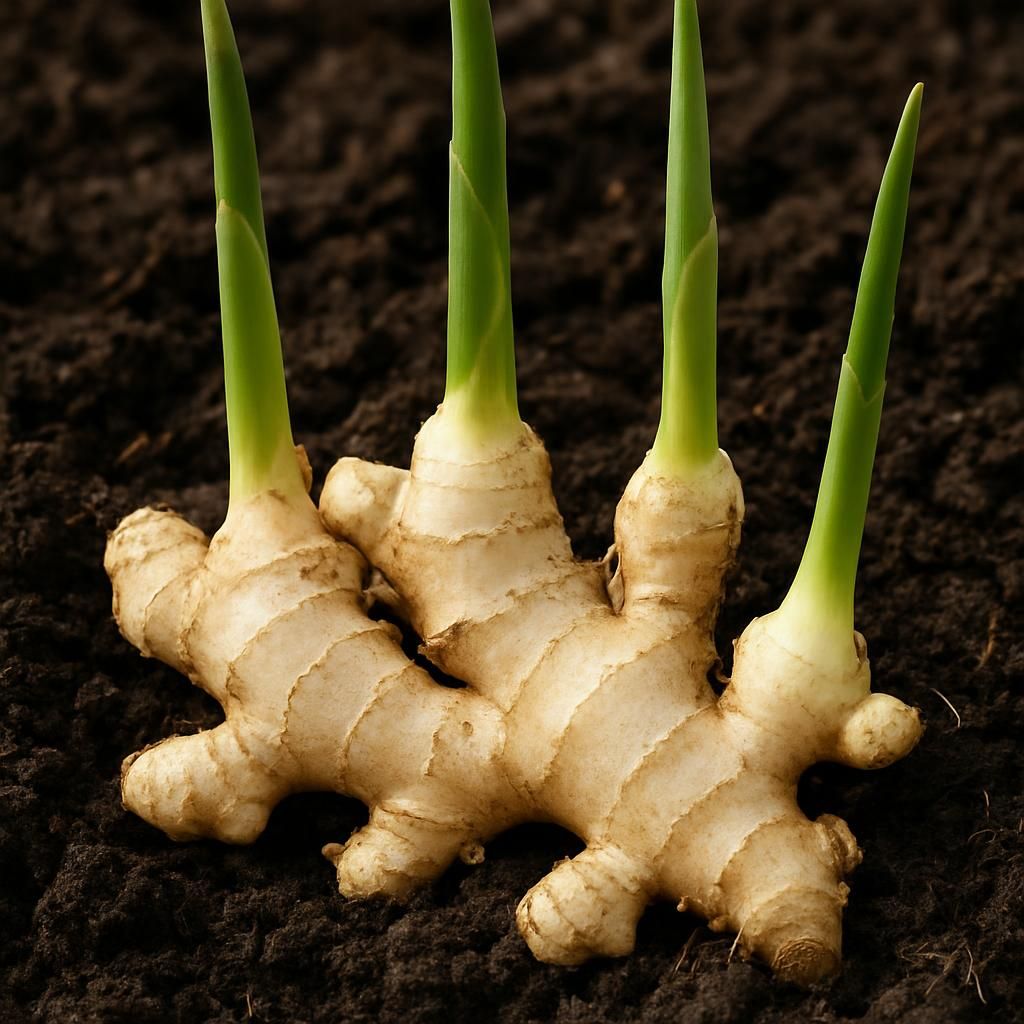
Introduction to Ginger (Zingiber officinale - Chinese)
Chinese ginger (Zingiber officinale) is one of the world's most important spice crops, valued for its aromatic rhizomes used in culinary, medicinal, and industrial applications. Grown extensively in subtropical and tropical regions, it offers farmers a high-value return when cultivated with precise agronomic practices. This definitive growing guide provides professional, field-tested recommendations tailored to commercial and serious home-scale production.
Botanical Profile of Ginger (Zingiber officinale - Chinese)
Ginger is a perennial herbaceous plant belonging to the Zingiberaceae family. It produces erect, reed-like pseudostems reaching 60–120 cm in height, with narrow, lanceolate leaves arranged alternately. The plant does not produce true seeds in cultivation; instead, it multiplies vegetatively through its underground rhizomes. The rhizomes are branched, fleshy, and aromatic, containing high levels of gingerol and shogaol compounds responsible for the characteristic pungency. Flowering occurs in specialized inflorescences but rarely sets viable seed under commercial conditions.
Soil, pH, and Climate Requirements for Ginger (Zingiber officinale - Chinese)
Ginger thrives in well-drained, fertile loamy soils rich in organic matter. It performs best in slightly acidic conditions and requires consistent warmth and humidity. Avoid heavy clay or waterlogged soils that promote root rot.
| Parameter | Ideal Range | Notes |
|---|---|---|
| Soil Type | Sandy loam to loam | High organic matter content essential |
| Soil pH | 5.5 – 6.5 | Slightly acidic; avoid alkaline soils |
| Temperature | 22–30 °C (day) | Minimum 15 °C; frost sensitive |
| Annual Rainfall | 1500–2500 mm | Even distribution preferred |
| Relative Humidity | 70–90 % | Critical during active growth |
| Altitude | 0–1500 m | Lower elevations often yield larger rhizomes |
Step-by-Step Planting & Propagation
- Select healthy, disease-free rhizome pieces (seed rhizomes) weighing 30–50 g with at least one active bud.
- Treat seed pieces with 0.2 % mancozeb or hot water (50 °C for 20 min) to reduce Pythium and bacterial contamination.
- Prepare raised beds 20–30 cm high and 1 m wide with 50 cm furrows; incorporate 20–30 t/ha well-rotted farmyard manure.
- Plant seed rhizomes 5–7 cm deep at 25 cm × 25 cm spacing in early spring when soil temperature exceeds 18 °C.
- Mulch immediately with 5–7 cm of straw or leaves to conserve moisture and suppress weeds.
Care & Maintenance regimes for Ginger (Zingiber officinale - Chinese)
Consistent moisture, balanced nutrition, and timely weeding are essential for high-quality rhizome development. Light earthing-up at 60 and 90 days after planting improves rhizome quality.
| Operation | Schedule | Details |
|---|---|---|
| Irrigation | Every 4–5 days (first 4 months) | Maintain 60–70 % field capacity; reduce after 5 months |
| Fertilizer | Basal: 20 t FYM + 60:40:40 NPK | Top-dress 40 kg N at 60 and 90 DAP; use organic sources where possible |
| Weeding | 3–4 times | First at 30–40 DAP; subsequent at 60 and 90 DAP |
| Mulching | Renew at 60 DAP | Maintain 5 cm layer to regulate temperature and moisture |
| Pruning | Remove yellow leaves only | Avoid cutting green foliage to maintain photosynthesis |
Pests, Diseases & Organic Management
Major pests include aphids, thrips, and root-knot nematodes. Key diseases are Pythium soft rot, bacterial wilt, and leaf spot diseases. Implement integrated management: use disease-free seed, crop rotation with rice or maize, neem-based sprays, and soil solarization. Encourage natural enemies such as lady beetles and predatory mites.
Harvesting, Curing & Optimal Storage
Harvest 8–10 months after planting when leaves begin to yellow and lodge. Lift rhizomes carefully to avoid bruising. Cure by washing, sun-drying for 3–5 days, then storing at 10–12 °C and 70–75 % RH. For seed purposes, store at 22–25 °C in well-ventilated conditions. Properly cured Chinese ginger maintains quality for 6–8 months.
Companion Planting for Ginger (Zingiber officinale - Chinese)
Ginger benefits from association with turmeric, garlic, and onion which deter soil-borne pathogens. Leguminous cover crops such as cowpea improve soil nitrogen. Avoid planting near potato due to shared nematode risks. Intercropping with banana provides shade in hotter climates while maximizing land-use efficiency.