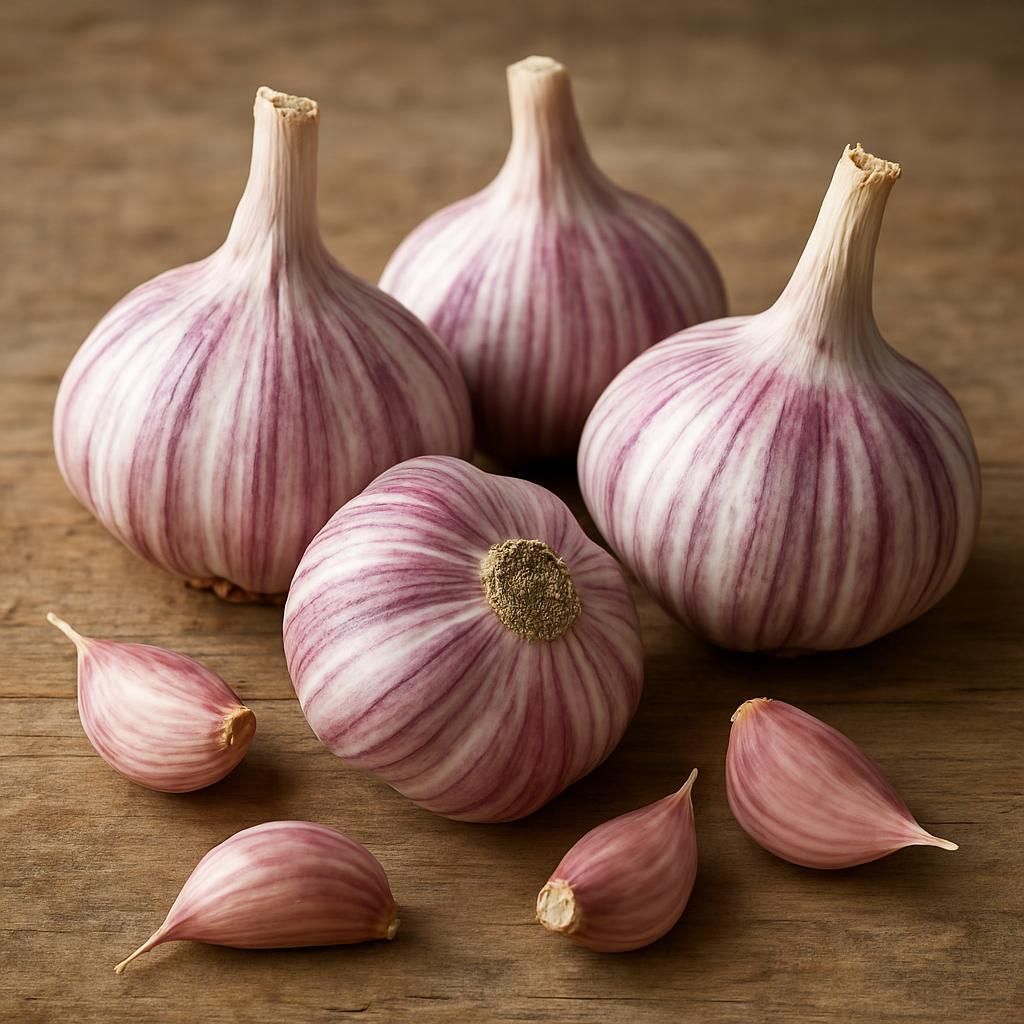
Introduction to Garlic (Inchelium Red)
Inchelium Red is a hardneck garlic cultivar originating from the Colville Indian Reservation in Washington state. It has earned a reputation among commercial and home growers for producing large, easy-to-peel cloves with a sweet, complex flavor that is milder than many other hardnecks. The variety stores exceptionally well, often remaining viable for 8–10 months under proper conditions. Because it performs reliably across a wide range of climates, Inchelium Red has become a staple for market gardeners seeking consistent quality and strong customer demand.
Botanical Profile of Garlic (Inchelium Red)
Inchelium Red belongs to the hardneck group of Garlic (Allium sativum). It produces a central scape that forms a single loop before straightening. The plant reaches 60–90 cm in height with flat, glaucous leaves. Each bulb typically contains 8–12 large cloves arranged in a single circle around the scape. The outer bulb wrappers are white with purple streaking, while individual clove skins show deeper purple-red hues. The variety is considered a Rocambole-type hardneck and is well adapted to cold winters.
Soil, pH, and Climate Requirements for Garlic (Inchelium Red) (MUST INCLUDE A MARKDOWN TABLE OF IDEAL CONDITIONS)
Garlic thrives in loose, fertile, well-drained soils. Heavy clay or waterlogged ground leads to bulb rot and poor development. Raised beds or well-tilled rows improve drainage in marginal soils. The crop prefers full sun and cool temperatures during early growth followed by warm, dry conditions for bulbing.
| Parameter | Ideal Range | Notes |
|---|---|---|
| Soil Type | Loamy sand to sandy loam | High organic matter; avoid compacted clay |
| Soil pH | 6.0 – 7.0 | Slightly acidic to neutral; lime if below 5.8 |
| Temperature (Day) | 15–24 °C (59–75 °F) | Optimal vegetative growth |
| Temperature (Night) | 5–10 °C (41–50 °F) | Promotes strong root development |
| USDA Hardiness Zones | 3–8 | Requires 6–8 weeks below 10 °C for vernalization |
| Annual Rainfall | 400–750 mm | Supplemental irrigation needed in dry periods |
| Sun Exposure | Full sun (minimum 6–8 hours) | Essential for large bulb formation |
Step-by-Step Planting & Propagation
- Select healthy, disease-free seed cloves from the previous season’s largest bulbs. Avoid supermarket garlic.
- Separate bulbs into individual cloves 24–48 hours before planting; keep the basal plate intact.
- Prepare beds by incorporating 5–7 cm of well-aged compost or aged manure. Conduct a soil test and amend with phosphorus and potassium according to results.
- Plant in fall 4–6 weeks before the ground freezes. In northern climates this is typically September–October; in milder zones, October–November.
- Place cloves pointed end up, 5–7 cm deep and 10–15 cm apart within rows spaced 30–45 cm apart.
- Mulch immediately with 10–15 cm of straw or shredded leaves to moderate soil temperature and suppress weeds.
- Water thoroughly after planting to settle soil around cloves.
Care & Maintenance regimes for Garlic (Inchelium Red) (MUST INCLUDE A MARKDOWN TABLE OF WATER, FERTILIZER, AND PRUNING SCHEDULES)
Consistent moisture and timely nutrient supply are critical during the rapid spring growth phase. Avoid high-nitrogen fertilizers after scape formation to prevent excessive foliage at the expense of bulb size. Remove scapes promptly when they form one complete loop to redirect energy into bulb development.
| Growth Stage | Watering Schedule | Fertilizer Application | Pruning / Scape Removal |
|---|---|---|---|
| Fall (Planting) | 25 mm/week until soil freezes | 5-10-10 or equivalent at 450 kg/ha | None |
| Early Spring | 25–40 mm/week; maintain even moisture | Side-dress 10-5-5 at 225 kg/ha when shoots reach 10 cm | None |
| Mid-Spring (Scape) | 25 mm/week; reduce if rainfall is adequate | Light compost tea or fish emulsion monthly | Remove scapes at first loop |
| Bulbing (Late Spring) | 15–20 mm/week; taper off 3 weeks before harvest | None after scape removal | Continue scape removal on any late plants |
| Pre-Harvest | Withhold water 10–14 days before digging | None | None |
Pests, Diseases & Organic Management
Inchelium Red is generally vigorous but can be affected by common allium pests and diseases. Monitor weekly from emergence through harvest. Onion thrips, aphids, and onion maggot are primary insect concerns. Fungal issues include white rot and botrytis. Practice strict crop rotation of at least four years away from alliums. Use floating row covers at planting to exclude onion maggot flies. Apply neem oil or insecticidal soap for thrips when populations exceed five per leaf. Maintain good airflow and avoid overhead irrigation to reduce botrytis risk. Remove and destroy infected plants immediately.
Harvesting, Curing & Optimal Storage
Harvest when 50–60 % of the leaves have turned brown and the remaining leaves are still green. Use a garden fork to gently lift bulbs, taking care not to bruise them. Shake off loose soil but do not wash. Tie plants in small bundles or lay on screens in a shaded, well-ventilated area with temperatures of 20–25 °C and 60–70 % humidity. Cure for 2–4 weeks until necks are dry and papery. Once cured, trim roots and tops, leaving 2–3 cm of neck. Store in mesh bags or open crates at 0–4 °C with 60–70 % relative humidity. Properly cured Inchelium Red maintains quality for 8–10 months.
Companion Planting for Garlic (Inchelium Red)
Garlic repels many common garden pests and improves the health of neighboring crops. Plant near tomato, carrot, beet, and lettuce to deter aphids, carrot fly, and slugs. Avoid planting near peas, beans, and asparagus because alliums can inhibit their growth. Interplant with strawberry to reduce spider mite pressure. Use marigold or nasturtium as trap crops around the garlic bed perimeter. Rotate garlic with brassicas or cover crops such as clover to build soil health between allium plantings.