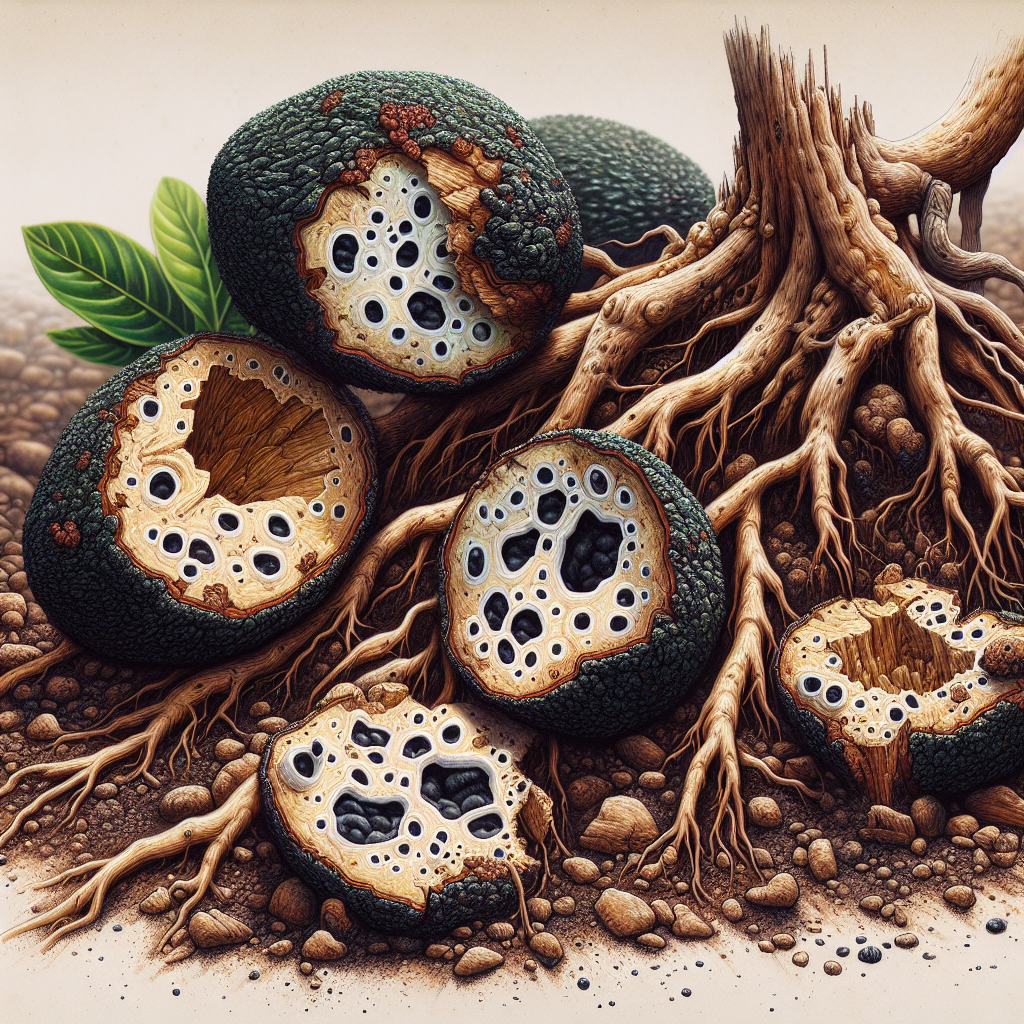
Introduction to Dry root rot
Dry root rot (DRR) is a severe fungal disease primarily caused by the basidiomycete fungus Phellinus noxius (formerly Rigidoporus noxius), which attacks the roots and lower trunk of trees and woody perennials. Unlike water-soaked root rot diseases caused by oomycetes like Phytophthora, DRR produces a dry, brittle decay with little moisture, hence its name. First identified in tropical and subtropical regions, it has spread globally, devastating orchards, plantations, and landscapes.
The pathogen forms extensive rhizomorphs—hard, cord-like structures—that enable soil penetration and root-to-root spread. Infected trees show gradual wilting, canopy thinning, and sudden collapse, often without external signs until advanced stages. Economic losses are staggering in high-value crops, with mortality rates exceeding 50% in unmanaged stands. This guide provides professional-grade diagnostics, lifecycle insights, and organic management strategies for farmers facing DRR outbreaks. Early intervention is critical, as the fungus persists in soil for decades via sclerotia and mycelial fragments.
Identifying Symptoms & Damage
Diagnosing dry root rot requires careful inspection, as symptoms mimic drought stress or Fusarium wilt. Above-ground signs include:
- Progressive yellowing and wilting of foliage, starting in the upper canopy.
- Sparse, off-color leaves with premature defoliation.
- Dieback of branches, often unevenly distributed.
- Sudden tree topple without wind, due to root failure.
Root and basal symptoms are diagnostic:
- Excavate around the base: roots appear dry, shrunken, and brittle, lacking the mushy texture of wet rots.
- Dark brown to black discoloration extends from feeder roots to taproots.
- White mycelial fans or plaques under bark at the root collar, turning yellowish-brown.
- Hard, plate-like rhizomorphs (1-5 mm thick) on root surfaces, fusing roots together.
- Cracked, peeling bark at the soil line with amber gum exudate in some hosts.
Damage escalates rapidly in warm weather; young trees succumb in months, mature ones in 1-3 years. Yield losses reach 100% in orchards, with secondary pests like termites exploiting weakened roots. Confirm via lab culture: P. noxius grows as white, feathery mycelium on potato dextrose agar, producing basidiospores. Differentiate from Rhizoctonia root rot by the absence of web-like strands and drier texture.
Lifecycle and Progression of Dry root rot
Phellinus noxius is a soil saprophyte turned aggressive root pathogen with a polycyclic lifecycle. It survives as dormant sclerotia or mycelium in infected roots and debris for 20+ years. Infection initiates via:
- Spore germination: Airborne basidiospores (3-5 µm) land on wounds or natural root tips, germinating in moist soil (optimal 25-35°C).
- Mycelial invasion: Hyphae penetrate cortex, colonizing xylem vessels, blocking water/nutrient flow.
- Rhizomorph formation: 4-8 weeks post-infection, black rhizomorphs form, spreading 1-2 m/year laterally.
- Fruiting: Basidiocarps (brackets, 10-30 cm) emerge at trunk base during rainy seasons, releasing trillions of spores.
Progression phases:
- Latent (0-6 months): No symptoms; internal decay.
- Acute (6-18 months): 50% root loss, foliar wilt.
- Chronic (>18 months): Full girdling, tree death. Spores alone rarely infect; rhizomorph contact drives 90% spread. High humidity (>80%) and poor aeration accelerate cycles, with 2-3 generations/year in tropics.
Environmental Triggers & Risk Factors
DRR thrives in warm (25-35°C), humid tropics/subtropics but adapts to Mediterranean climates. Key triggers:
- Soil conditions: Compacted, poorly drained clay-loam soils retain moisture, favoring mycelium. pH 5.5-7.0 optimal.
- Water stress: Drought weakens defenses, mimicking symptoms but priming infection.
- Mechanical injury: Root damage from machinery, flooding, or transplanting creates entry points.
- Monoculture: Continuous host planting builds inoculum; avocado orchards show 80% higher incidence.
- Climate: El Niño rains boost spore dispersal; irrigation without drainage mimics wet conditions.
Risk factors include over-mature trees (>10 years), alkaline irrigation water, and proximity to infested sites (100m buffer insufficient). Root-knot nematodes exacerbate by wounding roots. In Hass Avocado plantations, incidence spikes 3x post-flooding. For more on resilient farming, see Why 80% of Small Farms Battle Weather Disasters - And How Hyper-Local AI Forecasts Can Save Your Harvest.
Organic Control & Treatment Plans
No cure exists; focus on suppression. Integrated organic plans:
**Cultural Controls (Immediate):
- Remove infected trees/stumps entirely, including 1m radius soil ball (solarize at 50°C for 4 weeks).
- Soil solarization: Cover moist soil with clear plastic (6-8 weeks summer) kills 70-90% mycelium.
- Deep tillage (30-50 cm) disrupts rhizomorphs; amend with biochar (10 t/ha) to bind toxins.
**Biological Controls:
- Trichoderma spp. (T. harzianum, 10^9 CFU/g, 500 kg/ha drench): Colonizes roots, outcompetes P. noxius (60% efficacy).
- Bacillus subtilis (serene soil drench, 5 L/ha): Induces systemic resistance.
- Mycorrhizal inoculants (Glomus intraradices) enhance root vigor.
**Organic Amendments:
- Mustard biofumigant (20 t/ha green manure, incorporate pre-plant): Glucosinolates suppress sclerotia.
- Compost tea (aerated, 40 L/ha weekly): Boosts microbial diversity.
**Treatment Protocol:
- Scout quarterly; rogue 100% symptomatic trees.
- Drench survivors with Trichoderma (3x/year).
- Mulch with pine bark (10 cm, non-host) to acidify soil.
- Monitor with soil baiting (buried wood stakes). Field trials in India show 75% control in citrus with this combo. Avoid fungicides for organic certification.
Preventing Dry root rot in the Future
Prevention outperforms cure:
- Site Selection: Avoid infested histories; pre-plant soil tests (baiting assay).
- Resistant Varieties: Plant DRR-tolerant rootstocks (e.g., avocado 'Dusa', citrus trifoliate hybrids).
- Crop Rotation: 5-7 years non-hosts like onion or grasses.
- Sanitation: Disinfect tools (1% bleach); quarantine transplants.
- Irrigation Management: Drip only, maintain 20% soil moisture; avoid flooding.
- Soil Health: Annual green manures (clover); pH to 5.5 with sulfur.
- Barriers: 1m deep plastic sheeting between blocks. Long-term: Diversify orchards, integrate cover crops. Annual audits reduce risk 90%.
Crops Most Affected by Dry root rot
DRR targets woody perennials in tropics/subtropics:
- Fruit Trees: Avocado (Hass Avocado, Fuerte Avocado), mango (Kulfi Mango), citrus (orange, lemon), banana, mango.
- ** Plantation Crops**: Rubber, cocoa, coffee, coconut, oil palm.
- Others: Acacia, teak, ornamentals like Ficus. Over 200 hosts; avocados suffer 30-50% losses in Hawaii/India. Annual crops rarely affected due to shallow roots.