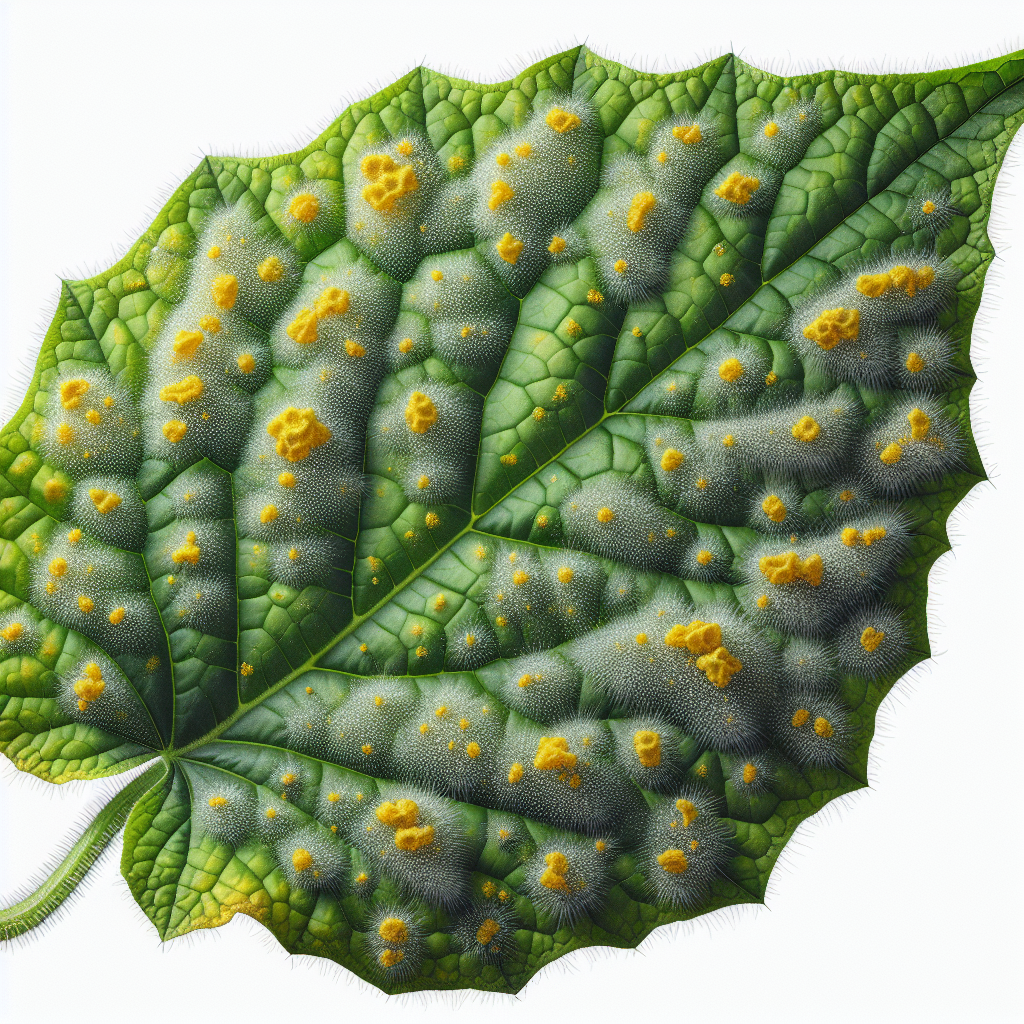
Introduction to Downy mildew (Pseudoperonospora cubensis)
Downy mildew (Pseudoperonospora cubensis) stands as one of the most destructive foliar diseases impacting cucurbit crops worldwide, causing billions in annual losses for commercial growers and home gardeners alike. This oomycete pathogen thrives in cool, humid conditions, rapidly spreading through spores that infect leaves, leading to chlorosis, necrosis, and plant defoliation. First identified in Cuba in the late 1800s, P. cubensis has evolved into multiple pathotypes, rendering some resistant varieties ineffective and challenging conventional control measures.
Unlike true fungi, downy mildews are water molds requiring free moisture for spore germination, making them particularly problematic in greenhouse and field settings with overhead irrigation or frequent dew. Symptoms often mimic powdery mildew, but the diagnostic purplish-gray sporulation on leaf undersides distinguishes it. This guide equips agricultural professionals with diagnostic tools, lifecycle knowledge, organic treatments, and prevention protocols to safeguard yields of key crops like cucumber, watermelon, and cantaloupe.
Economic impacts are severe: in severe epidemics, yields can drop by 50-100%, with infected fruits becoming unmarketable due to secondary rots. Climate change exacerbates spread, as warming temperatures expand host ranges and prolong favorable conditions. Successful management hinges on integrated approaches combining cultural, biological, and organic chemical controls. For small farms struggling with disease outbreaks, tools like those in Why Misidentifying Plants Costs Small Farms Thousands - And How AI Camera Diagnosis Fixes It Fast can accelerate accurate identification, preventing costly mistakes.
Identifying Symptoms & Damage
Early detection of downy mildew (Pseudoperonospora cubensis) is critical, as infections progress rapidly from subtle signs to total canopy collapse. Initial symptoms appear on older leaves as small, light green to yellow angular spots on the upper surface, confined by leaf veins, creating a mosaic-like pattern. These lesions expand to bright yellow or pale green, often with a mosaic appearance under high humidity.
Within 3-5 days, affected areas turn necrotic, developing brown to black irregular blotches. The hallmark diagnostic feature emerges on leaf undersides: dense, purplish-gray to violet sporangia in a felt-like growth, most visible during cool, moist nights. Sporulation requires relative humidity above 85% and temperatures of 10-25°C (50-77°F), often absent in dry conditions, complicating field diagnosis.
Damage escalates as lesions coalesce, causing leaves to wither and drop prematurely, exposing fruits to sunscald and reducing photosynthetic capacity by up to 90%. Fruits on infected vines remain small, deformed, or cull-grade due to poor assimilate supply. In advanced stages, stems and petioles show dark lesions, leading to vine collapse. Differentiate from angular leaf spot (bacterial, water-soaked lesions) or downy mildew (other species with different hosts) via microscopy: P. cubensis sporangia are lemon-shaped, 25-40 μm long.
Yield losses correlate with infection timing: pre-flowering infections slash marketable yield by 40-70%; mid-season hits reduce fruit size and quality. Scout weekly using a 10x hand lens, focusing on lower canopy. Threshold: 1-5% leaf area affected warrants action. Document via photos for resistance breeding programs.
Lifecycle and Progression of Downy mildew (Pseudoperonospora cubensis)
Pseudoperonospora cubensis follows an polycyclic lifecycle, completing 10-20 generations per season under optimal conditions. Primary inoculum arrives via wind-dispersed sporangia from infected debris or weed hosts, germinating in free water within 2-6 hours at 15-20°C (59-68°F). Biflagellate zoospores encyst and penetrate stomata, primarily on leaf undersides, initiating infection.
Incubation lasts 3-5 days, followed by lesion formation and sporangiophore emergence at night. Sporangia release 4-12 zoospores each, splashing or wind-blown up to 15 km. Optimal infection occurs at 16-21°C with 6+ hours leaf wetness; above 30°C, sporulation halts. Oospores in infected tissue serve as long-term soil inoculum, surviving 1-2 years.
Progression accelerates in dense canopies with poor airflow. Pathotype diversity (A1-A7) overcomes single-gene resistances like in 'Marketmore 76 cucumber'. Disease curves follow logistic growth, peaking mid-season. Systemic infections rare but occur in young seedlings via cotyledons. Understanding this enables predictive modeling: forecast risk using weather data (leaf wetness >6h, RH>90%).
Environmental Triggers & Risk Factors
Downy mildew (P. cubensis) epidemics ignite under specific microclimates: temperatures 10-25°C, prolonged leaf wetness from dew, rain, or irrigation, and relative humidity >85%. Nighttime conditions prime sporulation; daytime spread via convection currents. High nitrogen fertility promotes succulent tissues ideal for infection.
Risk factors include dense planting (>20,000 plants/ha), overhead watering, and susceptible varieties like 'Poinsett 76' cucumber. Volunteer cucurbits and weeds (e.g., wild cucumber) harbor inoculum. Soil moisture >60% fosters oospore survival. Regions like the U.S. Southeast, Mediterranean, and India see annual outbreaks post-rainy seasons.
Climate shifts extend seasons: warmer springs advance primary infections. Polyculture reduces risk; monocrops amplify. Monitor via regional networks; avoid planting in low-lying fog-prone areas.
Organic Control & Treatment Plans
Organic management of downy mildew demands IPM: cultural, biological, and OMRI-listed fungicides. Cultural: Space plants 1-1.5m apart for airflow; use drip irrigation; prune lower leaves; apply mulches to reduce splash. Rotate 3+ years away from cucurbits.
Biological: Apply Trichoderma harzianum or Bacillus subtilis (e.g., Serenade) preventively every 7-10 days. Spring Pest Patrol: Organic AI Strategies to Shield Your Crops from Common Invaders highlights biofungicide timing.
Organic Fungicides: Copper octanoate (e.g., Cueva), phosphorous acid (e.g., Reliant), potassium bicarbonate (MilStop). Alternate modes: FRAC codes M1, 33, P5. Apply at 5-7 day intervals from early yellowing, covering undersides. Efficacy: 60-80% suppression.
Resistant Varieties: 'Diva', 'Socrates' cucumbers; 'Athena' cantaloupe. Scout and rogue 5% infected plants. Post-harvest: flame-kill debris; solarize soil.
Treatment Protocol:
- Scout weekly.
- At 1% incidence: cultural + biofungicide.
- 5%+: add OMRI copper/phosphite.
- Harvest clean vines promptly.
Preventing Downy mildew (Pseudoperonospora cubensis) in the Future
Prevention trumps cure: select resistant hybrids like 'Corinto' cucumber; site in full sun with good drainage. Use plasticulture with row covers until flowering; vent greenhouses to <80% RH. Grafted plants onto resistant rootstocks (e.g., Cucurbita maxima x ficifolia) boost tolerance 50%.
Forecast using apps tracking leaf wetness hours. Eradicate volunteers; sanitize tools. Fallow with biofumigants like mustard cover crops releasing isothiocyanates suppressing oospores. Seed treatments with phosphite enhance systemic resistance. Long-term: breed stacked resistances against pathotypes A1-A7.
Monitor adjacent fields; buffer zones reduce inoculum. Integrated with Soil Health Mastery: 5 Proven Strategies for Small Farms to Build Fertile Ground Without Breaking the Bank builds resilient systems.
Crops Most Affected by Downy mildew (Pseudoperonospora cubensis)
Pseudoperonospora cubensis targets Cucurbitaceae: cucumbers (most susceptible), melons (honeydew, cantaloupe), squash (zucchini, butternut squash), pumpkins (sugar pie pumpkin), watermelons (crimson sweet watermelon), and gourds. Lesser hosts: cantaloupe, honeydew. Emerging reports on wild species expand reservoirs.
Susceptibility varies: slicing cucumbers > pickling > melons > squash. Yield impacts highest in fresh market due to cosmetic damage. Greenhouses amplify via humidity; fields suffer post-rain. Co-infections with cucumber mosaic virus worsen outcomes.