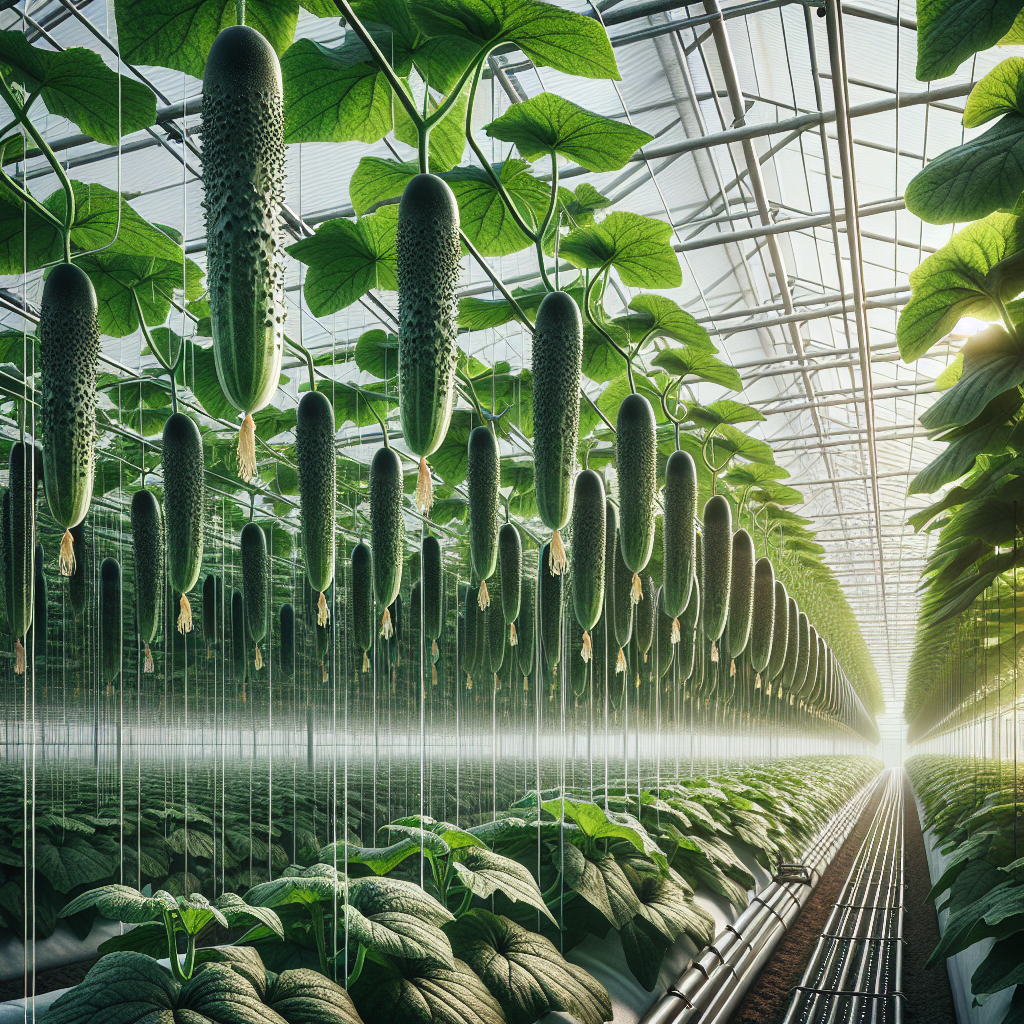
Introduction to English Greenhouse Cucumber
Prized for its slender shape, tender skin, mild flavor, and low seed content, this cucumber type is one of the most refined salad cucumbers grown under protection. It is distinct from field slicers and pickling cucumbers because it has been selected for greenhouse performance, parthenocarpic fruit set in many modern cultivars, and fruits that are typically harvested long, straight, and glossy before seeds fully develop.
Historically, the “English” or “European” greenhouse cucumber emerged from intensive protected cultivation systems in northern Europe, where growers needed crops that could thrive in glasshouses during cool, low-light seasons. That breeding history explains many of its defining traits: high vigor under trellising, sensitivity to environmental stress, and superior fruit quality when temperature and moisture remain consistent. Commercial cultivars are often marketed as burpless or seedless, though this is partly a result of harvesting stage and greenhouse pollination management rather than an absolute botanical rule.
For serious growers, this crop rewards precision. Compared with open-field cucumbers, it is less forgiving of erratic watering, salinity swings, root-zone oxygen deprivation, and poor air circulation. In return, it offers premium marketability, fast growth, and heavy yields from relatively small greenhouse footprints. If managed well, a single plant can produce repeatedly for weeks or months, especially when trained vertically and fed on a disciplined fertigation schedule.
Botanical Profile of English Greenhouse Cucumber
This crop belongs to the family Cucurbitaceae, the same family as melons, squash, and pumpkins. It is a frost-sensitive annual vine with a fast-growing, climbing habit and a shallow but vigorous root system concentrated mainly in the upper soil profile. That root distribution is one reason why moisture consistency matters so much: the plant depends on an evenly moist, aerated root zone rather than deep subsoil reserves.
Leaves are broad, rough-textured, and palmately lobed, creating a dense canopy that drives rapid transpiration under warm conditions. Tendrils help the plant anchor itself to strings, netting, or trellis wires. In greenhouse systems, plants are commonly trained to a single stem, with side shoots managed according to cultivar vigor and local light levels.
Many English greenhouse types are gynoecious and parthenocarpic. Gynoecious plants produce predominantly female flowers, which directly improves yield potential. Parthenocarpy allows fruits to develop without pollination, which is highly desirable in greenhouses because pollinated fruits may become misshapen, excessively seeded, or bitter in some cultivars. This is a key difference from many outdoor cucumbers; growers comparing systems may find it helpful to review general Cucumber production principles while remembering that greenhouse English types are more specialized.
Fruit morphology is highly characteristic: cylindrical, elongated, usually 25-40 cm long, dark to medium green, and thin-skinned with minimal external ribbing. The skin is much more delicate than standard slicers, which is why fruits are often wrapped commercially to reduce moisture loss. Internally, flesh is crisp, pale green, and tender with a small seed cavity. Premium fruit quality depends on uninterrupted growth; any stress can cause necking, tapering, curvature, ridging, or bitterness.
Soil, pH, and Climate Requirements for English Greenhouse Cucumber
This crop performs best in fertile, well-drained, biologically active soil or a professionally managed soilless medium with strong water-holding capacity and excellent air-filled porosity. In ground beds, ideal soil texture is a sandy loam to loam enriched with mature compost and well-decomposed organic matter. Heavy clay can be used only if raised beds, drainage amendments, and careful irrigation prevent saturation. Roots are very sensitive to anaerobic conditions; even short periods of waterlogging can trigger root decline, nutrient imbalance, and disease.
Target soil pH is 5.8-6.8, with an ideal working range around 6.0-6.5. Below pH 5.5, calcium, magnesium, and phosphorus uptake can become less reliable, while manganese toxicity may increase. Above pH 7.0, iron, manganese, and zinc availability often declines, producing chlorosis in young growth. Because English greenhouse cucumbers are fast feeders, even mild nutrient lockout shows up quickly as pale leaves, slow internode extension, weak flowering, or fruit abortion.
Electrical conductivity should be moderate rather than high. This crop is less tolerant of salt buildup than tomatoes. In soil, excess soluble salts often first appear as marginal leaf burn, downward leaf curl during warm afternoons despite moist soil, and reduced fruit length. If using fertigation, monitor root-zone salinity regularly and occasionally irrigate deeply enough to flush accumulated salts.
Temperature requirements are exacting. Optimal daytime air temperature is generally 22-28°C, with nighttime temperatures around 18-20°C. Below about 15°C, growth slows sharply, roots absorb nutrients less efficiently, and leaves may take on a dull, bluish cast. Above 32°C, pollen viability becomes less relevant in parthenocarpic cultivars, but plant stress still rises, fruit quality drops, and soft growth becomes more disease-prone. Root-zone temperature is equally important; cold media below 18°C commonly lead to stunting and susceptibility to root pathogens.
Relative humidity should usually be maintained around 60-80%. Too dry, and plants transpire excessively, causing tipburn, poor leaf expansion, and misshapen fruit. Too humid, and fungal diseases, guttation, and weak tissue become more likely. Ventilation is essential not just for heat control but for keeping leaf surfaces dry. A common professional target is to avoid prolonged condensation on foliage from dusk through mid-morning.
Light should be bright but not scorchingly intense in hot climates. In cool temperate greenhouse systems, maximize winter and spring light. In hot regions, 20-30% shade during peak summer may protect plants from heat stress without overly compromising yield. Consistency matters more than extremes; abrupt swings in heat, moisture, and light intensity are a major cause of bitter or crooked fruits. For broader protected-culture soil fertility concepts, see soil health strategies.
Step-by-Step Planting & Propagation
Propagation is almost always by seed. Use fresh, high-quality seed from greenhouse-adapted cultivars, ideally disease-resistant and parthenocarpic. Sow in sterile propagation trays or individual plugs to reduce transplant shock. A plug size of roughly 3.5-5 cm wide is usually adequate for short nursery cycles.
Fill cells with a fine, well-aerated seedling mix. Sow seed 1-1.5 cm deep, laying it flat or slightly on edge. Maintain media temperature at 26-28°C for rapid, uniform germination. Under these conditions, emergence usually occurs in 2-4 days. Temperatures below 22°C delay emergence and increase damping-off risk.
Immediately after emergence, provide strong light and reduce air temperature slightly to about 22-24°C days and 18-20°C nights. Water lightly but consistently; seedling media should remain moist, never saturated. If you squeeze a handful of media, it should feel cool and cohesive but should not release free water. Overwatered seedlings become pale, soft-stemmed, and vulnerable to Pythium.
Transplant when plants have 2-3 true leaves and a well-knit but not root-bound plug, usually 10-18 days from sowing depending on season and light. Delayed transplanting often causes a temporary check in vigor and reduces early yield.
Before planting greenhouse beds, incorporate finished compost and base fertility according to soil test results. A productive starting point is a bed rich in organic matter but not excessively high in undecomposed nitrogen, which can create soft, disease-prone growth. Form raised beds if drainage is imperfect.
Space plants 40-60 cm apart within rows, with rows 1.2-1.8 m apart depending on greenhouse layout, pruning style, and access. High-wire systems may use denser spacing if pruning is aggressive and nutrition is tightly controlled. Install vertical support strings at transplanting to avoid root disturbance later.
Transplant carefully so the root ball top sits level with the bed surface. Planting too deep can encourage stem rot; planting too shallow exposes the root ball to drying. Water in thoroughly to settle soil around roots, then maintain uniform moisture during the first week while roots expand into the bed.
If direct seeding into greenhouse soil is attempted, warm soil thoroughly first and protect seedlings from fungus gnats, cutworms, and early moisture stress. However, transplants are strongly preferred for precise stand establishment and earlier harvest.
Care & Maintenance regimes for English Greenhouse Cucumber
Irrigation is the most critical routine task. The root zone should remain evenly moist, with good oxygen availability at all times. In practical terms, soil should feel moist at 5-10 cm depth throughout active growth but never swampy, sour-smelling, or slick. A useful target is to irrigate before plants show true wilting, but not so frequently that the bed never partly re-aerates between events.
Young plants need smaller, more frequent irrigations as roots establish. During heavy fruiting, water demand rises sharply, especially in warm bright weather. Under greenhouse conditions, a mature cropping plant can move a surprisingly large volume of water in a day. Drip irrigation is strongly preferred because it keeps foliage dry and allows precise dosing. Signs of underwatering include dull leaves by midday, slow fruit elongation, bitter flavor, narrow necks on fruit, and abortion of young fruits. Signs of overwatering include persistent leaf droop despite wet soil, yellowing lower leaves, algae on bed surfaces, edema, and increased root disease.
Nutrient management should follow a staged program. Early growth requires sufficient nitrogen for canopy development, but excessive ammonium can damage roots and produce lush, weak tissue. Once flowering and fruit set begin, potassium demand rises substantially, along with steady calcium and magnesium supply. Calcium is especially important because rapid fruit expansion can outpace uptake in erratic moisture conditions, leading to poor texture and physiological disorders. Weekly low-dose fertigation is generally superior to occasional heavy feeding.
A balanced approach might emphasize nitrate-based nutrition with adequate potassium and supplemental magnesium during active fruiting. Watch for deficiency symptoms closely: nitrogen deficiency causes general pale foliage and reduced vigor; potassium deficiency causes marginal scorch and weak fruit fill; magnesium deficiency appears as interveinal chlorosis on older leaves; iron deficiency shows on the youngest leaves first.
Training and pruning define final yield and fruit quality. Most professional systems train English greenhouse cucumbers to a single main stem tied to a vertical string. Twist the stem gently around the support as it elongates or use clips. Remove malformed fruits early so the plant does not waste resources. Lower laterals are usually pruned back aggressively in the first 30-50 cm above the soil to improve airflow and reduce disease pressure. Beyond that, side shoots may be pinched to one leaf and one fruit, or removed entirely, depending on cultivar vigor and local practice.
Leaf pruning should be conservative. Remove old, yellow, diseased, or heavily shaded lower leaves, but never strip too much healthy foliage at once. Cucumber plants rely on a large photosynthetic canopy to sustain long fruit production. Over-pruning exposes fruit to sunscald and destabilizes the source-sink balance.
Because many greenhouse cultivars are parthenocarpic, exclude pollinators where possible if the cultivar is sensitive to pollination-related fruit deformity. In mixed systems near open vents, insect entry can occasionally produce bulbous or seeded fruits.
Sanitation is ongoing, not occasional. Remove senescent leaves, dropped flowers, aborted fruits, and cull material promptly. Keep walkways dry and weed-free. Disinfect tools used for pruning, especially if any viral or bacterial issue is suspected.
Pests, Diseases & Organic Management
English greenhouse cucumber is highly productive but vulnerable to several pests and diseases favored by protected conditions. The most common insect pests are aphids, whiteflies, spider mites, and thrips. aphids cluster on young shoots and leaf undersides, causing curling, sticky honeydew, and potential virus transmission. whiteflies increase rapidly in warm houses and reduce vigor through sap feeding. spider mites thrive in hot, dry conditions and create stippled leaves with fine webbing. thrips scar leaves and fruit and may vector disease.
Organic management starts with exclusion and early detection. Use insect screening where practical, inspect leaf undersides twice weekly, and deploy yellow or blue sticky cards for monitoring. Avoid excessive nitrogen, which encourages soft growth that sap-feeding pests prefer. Biological controls such as predatory mites, parasitoid wasps, and lacewings can be highly effective in greenhouse systems when introduced early.
Common diseases include powdery mildew, downy mildew, botrytis, Pythium root rot, Fusarium wilt, angular leaf spot, and viral complexes such as cucumber mosaic virus. powdery mildew is especially common in older canopies under stagnant air; it appears as white dusty colonies on leaves and weakens production. downy mildew creates angular yellow lesions and gray-purple sporulation under humid conditions. botrytis often attacks wounded tissue, pruned leaf stubs, and senescing flowers in humid houses.
Root diseases are frequently management diseases rather than random events. Pythium and other damping-off organisms explode in saturated, cool, poorly aerated media. Prevention depends on sterile propagation media, clean trays, controlled watering, warm root zones, and avoidance of chronically wet beds.
For organic prevention, focus on four priorities: airflow, sanitation, irrigation timing, and canopy discipline. Water early enough that excess humidity dissipates before nightfall. Space and prune plants so lower leaves dry quickly after irrigation or condensation. Remove infected tissue immediately and dispose of it away from the greenhouse.
If sprays are needed, sulfur products may help suppress powdery mildew where crop safety and temperature conditions allow, while potassium bicarbonate, biological fungicides based on Bacillus species, and neem-based products can play supporting roles. Always test any organic product on a few plants first, because cucumbers can be sensitive to phytotoxicity, especially under heat.
Virus management depends heavily on vector control and hygiene. Remove suspicious plants early if they show mosaic, severe distortion, shoestring leaves, or mottled fruit. Do not handle healthy plants after touching infected ones without washing or changing gloves.
Harvesting, Curing & Optimal Storage
Harvest timing is based on size, straightness, color, and tenderness rather than physiological maturity. Fruits are usually ready 10-20 days after flowering, depending on temperature and cultivar. Premium English greenhouse cucumbers are harvested while uniformly green, firm, slender, and before any yellowing or seed enlargement begins. Typical harvest length is about 25-35 cm, though market preference varies.
Use a clean knife or pruners to cut fruit with a short stem stub rather than twisting aggressively, which can damage vines. Harvest at least every 2-3 days in peak production, and daily in warm, high-yield periods. Delayed harvest suppresses further fruit set and shifts plant resources toward oversized fruit. Overmature fruits become thicker-skinned, less crisp, and more seed-pronounced.
Unlike onions, garlic, or winter squash, cucumbers are not cured. They should be handled as a high-moisture, highly perishable fresh vegetable. Keep harvested fruit shaded immediately. Do not leave fruit in a hot greenhouse aisle, where temperature can rise enough to accelerate softening and moisture loss within an hour.
Grade fruit by straightness, uniform diameter, skin finish, and absence of scars. Because skin is delicate, avoid rough bins and stacking pressure. Commercial growers often wrap each fruit individually to reduce desiccation and preserve gloss.
Store at 10-13°C with 90-95% relative humidity. Temperatures much below about 7-10°C can cause chilling injury, seen as pitting, water-soaked areas, rapid breakdown, and poor flavor after removal from storage. At ideal conditions, storage life is often about 10-14 days, though best eating quality is usually within the first week. Ethylene exposure should be minimized; do not store near ripening apples, bananas, or tomatoes, which can accelerate yellowing and softening.
Companion Planting for English Greenhouse Cucumber
In greenhouse production, companion planting should be approached as functional understory management rather than casual intermixing. The best companions are those that either attract beneficial insects outside the main crop zone, repel or confuse pests, or occupy shallow edge spaces without competing heavily for light and root volume.
Thai Basil is a strong companion because its aromatic foliage may help disrupt pest location cues while remaining compact enough for border or container placement near greenhouse entrances and pathways. Lettuce can be grown as a quick, shallow-rooted intercrop early in the cucumber cycle before the canopy closes, making efficient use of lower light zones without imposing major nutrient competition. Onion works best along bed edges where its upright habit occupies little horizontal space and may contribute to pest deterrence through pungent sulfur compounds. Yarrow is especially valuable near, but not crowded beneath, cucumber rows because it supports predatory insects and parasitoids that help suppress aphids and other pests.
Avoid pairing with aggressive, heavy-feeding cucurbits such as squash or melons in the same protected bed, as they amplify humidity, compete intensely for nutrients, and can share disease problems. Also avoid overcrowding with tall, dense crops that reduce airflow around the cucumber base.
A practical greenhouse strategy is to keep the main production row dedicated to cucumbers and place companions at borders, entrances, external pollinator strips, or in removable containers. This preserves the controlled environment that premium cucumber production requires while still gaining ecological benefits from plant diversity.