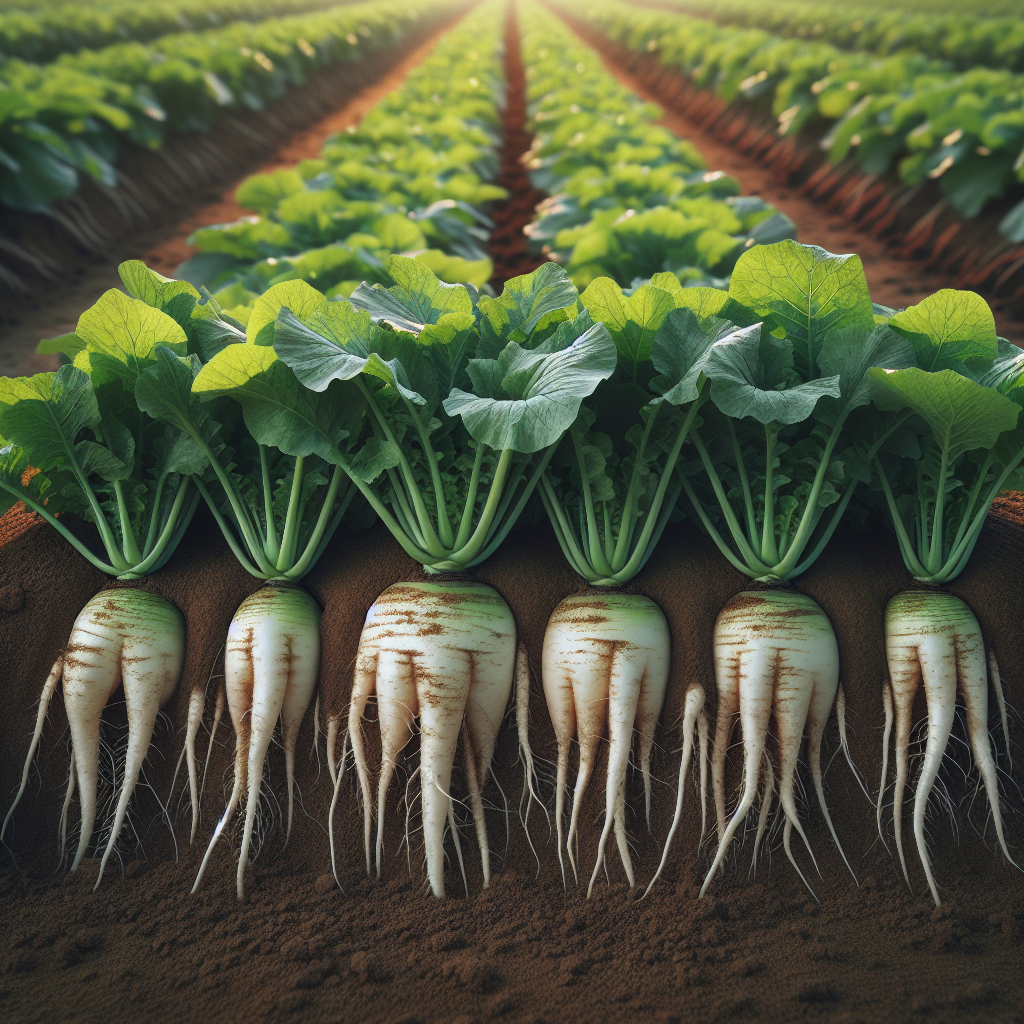
Introduction to Daikon Radish
A classic East Asian root vegetable, daikon has been cultivated for centuries in Japan, China, Korea, and across South and Southeast Asia, where it serves both as a staple food crop and a functional field plant used to loosen compacted soil. Unlike small spring radishes, daikon is typically grown for a substantial storage root that can range from 15 cm to over 60 cm long depending on cultivar and season. The flavor is generally milder than common table radishes, especially in cool weather, with a juicy, crisp flesh that can be eaten raw, pickled, braised, fermented, or cooked into soups and stews.
From a production perspective, this crop is deceptively simple: direct sow it at the right time, avoid nitrogen excess, maintain even moisture, and provide friable soil depth. However, quality failures are common when growers underestimate the importance of timing and soil structure. Heat, drought, shallow hardpan, fresh manure, or interrupted growth often lead to pithiness, splitting, branching, harsh flavor, or premature bolting. In well-managed systems, daikon is one of the most rewarding cool-season root crops, and it also functions as a bio-drilling cover crop in rotations where subsoil compaction is a concern. For broader soil strategies, see soil health tips.
Botanical Profile of Daikon Radish
This crop belongs to the Brassicaceae family, the same family as mustard, cabbage, and turnip. Its species, Raphanus sativus, includes many radish forms, but daikon types are distinguished by their elongated, often white roots, relatively upright foliage, and preference for cool growing conditions. The edible “root” is actually an enlarged hypocotyl-root structure, meaning both stem and root tissues contribute to the swollen storage organ.
Plants typically form a rosette of rough, lobed, medium- to deep-green leaves. Depending on cultivar, foliage may be compact or vigorous enough to shade the row middles. Mature roots may be cylindrical, tapered, blunt-ended, or half-exposed above the soil line. Skin color is usually white, though some specialty forms show green shoulders, pale green tops, or pink interiors. Popular cultivar groups include Miyashige, Minowase, Shogoin, and Korean mu types. Long-rooted cultivars are best for deep sandy loams, while shorter or rounder forms perform better in heavier soils.
Daikon is generally a biennial grown as an annual. If exposed to sufficient cold after juvenile growth and then followed by warming temperatures, it can vernalize and bolt, producing a flowering stalk and eventually seed pods. This tendency is more relevant in spring sowings; autumn production usually avoids bolting because plants mature before floral induction progresses to seed stalk formation.
Compared with Radish, daikon usually requires a longer growing period, more root-zone depth, and more precise sowing windows for premium texture. Days to harvest commonly range from 45 to 75 days, though some specialty storage types may take longer.
Soil, pH, and Climate Requirements for Daikon Radish
The most important requirement is deep, loose, obstruction-free soil. For straight, marketable roots, aim for at least 25-40 cm of worked soil depth for medium cultivars and 45 cm or more for long cultivars. Stones, compacted layers, undecomposed debris, or dense clay pockets force the root to fork, twist, or become stubby. Raised beds are especially effective in marginal soils because they improve drainage and increase rooting depth.
The ideal soil texture is sandy loam to fine loam with high organic matter that is fully decomposed, not fresh. Fresh compost that is chunky or manure that is still releasing ammonia often causes root branching and excessive leaf growth. Well-finished compost incorporated several weeks before sowing is preferable at moderate rates. A target organic matter range of 3-5% is excellent for garden and small-farm production.
Optimal pH is 6.0-7.2. The crop tolerates slightly alkaline conditions better than many vegetables, but growth slows and nutrient availability drops below pH 5.8. In acidic soils, calcium and boron availability can become limiting, contributing to poor root quality, internal browning, or hollow center in severe cases. If liming is needed, apply and incorporate lime well in advance of planting rather than immediately before sowing.
Climate matters enormously. Daikon is a cool-season crop that performs best between 10-24°C, with highest root quality usually produced around 12-18°C. Above about 27°C, roots can become pungent, fibrous, or pithy, especially if moisture fluctuates. Hard freezes can damage exposed shoulders and foliage, but established plants tolerate light frost and often become sweeter after cool nights.
In temperate regions, the premium crop is usually sown in late summer to early autumn for fall harvest. Spring sowing is possible in cool climates, but the risk of bolting rises as day length increases and temperatures fluctuate. In mild winter regions, autumn sowing for winter harvest is often ideal. Hot tropical lowlands are generally less suitable unless production is timed for the coolest months or higher elevations.
Moisture should be consistent rather than abundant. The root zone should remain evenly moist to roughly field capacity, never saturated for prolonged periods. In practical terms, the top 5-8 cm of soil should not be allowed to dry into hard crust, while the deeper zone should feel cool and slightly damp when pressed in the hand, not sticky or anaerobic. Signs of under-watering include sharp flavor, slow bulking, cracked shoulders, and tough texture. Signs of overwatering include yellowing lower leaves, a sour soil smell, edema-like blisters on foliage, sluggish growth despite wet soil, and increased risk of root rot.
Step-by-Step Planting & Propagation
Propagation is by seed, and direct sowing is strongly preferred. Transplanting almost always compromises root shape because the taproot is easily disturbed.
Prepare the bed deeply. Remove stones, clods, roots, and uncomposted residues. Broadforking or deep cultivation is worthwhile where soil pans exist. Rake to a fine, even tilth.
Pre-irrigate if the soil is dry. Seeds germinate best in moist seedbeds with close soil-seed contact. If the bed is dusty, water thoroughly 12-24 hours before sowing so the soil settles without becoming muddy.
Sow seed 1-1.5 cm deep. In cool or heavy soil, stay near 1 cm; in lighter soil or dry conditions, sow slightly deeper. Row spacing can range from 30-45 cm for hand cultivation and dense garden plantings up to 45-60 cm for larger cultivars or easier access.
Space seeds closely at sowing, then thin. A common practice is sowing every 2.5-5 cm and thinning to final spacing once seedlings are established. Final spacing depends on root size goals: 10-15 cm for medium roots, 15-20 cm for large roots, and 20-25 cm for giant storage types.
Thin early. Perform the first thinning when seedlings have developed their first true leaves. Delay causes competition stress and malformed roots. Cut rather than pull if plants are crowded tightly, to avoid disturbing neighboring seedlings.
Protect emergence. Flea beetles and hot dry winds can devastate young seedlings. In high-pressure areas, insect netting or floating row cover installed immediately after sowing is extremely effective. Remove covers if pollination is required only if growing for seed, not roots.
Succession sow if desired. Plant every 1-3 weeks during the suitable seasonal window for a steady harvest. Commercial growers often stagger sowings by cultivar maturity and intended market size.
Typical germination occurs in 3-7 days in warm-but-not-hot soils, and 7-12 days in cooler conditions. Ideal soil temperature for germination is roughly 10-30°C, with the most uniform stands near 18-24°C.
Care & Maintenance regimes for Daikon Radish
Once established, the crop benefits from steady, low-stress growth. The goal is uninterrupted development from seedling to harvest. Any check in growth shows up later as woody texture, shape defects, or strong flavor.
Irrigation should moisten the root zone to at least 15-20 cm early in the crop and 20-30 cm as roots enlarge. In sandy soils this may mean watering more frequently with smaller volumes; in loams, deeper irrigation at longer intervals works better. A practical target is about 25-40 mm of water per week from rain plus irrigation, adjusted upward in dry, windy conditions and downward in cool, cloudy weather. Rather than following a fixed schedule, assess soil moisture by digging beside the row. If the soil at 10 cm depth is barely damp or crumbly-dry before noon, irrigation is overdue. If it is glossy, sticky, and airless 24 hours after watering, drainage is insufficient or irrigation is excessive.
Mulching with fine straw or shredded leaves can stabilize moisture and reduce soil splash, but keep mulch light during early emergence so seedlings are not shaded. In wet climates, heavy mulch may increase slug pressure.
Nutrition should be balanced, not aggressive. Excess nitrogen causes lush tops, delayed root bulking, and increased susceptibility to Aphids and soft growth disorders. A moderate fertility program works best. Before planting, incorporate a balanced organic amendment based on soil testing. As a general guide, growers often aim for modest available nitrogen, adequate phosphorus for root establishment, and strong potassium for root density and quality. If leaves are pale and growth is slow, a light side-dressing of a mild nitrogen source when plants are small can help, but stop once root swelling begins. Avoid fresh manure entirely in the same season.
Weed control is most important in the first 3-4 weeks. After canopy closure, vigorous foliage suppresses many later weeds. Use shallow hoeing because deep cultivation near developing roots can scar or disturb them. Flame weeding before emergence is possible in stale seedbed systems.
Do not hill soil around roots unless shoulders are becoming green from light exposure; even then, only a light pull of loose soil is needed. Heavy hilling can trap moisture around the crown and increase disease risk.
Watch for physiological quality issues:
- Pithiness: usually from overmaturity, heat, or erratic moisture.
- Splitting: often follows drought stress followed by heavy irrigation or rain.
- Forking: caused by stones, compaction, or undecomposed organic matter.
- Hollow center: linked to rapid growth, heat, boron deficiency, or delayed harvest in some cultivars.
- Excess pungency: most common in hot weather, nutrient imbalance, or moisture stress.
Pests, Diseases & Organic Management
As a brassica-family crop, daikon attracts many familiar cool-season pests. Integrated management begins with timing, exclusion, sanitation, and rotation rather than reactive spraying.
Flea beetles are among the most common early pests. They create tiny “shot holes” in cotyledons and first true leaves, and heavy feeding can stunt or kill seedlings. The most reliable organic control is exclusion with lightweight row cover immediately after sowing. Fast, vigorous growth in moist soil also reduces damage severity.
Aphids cluster on undersides of leaves and around growing points, especially when nitrogen is excessive or weather is dry and mild. A strong water spray, conservation of beneficial insects, and avoidance of overfertilization usually keep them manageable. In stubborn infestations, insecticidal soap can be used with thorough coverage.
Root maggots are a serious issue in some regions. Adult flies lay eggs near the stem base, and larvae tunnel into roots, causing scarring, decay, and unmarketable harvests. Fine insect netting, strict crop rotation, and removal of crop residues are key controls. Avoid successive brassica plantings in the same bed.
Cabbage loopers and Imported cabbageworms may chew leaves but are usually less economically damaging unless foliage loss is severe. Hand-picking, exclusion netting, and Bacillus thuringiensis var. kurstaki are effective organic options.
Slugs may feed on seedlings and root shoulders in cool, damp conditions. Reduce excess mulch, improve airflow, irrigate in the morning rather than evening, and use iron phosphate baits if needed.
Disease pressure rises in poorly drained or repeatedly cropped brassica beds. Common problems include Damping-off, Downy mildew, Alternaria leaf spot, Black rot, and Bacterial soft rot. Prevention is far more effective than treatment.
Key organic disease management practices include:
- Rotate out of brassicas for at least 3 years where disease history is significant.
- Use well-drained soils and avoid waterlogging.
- Irrigate early in the day so foliage dries quickly.
- Thin properly for airflow.
- Remove and destroy badly infected plants.
- Sanitize tools and avoid working in wet foliage.
Clubroot can be devastating in acidic, poorly drained soils. Symptoms include wilting despite adequate moisture and swollen, distorted roots. If Clubroot is present, raise pH toward neutral with lime, improve drainage, lengthen rotations, and avoid moving contaminated soil. Because the pathogen persists for years, prevention is essential.
Harvesting, Curing & Optimal Storage
Harvest timing depends on cultivar, intended use, and season. For fresh eating, roots are usually best while firm, glossy, and fully formed but before they become oversized. Most standard daikon types are harvested at 4-8 cm diameter. Waiting too long increases the risk of pithiness, coarse fiber, and stronger flavor, particularly if warm weather arrives.
Loosen soil with a fork before pulling long-rooted cultivars to avoid snapping them. Hold foliage low at the crown and lift gently. In compact soils, never yank forcefully; broken roots store poorly and invite bacterial decay.
After harvest, trim leaves to 1-2 cm above the crown unless the crop is being sold with tops immediately. Leaving full tops attached accelerates moisture loss from the root. Wash only if necessary for immediate sale; for storage, dry brushing is often better because wet roots require more careful curing and drying.
Daikon does not require curing in the same way as onions or winter squash, but it does benefit from brief post-harvest drying. Place roots in shade with good airflow until surface moisture evaporates and skins are fully dry. Do not sun-scald them. Optimal storage conditions are 0-2°C with 95-100% relative humidity. Under these conditions, sound roots can last 2-4 months depending on cultivar and harvest maturity.
For home-scale storage, perforated plastic bags or bins of slightly damp sand in a refrigerator, root cellar, or cold room work well. The storage medium should be moist enough to reduce shriveling but not wet enough to encourage rot. Check roots every 1-2 weeks and remove any showing soft spots, translucency, sour odor, or blackened tissue.
If storing in the ground in mild climates, use heavy mulch and harvest as needed before severe freezing. This method preserves crispness well, but rodent pressure can become a problem.
Flavor often improves after a short period of cold storage, becoming milder and sweeter. However, once roots begin to lose firmness or develop internal sponginess, culinary quality declines rapidly.
Companion Planting for Daikon Radish
This crop works best with companions that either deter pests, attract beneficial insects, or occupy different rooting and canopy niches without competing heavily during establishment. Onion is a strong partner because its pungent foliage can help confuse some insect pests while occupying relatively little horizontal space. Lettuce is another good match because it matures quickly, shades the soil lightly, and shares similar cool-season timing. Peas can complement daikon in cool weather when trellised so they do not overcrowd the bed, and they help diversify the planting structure. Nasturtium is especially useful at bed edges as a trap and pollinator-support plant in mixed gardens.
Avoid combining daikon too closely with other heavy-feeding brassicas such as cabbage, broccoli, or cauliflower in tight spacing, since they share pests and diseases and can create dense canopies that reduce airflow. Also avoid placing it where root crops with similar depth demands, such as carrots or large beets, will compete directly in narrow rows.
Daikon is also valuable as a rotational companion or preceding crop. Its strong taproot can fracture upper compaction layers and improve infiltration for later plantings. In market gardens, growers sometimes use it before shallow-rooted greens or after summer crops to capture residual nutrients, suppress some weeds through quick canopy formation, and leave the soil more friable for the next succession.