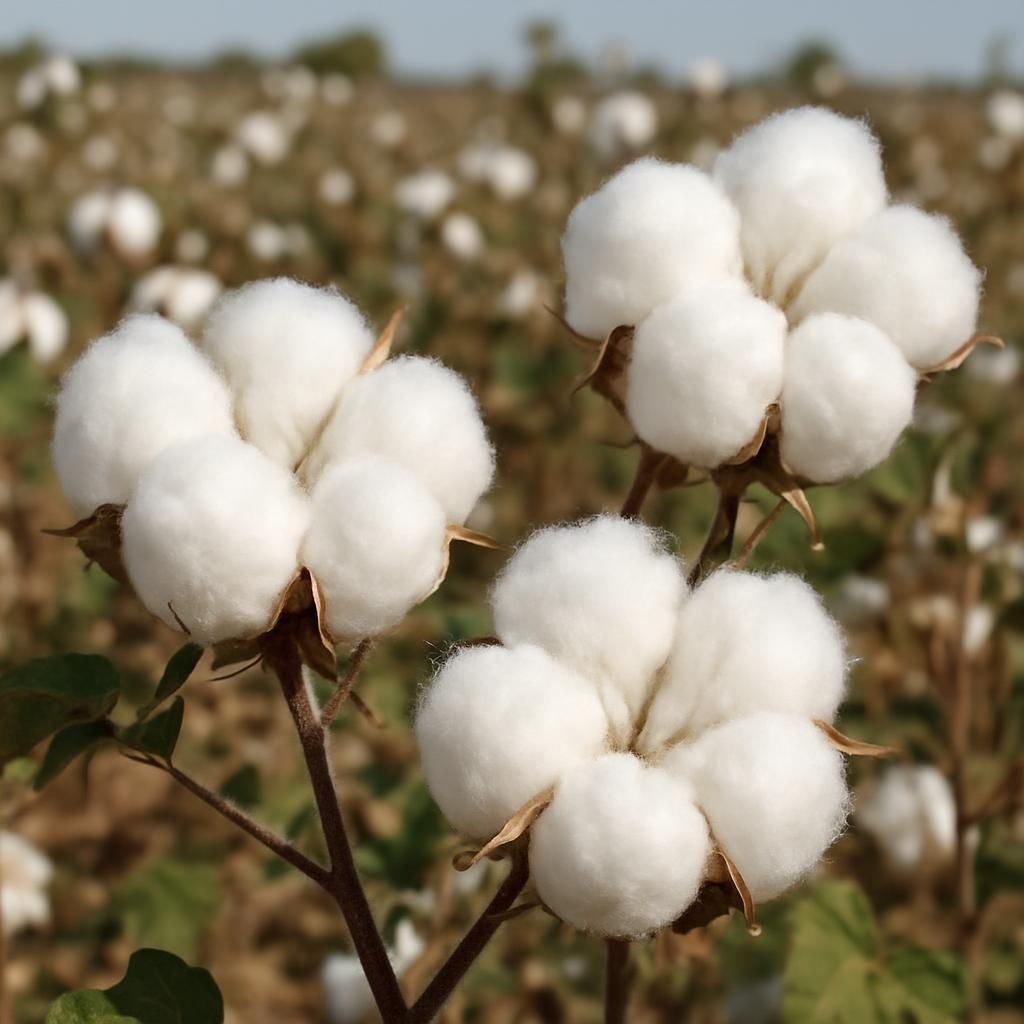
Introduction to Cotton Seed (Gossypium)
Cotton seed belongs to the genus Gossypium and is cultivated primarily for its long, spinnable fibers and nutrient-rich seeds. The crop supports global textile industries while the seeds yield edible oil, protein meal for livestock, and biofuel feedstock. Modern upland varieties such as Upland Cotton dominate commercial production because of their high lint percentage and adaptability.
Successful cultivation requires warm temperatures, well-drained soils, and careful management of water and nutrients. Growers must also monitor for key pests including Aphids, Spider mites, and boll weevils that can quickly reduce yields.
Botanical Profile of Cotton Seed (Gossypium)
Gossypium species are members of the Malvaceae family and include four cultivated types: G. hirsutum (upland), G. barbadense (Pima or Egyptian), G. arboreum, and G. herbaceum. Upland cotton accounts for over 90 % of world production. Plants are herbaceous annuals or short-lived perennials reaching 1–2 m in height with palmately lobed leaves, showy cream or yellow flowers, and distinctive capsular fruits called bolls. Each boll contains 20–40 seeds surrounded by cellulose fibers.
Seeds are ovoid, 8–12 mm long, and covered with short fuzz and longer lint. The embryo stores high-quality protein and oil (18–25 %). Flowering occurs 45–60 days after planting; bolls mature in 50–70 days. Fiber length, strength, and micronaire vary by cultivar and environment.
Soil, pH, and Climate Requirements for Cotton Seed (Gossypium)
Cotton thrives on deep, fertile, well-drained soils with good water-holding capacity. Avoid compacted or saline soils that restrict root growth and reduce fiber quality.
| Parameter | Ideal Range | Notes |
|---|---|---|
| Soil Type | Sandy loam to clay loam | Good drainage essential; avoid heavy clays |
| Soil pH | 5.8–7.5 | Slightly acidic to neutral |
| Temperature | 21–35 °C daytime; >15 °C at night | Frost-free period of 160–200 days |
| Annual Rainfall | 500–1 200 mm | Supplemental irrigation often required |
| Growing Degree Days | 2 200–3 000 GDD (base 15.6 °C) | Critical for boll maturation |
Step-by-Step Planting & Propagation
- Select certified, delinted, and fungicide-treated seed of regionally adapted varieties.
- Test soil and apply lime or sulfur six weeks before planting to reach target pH.
- Prepare seedbed by deep plowing followed by disking to create a fine, firm tilth.
- Plant when soil temperature at 10 cm depth reaches 18 °C and frost risk has passed.
- Sow seeds 2.5–4 cm deep in rows 76–102 cm apart at 8–12 kg/ha for rain-fed or 15–20 kg/ha for irrigated systems.
- Maintain in-row spacing of 10–15 cm to achieve 80 000–120 000 plants/ha.
- Use precision planters or hill-drop methods for uniform emergence.
Care & Maintenance regimes for Cotton Seed (Gossypium)
Consistent moisture and timely nutrient applications are critical during squaring, flowering, and boll development.
| Growth Stage | Irrigation Schedule | Fertilizer (N-P-K kg/ha) | Pruning/Training |
|---|---|---|---|
| Pre-plant | Bring profile to field capacity | 20-40-40 basal | None |
| Emergence–Squaring | 25–30 mm every 7–10 days | 40-0-0 sidedress at 4–6 weeks | None |
| Flowering | 30–35 mm every 5–7 days | 30-0-30 at first flower | Remove vegetative branches if dense |
| Boll Development | 25 mm every 5 days; stop 3 weeks prior | 0-0-30 potassium boost | None |
| Harvest Prep | Withhold water to open bolls | None | Defoliate chemically or mechanically |
Monitor leaf petiole nitrate levels weekly during peak bloom to fine-tune nitrogen.
Pests, Diseases & Organic Management
Major insect pests include boll weevils, Helicoverpa species, Spider mites, Jassids, and cutworms. Key diseases are Fusarium wilt, Verticillium wilt, Alternaria leaf spot, bacterial blight, and seedling damping-off.
Organic strategies begin with resistant cultivars and crop rotation with Sorghum or Peanuts. Use yellow sticky traps and pheromone lures for monitoring. Release beneficial insects such as lady beetles and lacewings. Apply neem oil, spinosad, or Bacillus thuringiensis (Bt) sprays at economic thresholds. Maintain field sanitation by destroying crop residues promptly.
Harvesting, Curing & Optimal Storage
Harvest when 60–70 % of bolls are open and fiber moisture is below 12 %. Use spindle or stripper pickers calibrated to minimize trash. Immediately transport seed cotton to a gin or dry it to 8 % moisture if delayed. Store seed cotton in modules under breathable covers; protect from rain and direct sun. Ginned seed should be cooled to <15 °C and held at <65 % RH for long-term viability.
Companion Planting for Cotton Seed (Gossypium)
Interplanting with Cowpeas or Sesame improves soil nitrogen and disrupts pest cycles. Border rows of Marigold or Sorghum act as trap crops for boll weevils and attract beneficial insects. Avoid planting near Okra or Hibiscus which share pests and diseases.