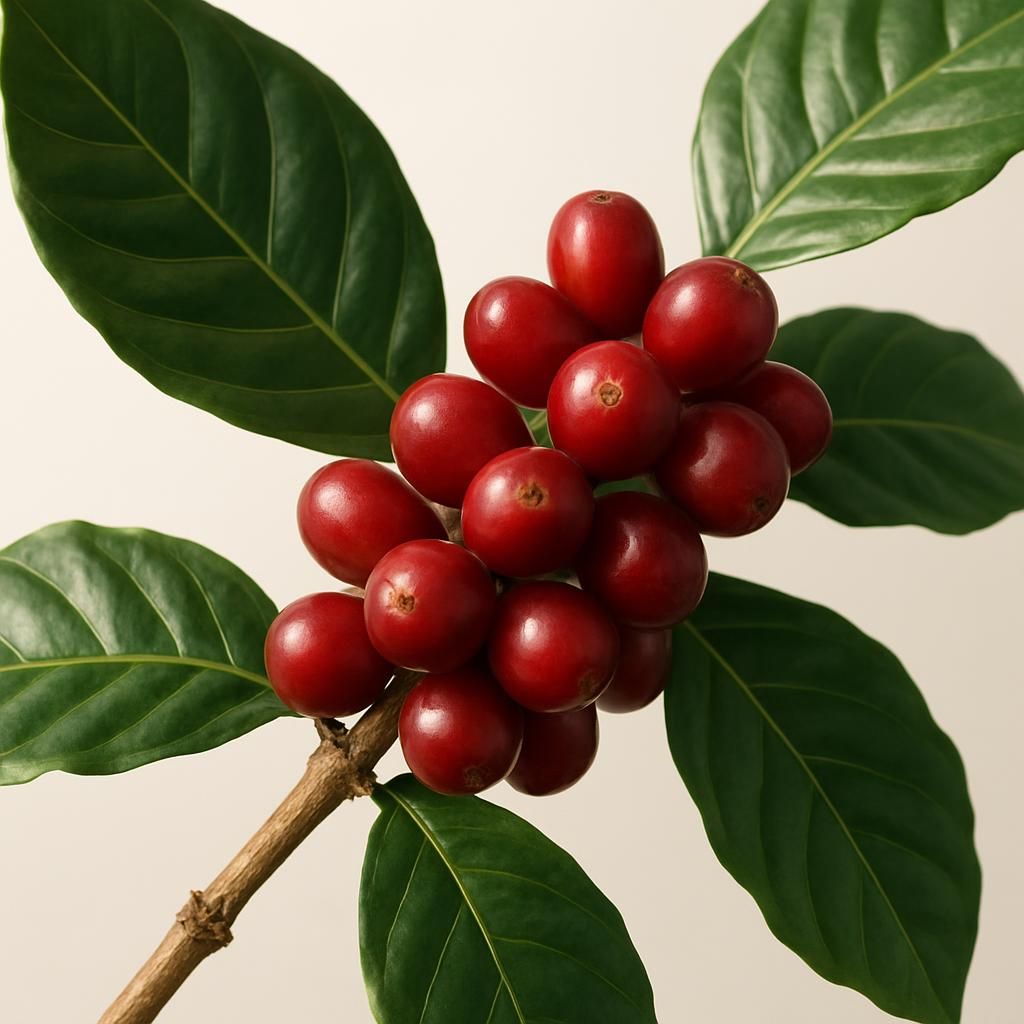
Introduction to Coffee (Arabica - Bourbon)
Bourbon is one of the oldest and most influential Arabica varieties, tracing its origins to the island of Réunion (formerly Bourbon) in the Indian Ocean. It produces beans with bright acidity, pronounced sweetness, and layered aromatics that range from stone fruit to caramel and floral notes. Today, Bourbon and its many sub-varieties remain central to specialty coffee production across Latin America, East Africa, and parts of Asia. Growers value the cultivar for its balanced vigor and the potential for exceptional cup scores when grown at elevation with careful management.
Successful Bourbon cultivation demands precise attention to altitude, temperature stability, soil fertility, and shade management. While the variety offers excellent flavor potential, it is moderately susceptible to common Arabica diseases and requires consistent agronomic practices to reach its full quality and yield potential.
Botanical Profile of Coffee (Arabica - Bourbon)
Coffea arabica 'Bourbon' belongs to the Rubiaceae family. The plant is an evergreen shrub or small tree that typically reaches 3–5 meters in height when unpruned. Leaves are dark green, glossy, and elliptical, arranged oppositely along the stem. White, fragrant flowers appear in clusters at the nodes and develop into oval drupes that ripen from green to deep red. Each fruit usually contains two seeds (the coffee beans) surrounded by sweet mucilage.
Bourbon is genetically closer to the original Ethiopian landraces than many modern cultivars. It exhibits a relatively upright growth habit with strong apical dominance and produces secondary and tertiary branches that bear the majority of the crop. The variety is self-fertile but benefits from cross-pollination by insects for improved fruit set.
Soil, pH, and Climate Requirements for Coffee (Arabica - Bourbon)
Bourbon performs best in deep, well-drained, fertile soils rich in organic matter. Volcanic andisols and loamy clay soils with good structure are ideal. The plant is sensitive to waterlogging and compacted subsoils.
| Parameter | Ideal Range | Notes |
|---|---|---|
| Soil pH | 5.5 – 6.5 | Slightly acidic; avoid alkaline conditions |
| Soil Texture | Loam to sandy clay loam | High organic matter preferred |
| Altitude | 1,000 – 2,000 m | Higher elevations improve cup quality |
| Temperature (day) | 18 – 24 °C | Avoid prolonged exposure above 30 °C |
| Temperature (night) | 10 – 15 °C | Cool nights enhance bean density |
| Annual Rainfall | 1,500 – 2,500 mm | Even distribution; 2–3 month dry season |
| Relative Humidity | 60 – 80 % | Moderate humidity reduces disease pressure |
| Frost Tolerance | None | Sensitive below 5 °C |
Step-by-Step Planting & Propagation
- Select certified Bourbon seed or vegetative cuttings from disease-free mother plants. Fresh seed should be sown within 4–6 weeks of harvest.
- Prepare germination beds with a 1:1:1 mix of sterilized topsoil, coarse sand, and well-decomposed compost. Maintain 50 % shade.
- Sow seeds 1–2 cm deep at 5 cm spacing. Keep substrate moist but not saturated. Germination occurs in 4–8 weeks.
- Transplant seedlings at the two-pair-leaf stage into polybags or nursery beds with 30 cm spacing. Use a fertile, well-draining medium.
- Gradually harden plants over 4–6 weeks by increasing sun exposure before field planting.
- Field planting is best done at the onset of the rainy season. Dig holes 60 × 60 × 60 cm and incorporate 5–10 kg of well-rotted manure plus 100 g of rock phosphate per hole.
- Recommended spacing is 2.0 m × 2.5 m (2,000 plants/ha) for single-stem systems or 2.5 m × 3.0 m for multi-stem.
Care & Maintenance regimes for Coffee (Arabica - Bourbon)
Bourbon responds well to consistent nutrition, moisture management, and structured pruning. Shade trees such as Gliricidia or Inga species are commonly used to moderate temperature and provide organic mulch.
| Growth Stage | Watering Schedule | Fertilizer Application | Pruning Schedule |
|---|---|---|---|
| Establishment (Yr 1) | 15–20 L/plant/week; mulch to retain moisture | 50 g NPK 15-15-15 every 8 weeks; foliar micronutrients quarterly | Formative pruning at 4–6 months to establish single stem |
| Vegetative (Yr 2–3) | 10–15 L/plant/week during dry periods | 150 g NPK 20-10-20 split into 3 applications; 2 kg compost per plant | Top at 1.8–2.0 m; remove basal suckers monthly |
| Production (Yr 4+) | 20–30 L/plant/week; deficit irrigation 4–6 weeks pre-flowering | 200–300 g NPK 18-6-18 + 50 g MgSO₄ split 3× yearly; annual 5 kg compost | Annual stumping or selective pruning after harvest; remove dead wood |
Mulch with 10–15 cm of coffee pulp or legume residues to suppress weeds and regulate soil temperature. Monitor leaf nutrient levels annually and adjust programs accordingly.
Pests, Diseases & Organic Management
Major insect pests include Coffee berry borer, Aphids, Mealybugs, and Scale insects. Regular monitoring and cultural sanitation are the first lines of defense.
Key diseases are Coffee leaf rust (Hemileia vastatrix), Coffee berry disease (Colletotrichum kahawae), and root rots caused by Phytophthora and Fusarium. Resistant rootstocks and strict nursery hygiene reduce incidence.
Organic strategies include:
- Release of predatory beetles and parasitoid wasps for berry borer and scale.
- Copper-based and neem-oil sprays timed to early infection stages.
- Removal and destruction of infected cherries and leaves.
- Interplanting with Marigold and Nasturtium to deter nematodes and attract beneficial insects.
Harvesting, Curing & Optimal Storage
Bourbon typically ripens 7–9 months after flowering. Selective hand-picking of fully ripe red cherries every 7–10 days ensures maximum quality. Avoid stripping unripe or overripe fruit.
Post-harvest processing options:
- Washed (wet) process: depulp within 12 hours, ferment 24–48 hours, wash thoroughly, and dry to 10–12 % moisture on raised beds.
- Honey/natural process: dry whole cherries on raised beds with regular turning for 10–20 days.
Store parchment coffee in jute bags inside ventilated warehouses at 15–20 °C and <65 % RH. Maintain moisture below 12 % and protect from direct light and strong odors. Quality cupping should be performed every 3–4 months.
Companion Planting for Coffee (Arabica - Bourbon)
Strategic companion planting improves biodiversity, nutrient cycling, and pest regulation. Leguminous shade trees such as Gliricidia and Pigeon pea fix nitrogen and provide mulch. Banana and Avocado offer temporary shade during establishment while generating additional income.
Flowering companions including Marigold, Thyme, and Nasturtium attract pollinators and predatory insects while repelling nematodes. Sesame and Sunflower act as trap crops for Aphids and Thrips. Avoid planting solanaceous crops nearby to reduce shared disease pressure.
For more on resilient small-farm systems, see The Truth About Weather Patterns and Small Farm Resilience.