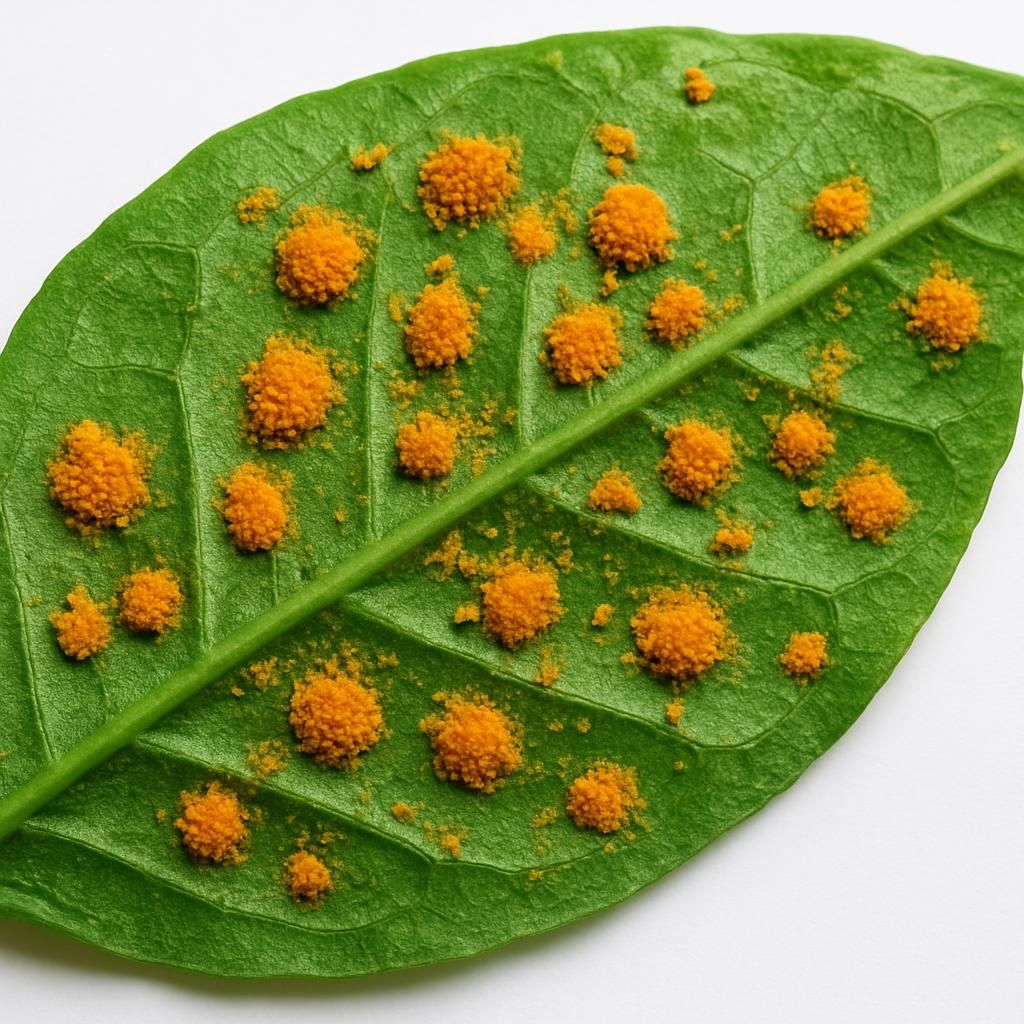
Introduction to coffee leaf rust
Coffee leaf rust (CLR), scientifically known as Hemileia vastatrix, stands as one of the most destructive diseases plaguing coffee production worldwide. First identified in Sri Lanka in 1869, this fungal pathogen has since spread to virtually all coffee-growing regions, causing billions in economic losses annually. Smallholder farmers, who produce over 70% of the world's coffee, are particularly vulnerable, often facing complete crop failure without timely intervention.
This comprehensive guide provides professional-grade diagnostic tools, symptom identification, lifecycle understanding, environmental risk assessment, organic management strategies, prevention protocols, and insights into affected crops. Whether you're managing a commercial plantation or a small farm growing Arabica Coffee (Typica) or Robusta Coffee, mastering coffee leaf rust control is essential for sustainable yields. Early detection through regular scouting—checking undersides of lower leaves weekly—can prevent outbreaks from escalating. Learn more about Coffee (crop) cultivation basics in our detailed wiki.
The disease thrives in the warm, humid conditions ideal for coffee, making integrated pest management (IPM) critical. Annual global losses exceed $1 billion, underscoring the urgency for proactive strategies. This guide draws from decades of agronomic research to deliver actionable advice tailored for tropical agriculture.
Identifying Symptoms & Damage
Recognizing coffee leaf rust early is crucial for containment. Initial symptoms appear as small, pale yellow spots (1-2 mm) on the upper leaf surface, often on lower branches. These chlorotic flecks evolve into necrotic lesions with brick-red to orange spore masses visible on the underside, earning the disease its 'rust' moniker.
Diagnostic Checklist:
- Early Stage (7-10 days post-infection): Faint yellow spots, no spores yet.
- Active Stage: Circular to oval lesions (3-12 mm), surrounded by yellow halos; powdery orange urediniospores easily rub off on fingers.
- Advanced Stage: Lesions coalesce, covering 50-100% of leaf area; leaves turn yellow, then brown, leading to premature defoliation.
Damage escalates rapidly: 20% leaf loss reduces yields by 10-20%; 50% defoliation can slash production by 50%. Severely affected trees weaken, becoming susceptible to secondary issues like root rots or caterpillars. Bean size decreases, flavor quality suffers, and trees may die after repeated epidemics.
Field Diagnosis Tips:
- Use a 10x hand lens to confirm bicellular urediniospores (oval, 25-35 μm).
- Differentiate from nutrient deficiencies (no spores) or angular leaf spot (water-soaked lesions).
- Severity rating: 0-6 scale (0 = no disease; 6 = >80% leaf area affected).
For small farms, Why Misidentifying Plants Costs Small Farms Thousands - And How AI Camera Diagnosis Fixes It Fast offers tech solutions for rapid, accurate ID.
Lifecycle and Progression of coffee leaf rust
Hemileia vastatrix is an obligate parasite completing its lifecycle on living coffee leaves. Urediniospores, the primary infectious units, germinate in free water (dew, rain) within 2-6 hours at 22-24°C, penetrating stomata directly.
Lifecycle Stages:
- Infection (24-48 hours): Germ tubes form appressoria; haustoria invade mesophyll cells.
- Incubation (7-14 days): Invisible development; first symptoms appear.
- Spore Production: Up to 300,000 urediniospores per lesion daily; dispersal via wind up to 50 km.
- Overwintering: As teliospores or on alternate hosts (rare); primarily survives on green branches.
One lesion can produce 10^9 spores seasonally. Epidemics follow a sigmoidal curve: slow buildup, exponential spread during wet periods, plateau at canopy closure. Multiple cycles (6-8/year) in tropics amplify damage. Unlike wheat stem rust, no sexual stage dominates; clonal reproduction drives rapid adaptation.
Progression monitoring: Track disease incidence (infected leaves %) and severity. Threshold for action: 5% severity on 20% of trees.
Environmental Triggers & Risk Factors
Coffee leaf rust epidemics require a 'disease triangle': susceptible host, virulent pathogen, favorable environment. Optimal conditions: 20-24°C, 80-90% RH, leaf wetness >8 hours.
Key Triggers:
- Rainy Seasons: Leaf wetness >12 hours doubles infection rates.
- Altitude: Severe below 1,200m; milder >1,600m due to cooler nights.
- Canopy Density: Dense shade promotes humidity; open canopies dry faster.
- Plant Stress: Drought, nutrient imbalance (N/K excess), high plant density (>4,000 trees/ha).
Risk factors include monoculture of susceptible varieties like Caturra, poor airflow, and nearby infected fields. Climate change extends wet seasons, boosting outbreaks. For tea growers nearby, similar humidity risks apply. Monitor with weather stations; act when leaf wetness duration exceeds 10 hours.
Organic Control & Treatment Plans
Organic management emphasizes prevention but includes curative options. Integrated strategies yield 70-90% control.
Cultural Controls (Foundation): Prune lower branches for airflow; space trees 2x2m; remove infected debris.
Biological Agents: Lecanicillium lecanii (mycoparasite) applied at 10^9 spores/L, 7-10 day intervals.
Organic Fungicides:
- Copper-based (e.g., Bordeaux mix): 1-2 kg/ha, every 14 days; tank-mix with oils.
- Potassium bicarbonate: 2-5 g/L, weekly during high risk.
- Neem oil + sulfur: Suppresses spore germination 60-80%.
Treatment Protocol: Scout weekly; apply at 1-5% severity. Rotate modes of action. For downy mildew, combine with broad-spectrum organics.
Resistant Varieties: Catimor, Hibrido de Timor (20-50% less susceptible). Intercrop with banana for shade/microclimate regulation.
Field trials show IPM reduces fungicide use 50% while maintaining yields. See Spring Pest Patrol: Organic AI Strategies to Shield Your Crops from Common Invaders for enhanced monitoring.
Preventing coffee leaf rust in the Future
Long-term prevention builds resilient systems. Plant resistant cultivars like Castillo, Sarchimor. Sanitation: Destroy volunteer seedlings; burn/prune infected material.
Monitoring Systems: Use apps for degree-day models predicting outbreaks. Threshold-based spraying saves 30-40% costs.
Soil & Nutrition: Balance NPK (120:40:120 kg/ha); silicon amendments boost defenses.
Landscape Management: Windbreaks reduce spore influx; diversify with cacao.
Quarantine: Inspect transplants; buffer zones around farms.
Annual programs combining these cut incidence 80%. Climate-resilient practices include higher altitudes, drought-tolerant rootstocks.
Crops Most Affected by coffee leaf rust
Primarily attacks Coffea arabica (95% losses in epidemics); C. robusta and C. liberica show partial resistance. No other major crops affected, though minor reports on C. eugenioides. Arabica varieties like Typica, Bourbon most vulnerable; hybrids like Catuai moderate. Global hotspots: Latin America (50% production risk), Africa, Asia. Robust intercropping with shade trees mitigates spread. Related rusts impact wheat via Leaf Rust, but CLR is coffee-specific.