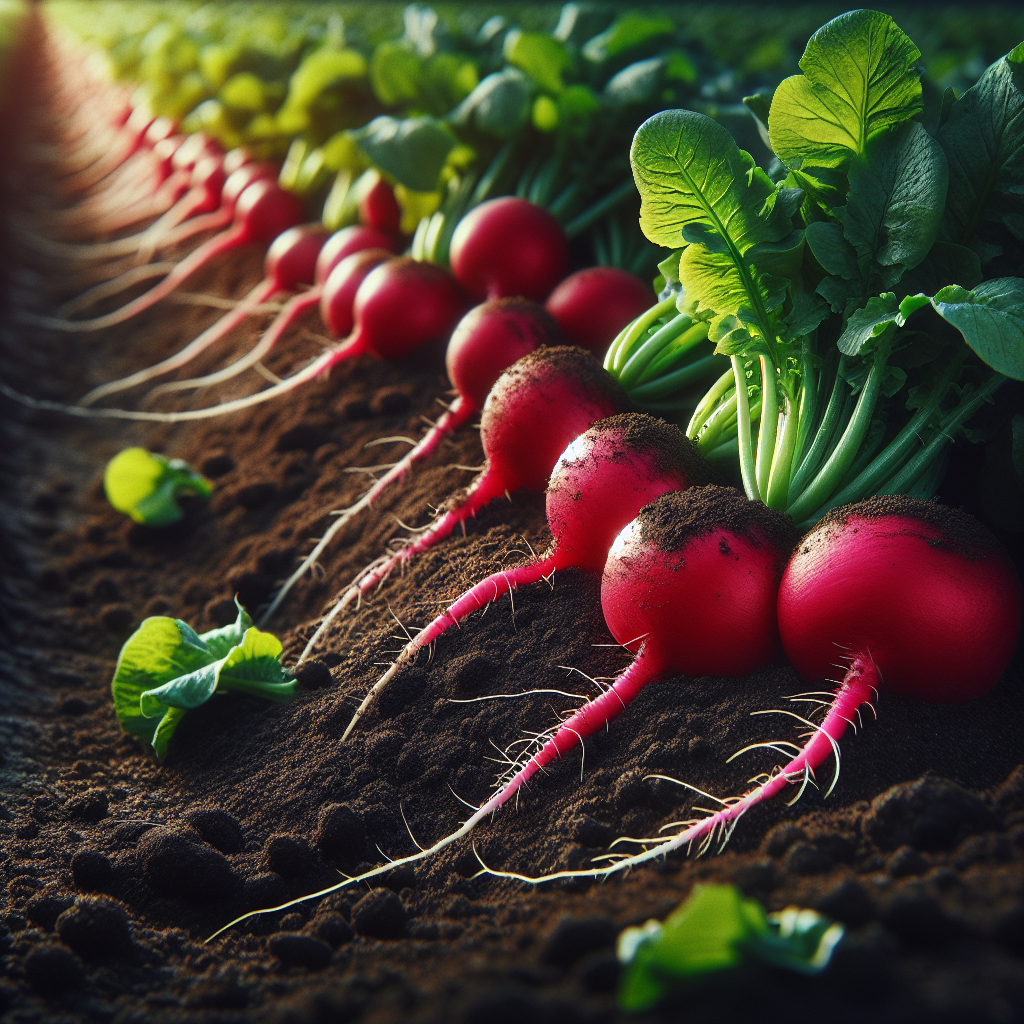
Introduction to Cherry Belle Radish
A classic spring radish, this variety has been widely grown for generations because it is fast, dependable, and highly marketable. It typically forms small, round to slightly top-shaped roots with smooth, vivid red skin and dense white flesh that stays crisp when grown under cool, even conditions. Compared with many heirloom radishes, it is valued for relatively uniform sizing and a mild-to-moderate pungency rather than extreme heat.
For growers, its greatest strength is speed. Under ideal conditions, roots can size up in about 22 to 30 days from sowing, which makes it an excellent crop for succession planting, intercropping, and filling short seasonal windows before warm-weather crops take over. Because the crop matures so quickly, small mistakes in watering, spacing, or fertility show up fast, but so do good practices.
Cherry Belle is especially useful in intensive beds, raised beds, tunnel edges, and market garden systems where quick turnover matters. It can also be used as an indicator crop for spring soil readiness: if it germinates evenly and bulks smoothly, conditions are usually favorable for many other cool-season vegetables. For a broader overview of radish culture, see Radish.
Botanical Profile of Cherry Belle Radish
This cultivar belongs to the Brassicaceae family, the same family as mustard, cabbage, and turnips. It is a selected form of Raphanus sativus, grown as an annual for its swollen hypocotyl-root structure. What most growers call the “radish root” is botanically a combination of upper root and hypocotyl tissue that enlarges in response to genetics and growing conditions.
Cherry Belle produces a compact rosette of medium green, slightly rough or lobed leaves. The foliage is edible when young, though older leaves can become bristly. Its growth habit is quick and concentrated: first, germination and cotyledon emergence; next, a brief juvenile leaf stage; then rapid root swelling if temperature, spacing, and soil texture are favorable.
This variety is typically harvested immature, before the plant shifts toward reproductive stress. If exposed to prolonged heat, long days, crowding, or interrupted moisture, it may bolt, sending up a flower stalk. Once that reproductive transition begins, root quality usually declines sharply. Flesh becomes pithy, texture turns spongy, and flavor becomes much hotter.
Morphologically, Cherry Belle is known for:
- bright cherry-red skin
- round globe roots, usually 2.5 to 4 cm across at prime harvest
- white interior flesh with crisp texture
- short growing cycle
- moderate tops suited to bunching
Its flavor chemistry comes from glucosinolates and their breakdown products, especially isothiocyanates, which create the characteristic radish bite. In cool conditions with steady growth, the flavor is clean and mild. Under stress, especially heat and erratic watering, pungency intensifies.
Soil, pH, and Climate Requirements for Cherry Belle Radish
This crop performs best in loose, stone-free, well-drained soil with a fine tilth. The ideal texture is sandy loam to loamy soil rich in stable organic matter but not freshly manured. Heavy clay can produce misshapen, rough, or cracked roots because the enlarging tissue meets physical resistance and uneven moisture pockets. Fresh uncomposted manure or excessively rich nitrogen sources often stimulate leafy growth at the expense of root formation.
A preferred soil pH is 6.0 to 7.0, with 6.3 to 6.8 often giving especially reliable performance. Below pH 5.8, nutrient availability becomes less balanced and Clubroot risk in brassicas can increase in infested soils. Above pH 7.2, micronutrient tie-up may appear, especially on calcareous soils, though radishes generally tolerate slightly alkaline conditions better than many vegetables.
The seedbed should be prepared deeply enough that the top 10 to 15 cm is friable and free of clods. For market-grade roots, the upper profile matters more than deep rooting depth, because the swelling portion forms near the surface. Remove stones, break crust-prone aggregates, and rake to a level finish so seed can be placed shallowly but in firm contact with moist soil.
Temperature is critical. Optimum germination occurs around 10 to 24°C, with seed often emerging in 3 to 7 days depending on soil warmth and moisture. Best root quality develops in cool weather, generally 8 to 18°C. When daytime temperatures consistently exceed 24°C, especially with warm nights, root swelling slows, pungency increases, and bolting risk rises.
In practical terms, the crop prefers:
- full sun in cool seasons
- light afternoon shade in warm spring regions
- cool soil temperatures
- uninterrupted moisture
- high airflow to keep foliage dry and vigorous
Soil moisture should remain consistently in the moderate range, roughly equivalent to 60 to 80% of field capacity in the top root zone. For growers not measuring moisture formally, the bed should feel cool and slightly moist 2 to 5 cm below the surface, never dusty-dry and never sticky-saturated. If squeezed by hand, soil should hold shape briefly then crumble with a light touch.
Overwatering signs include yellowing lower leaves, slowed growth despite wet soil, algae or moss on the bed surface, shallow rooting, and roots that split after rapid water uptake. Underwatering signs include delayed germination, strong heat or bitterness, elongated rather than rounded roots, and woody or pithy interiors.
Because this is a cool-season crop, spring and autumn are the primary production windows in temperate climates. In mild winter climates, it can be grown through much of the cool season. In hot climates, it is often best as a short-cycle crop in the coolest available months.
Step-by-Step Planting & Propagation
Propagation is by seed only. Transplanting is not recommended because disturbance to the taproot axis commonly results in malformed roots, stunting, or failure to bulb properly.
Prepare a fine, level seedbed. Work composted organic matter into the soil well before sowing if needed, but avoid making the bed excessively rich. A modestly fertile, crumbly bed is better than a heavily manured one.
Pre-irrigate if conditions are dry. Moisten the bed before sowing so seed is placed into uniformly damp soil rather than watered heavily after seeding, which can crust the surface.
Sow shallowly. Plant seeds 0.6 to 1.25 cm deep. In cool, heavy soils, stay shallower; in lighter sandy soils or drying conditions, sow slightly deeper. Seed planted too deep often emerges unevenly and produces variable stands.
Space for target root size. For standard bunching roots, sow in rows 15 to 20 cm apart, then thin seedlings to 2.5 to 5 cm apart. Closer spacing yields smaller, quicker roots; wider spacing yields larger roots but increases the chance of overmaturity if harvest is delayed. In intensive beds, broad-sow in bands or blocks with final spacing around 4 cm between plants.
Thin early. Thin when seedlings have developed their first true leaf. Delayed thinning is one of the main causes of narrow, elongated, or undersized roots because crowded seedlings compete before the swelling stage begins.
Succession sow. To maintain continuous harvest, sow every 7 to 10 days during suitable weather. Because Cherry Belle matures rapidly, staggered sowing prevents a glut followed by a gap.
Protect emergence if Flea Beetles are common. Floating row cover applied immediately after sowing can protect young foliage from early shot-hole damage, provided the bed is weed-free and edges are sealed.
A useful production strategy is to sow Cherry Belle on the shoulders of slower crops such as Lettuce, harvesting radishes before the companion crop expands. This maximizes bed use in small spaces.
For growers planning cool-season successions, seasonal timing principles in this fall guide also align well with radish scheduling.
Care & Maintenance regimes for Cherry Belle Radish
This is an easy crop only when growth remains uninterrupted. Cherry Belle responds strongly to consistency: consistent spacing, consistent moisture, and consistent temperature produce the highest percentage of smooth, marketable roots.
Water management is the most important maintenance factor. Aim to keep the upper 10 cm of soil evenly moist throughout germination and root swelling. As a practical benchmark, most garden beds need about 2.5 cm of water per week in cool weather, but sandy soils, raised beds, and windy conditions may require lighter, more frequent irrigation. Rather than waiting for visible wilt, check soil daily during warm spells.
The crop should never swing between drought and flooding. A dry spell followed by heavy irrigation or rain commonly causes splitting because the outer tissues cannot expand evenly when internal water uptake surges. Small surface cracks near maturity are an early warning that irrigation has been irregular.
Fertility should be moderate. Excess nitrogen creates lush tops and poor root bulking. If soil is reasonably fertile, a light preplant application of balanced organic fertilizer is enough. A general target for productive garden soils is modest available nitrogen with sufficient phosphorus and potassium, especially if previous crops were heavy feeders. Avoid side-dressing with high-nitrogen materials once seedlings are established.
Weed control is essential in the first two weeks. Because Cherry Belle grows quickly and occupies shallow soil, even mild weed pressure can reduce size uniformity. Use a stirrup hoe or hand weeding while weeds are thread-stage small. Deep cultivation after roots begin swelling risks damage and misshaping.
Mulch is optional. In cool spring beds, bare fine soil often warms and germinates seed faster. In warmer conditions, a very light organic mulch between rows can reduce moisture swings, but keep it away from the seed line until seedlings are established.
If top growth is pale green despite adequate moisture, check for compaction, cold soil, or nutrient imbalance before adding fertilizer. If tops become overly large and roots remain small, the likely causes are too much nitrogen, excess shade, overcrowding, or high temperatures.
Common quality disorders and likely causes include:
- pithiness: harvest delayed, heat stress, erratic moisture
- cracking: sudden water uptake after dryness, overmaturity
- hairiness or rough roots: fresh manure, undecomposed organic matter, poor tilth
- misshapen roots: stones, compaction, transplant injury, crowding
- excessive pungency: heat, stress, slow growth
Pests, Diseases & Organic Management
Because Cherry Belle matures quickly, prevention is usually more effective than treatment. A clean seedbed, crop rotation, row covers, and consistent irrigation solve many problems before they begin.
The most common insect pests are Flea Beetles. These tiny jumping beetles chew numerous small holes in the leaves, especially in dry spring weather. Light feeding is usually cosmetic on a fast crop, but severe pressure can slow seedling growth enough to reduce root sizing. Organic management includes immediate post-sowing row cover, removal of brassica weeds, maintaining rapid growth, and avoiding planting next to overwintered brassicas that harbor adults.
Root Maggots can also be serious in some regions. Adult flies lay eggs at the base of seedlings; larvae feed on roots, causing tunnels, scarring, and decay. Use floating row covers from sowing, rotate away from brassica beds for at least 2 to 3 years where infestations are chronic, and remove crop residues promptly after harvest.
Aphids occasionally colonize foliage during mild weather. They are less damaging on a short-cycle radish crop than on long-season brassicas, but heavy populations can distort leaves and spread stress. Encourage beneficial insects, wash off colonies with water, and avoid excess nitrogen that produces overly soft growth.
Slugs may damage seedlings in damp beds with heavy mulch or debris. Reduce hiding places, water in the morning rather than evening, and use iron phosphate baits if necessary.
Disease pressure is usually environmental. Damping-off can kill seedlings in cold, wet, poorly aerated seedbeds. Prevent it with fresh seed, clean soil conditions, careful watering, and shallow sowing into a firm but not compacted bed.
Downy Mildew and Leaf Spots can appear in cool, humid conditions with dense canopies and poor airflow. Space correctly, water soil rather than leaves where possible, and avoid late-day overhead irrigation.
Clubroot, a soilborne brassica disease, causes swollen distorted roots and stunting in acidic infested soils. Prevention is the only practical approach: rotate crops, maintain pH near neutral if Clubroot is known locally, improve drainage, and avoid moving contaminated soil on tools or boots.
Organic prevention checklist:
- rotate out of brassicas for multiple seasons where disease or maggots occur
- use insect netting or row cover during vulnerable early growth
- maintain even moisture for vigorous, stress-resistant plants
- remove and compost healthy residues or discard diseased residues appropriately
- control brassica weeds that host pests and pathogens
- sanitize tools when moving between infected and clean beds
Harvesting, Curing & Optimal Storage
This crop should be harvested on time, not “when convenient.” Cherry Belle reaches best eating quality when roots are firm, brightly colored, and typically 2.5 to 4 cm across. Waiting even a few extra days in warm weather can move roots from ideal to pithy surprisingly fast.
Test harvest a few roots before pulling an entire bed. A prime root feels solid, snaps crisply when cut, and shows dense white flesh without hollow centers. Oversized roots often become woody, hotter, and less juicy.
Harvest in cool morning conditions if possible. Loosen soil lightly if needed, especially in heavier ground, to avoid tearing tops from roots. For bunching, wash gently and trim ragged roots while keeping tops attached if marketing quickly. For longer storage, remove tops to within 1 to 2 cm of the crown soon after harvest because leaves continue transpiring and pull moisture from the root.
Unlike onions, radishes are not cured in a warm, dry sense. Instead, they are hydro-cooled or quickly chilled after harvest to preserve crispness. Wash off soil, drain, and cool to near 0 to 2°C with very high relative humidity, ideally 95 to 100%. Under these conditions, topped roots may store for 2 to 4 weeks, sometimes longer if impeccably fresh and uninjured. With tops attached, storage life is much shorter.
At home scale, store in perforated plastic bags or lidded containers with a slightly damp towel to maintain humidity without free water accumulation. Do not store with ethylene-producing fruits in enclosed spaces for extended periods, as quality may decline more quickly.
Storage failure signs include:
- limp texture: low humidity or delayed cooling
- translucent flesh: chilling injury is rare at proper temperatures but can occur with freezing
- surface slime or odor: excess free moisture and bacterial breakdown
- internal sponginess: roots were already overmature before storage
If roots are harvested slightly large but still sound, use them promptly for roasting, pickling, or fermentation rather than long storage.
Companion Planting for Cherry Belle Radish
This variety works exceptionally well in mixed plantings because it matures before many neighboring crops need full space. The best companions are those that either share cool-season timing, help mask pest cues, or benefit from the quick occupancy of open soil.
Onion is one of the strongest companions because its pungent foliage can help diversify pest signals in mixed beds, and both crops occupy shallow to moderate root zones without heavy competition during the radish’s short life cycle. Peas also pair well, especially in spring, because the radishes can be harvested before pea vines cast significant shade. Spinach is another excellent match in tight cool-season beds, with similar moisture preferences and harvest windows.
A classic market-garden pattern is alternating short rows or bands of radish with salad greens. Radishes mark rows quickly, helping growers identify planted lines before slower seedlings emerge. They also make good edge crops beside trellised peas or around wider-spaced brassicas, provided Flea Beetles are monitored.
Avoid pairing with crops that will immediately shade the bed heavily or require frequent deep cultivation. Also be cautious about grouping too many brassicas together in areas with root maggot or flea beetle pressure, since concentrated host plantings can intensify infestation.
Good companion principles for this crop include:
- combine with fast cool-season greens
- use beside alliums for diversity in plant volatiles
- slot into spaces before long-season crops expand
- maintain airflow and harvest access so roots are not forgotten in mixed beds