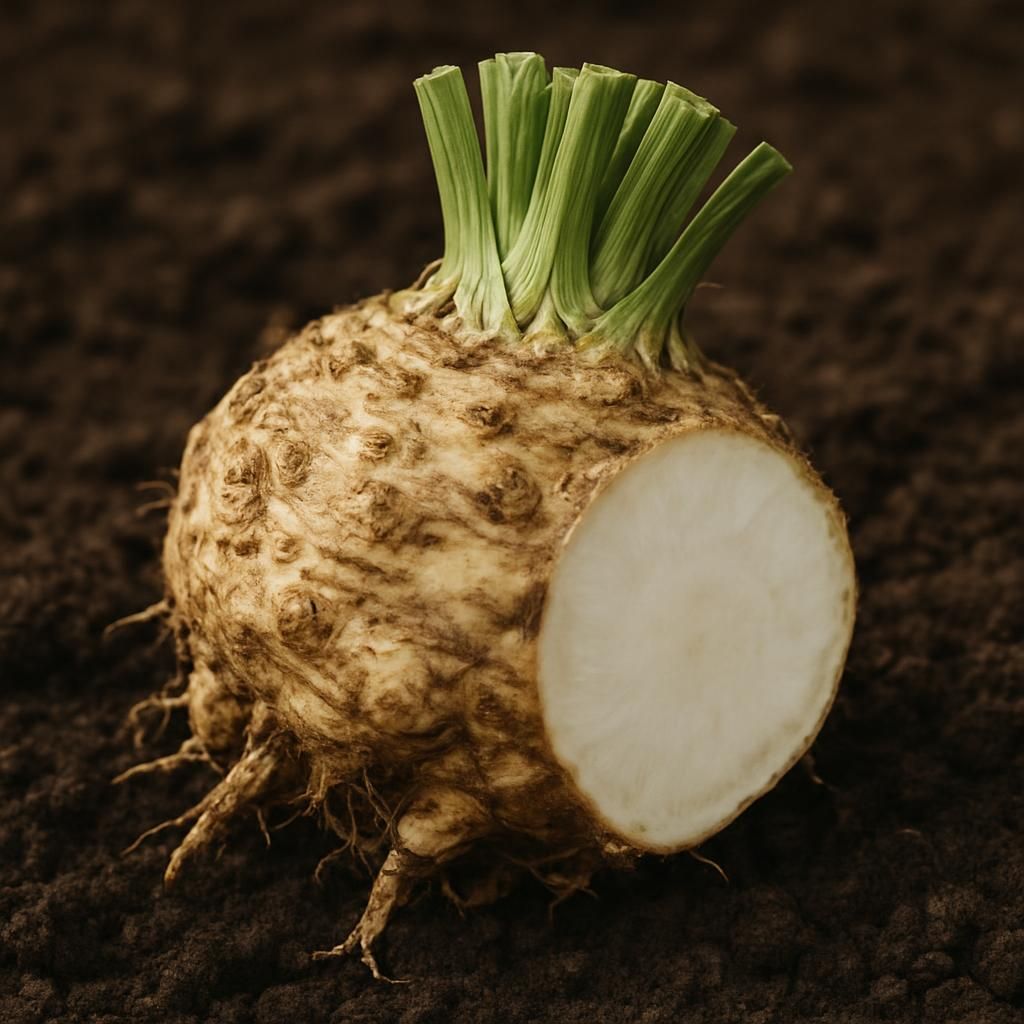
Introduction to Celeriac (Giant Prague)
Celeriac (Giant Prague), also known as turnip-rooted celery, is a biennial member of the Apiaceae family cultivated primarily for its swollen, flavorful root rather than its stalks. The variety "Giant Prague" is renowned for producing large, rounded hypocotyls that reach 4–6 inches in diameter at maturity while retaining a smooth, white interior with a mild celery-parsnip flavor. Gardeners and commercial growers value it for its exceptional storage life, versatility in soups, mashes, and gratins, and its ability to thrive in cool climates where many other root crops struggle.
Unlike standard celery, celeriac tolerates light frosts and can remain in the ground well into late autumn, making it a staple for winter kitchens. Its long growing season (typically 120–150 days from transplant) demands patience and precise cultural practices, but rewards growers with dense, aromatic roots that store for months in cool, humid conditions.
Botanical Profile of Celeriac (Giant Prague)
Celeriac (Giant Prague) develops a swollen, edible hypocotyl formed from the fusion of stem and root tissues. The plant produces a rosette of dark green, pinnately divided leaves supported by long, fibrous petioles. Flowers appear in the second year as compound umbels of tiny white blooms that attract beneficial insects. Seeds are small, oval, and ribbed, requiring light for germination.
The cultivar "Giant Prague" exhibits vigorous growth, resistance to bolting under moderate stress, and consistent root shape. Its root surface is moderately rough with shallow eyes, while the flesh remains crisp and aromatic even after prolonged storage.
Soil, pH, and Climate Requirements for Celeriac (Giant Prague)
Celeriac (Giant Prague) performs best in deep, fertile, moisture-retentive soils with excellent structure. Heavy clay soils should be amended with well-rotted compost or aged manure to improve drainage and aeration. Avoid fresh manure, which can cause forking or hairy roots.
| Parameter | Ideal Range | Notes |
|---|---|---|
| Soil Type | Loam to sandy loam | Deep, stone-free, well-drained |
| Soil pH | 6.0–7.0 | Slightly acidic to neutral |
| Soil Temperature | 50–65 °F (10–18 °C) | For transplanting and early growth |
| Air Temperature Range | 55–75 °F (13–24 °C) daytime | Cool-season crop; tolerates light frost |
| Spacing | 12–18 in (30–45 cm) between plants | Rows 24–30 in (60–75 cm) apart |
| Sun Exposure | Full sun (minimum 6–8 hours) | Partial shade acceptable in heat |
Step-by-Step Planting & Propagation
- Seed Starting (8–10 weeks before last frost): Sow seeds indoors in sterile seed-starting mix. Press lightly into the surface; do not cover as light is required for germination. Maintain 65–70 °F (18–21 °C) and consistent moisture. Germination occurs in 14–21 days.
- Hardening Off: Gradually acclimate seedlings to outdoor conditions over 7–10 days when they have 3–4 true leaves.
- Transplanting: Set plants outdoors after danger of hard frost has passed and soil has warmed to at least 50 °F (10 °C). Plant at the same depth as in the cell tray; avoid burying the crown.
- Direct Seeding Option: In mild climates, direct sow in early spring once soil reaches 50 °F. Thin seedlings to final spacing when they reach 3 inches tall.
- Row Configuration: Use 24–30 inch rows with 12–18 inch in-row spacing. Raised beds improve drainage and root development.
Care & Maintenance regimes for Celeriac (Giant Prague)
Consistent moisture and balanced fertility are critical. Mulch with 2–3 inches of straw or leaf mold to retain soil moisture, suppress weeds, and moderate temperature fluctuations. Side-dress with compost tea or a balanced organic fertilizer (5-5-5) at 4–6 week intervals.
| Growth Stage | Watering Frequency | Fertilizer Schedule | Pruning / Other Tasks |
|---|---|---|---|
| Seedling (0–4 wks) | Keep evenly moist; mist daily | None; rely on seed-starting nutrients | Thin to one seedling per cell |
| Vegetative (4–10 wks) | 1–1.5 inches per week; drip irrigation ideal | Side-dress with ½ cup compost per plant every 4 weeks | Remove lower leaves that yellow |
| Bulking (10–18 wks) | Maintain consistent moisture; avoid water stress | Apply fish emulsion or seaweed extract monthly | Hill soil around roots if exposed |
| Pre-Harvest (18+ wks) | Reduce slightly to firm roots | Cease nitrogen applications 4 weeks before harvest | Remove weeds; monitor for pests |
Pests, Diseases & Organic Management
Celeriac (Giant Prague) is susceptible to Aphids, carrot rust fly, cutworms, and slugs. Fungal issues include leaf spot diseases and root rot in poorly drained soils. Practice crop rotation of at least three years, use floating row covers during early growth, and encourage beneficial insects with flowering borders. Apply neem oil or insecticidal soap for aphids and hand-pick larger pests. Improve drainage and avoid overhead watering to reduce fungal pressure.
Harvesting, Curing & Optimal Storage
Harvest when roots reach 3–5 inches in diameter, typically 120–150 days after transplant. Lift carefully with a garden fork to avoid damage. Trim foliage to 1 inch above the crown. Cure by laying roots in a shaded, well-ventilated area for 2–3 days. Store at 32–40 °F (0–4 °C) with 90–95% humidity; roots keep 3–6 months in perforated plastic bags or damp sand. Smaller roots can be left in the ground under heavy mulch for winter harvest in mild climates.
Companion Planting for Celeriac (Giant Prague)
Celeriac (Giant Prague) pairs well with Onion, Leek, Lettuce, and Cabbage. These companions help deter pests and optimize space. Avoid planting near Corn or Potato to reduce shared pest and disease pressure. Aromatic herbs such as Thyme and Rosemary can mask the scent of celeriac foliage from carrot rust flies. For further insights on strategic pairings, see Summer Companion Planting: 10 Organic Pairings to Boost Small Farm Resilience.