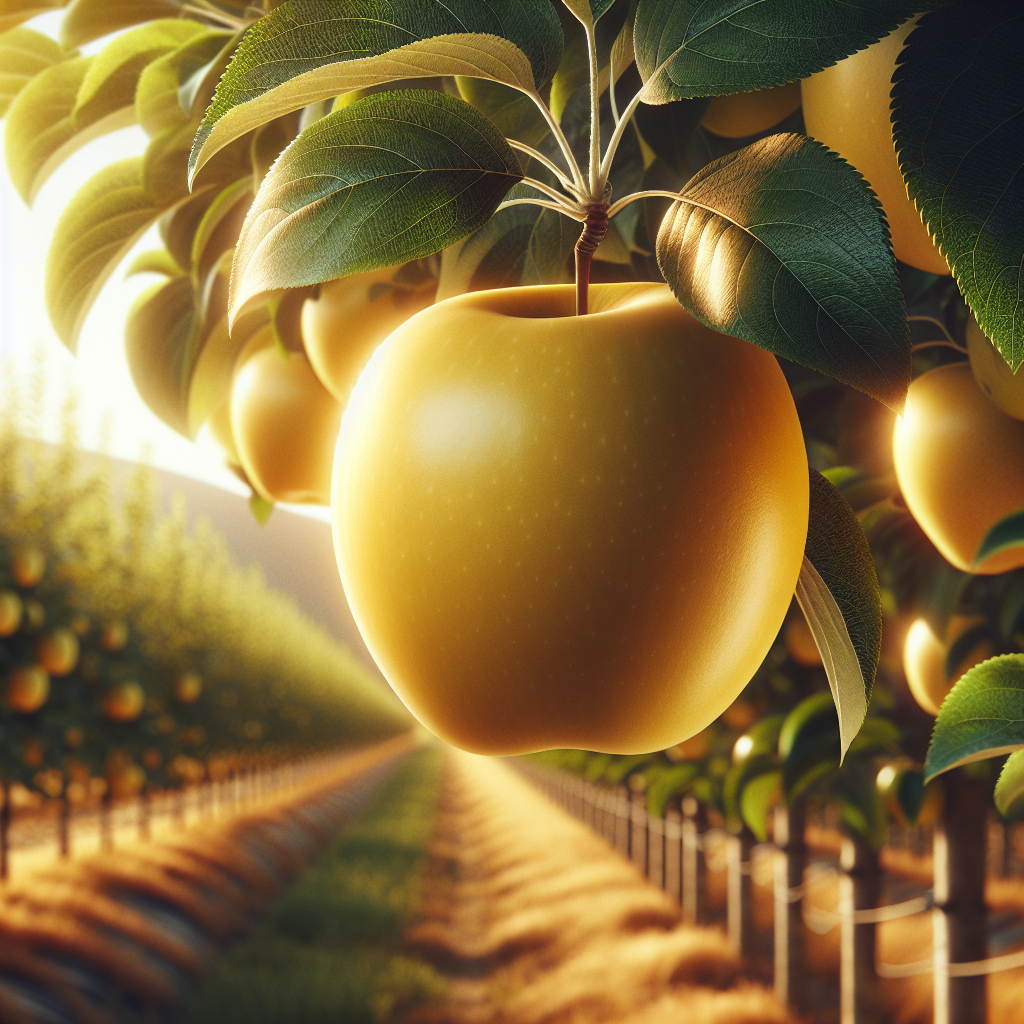
Introduction to Golden Delicious Apple
Discovered as a chance seedling in Clay County, West Virginia, in the late 19th to early 20th century, this cultivar became one of the most influential commercial apples in the world. It is not closely related to Red Delicious despite the shared marketing name, and growers value it for its sweet honeyed flavor, yellow skin, fine-textured flesh, and versatility in fresh markets, baking, juice, and breeding programs. Many modern apples carry Golden Delicious in their parentage because it contributes sweetness, productivity, and useful horticultural traits.
In the orchard, it is typically considered a dependable and moderately vigorous tree, but it is not a low-management variety. Fruit can russet under humid conditions, overcrop if not thinned, and become bland or mealy if harvested late or stored poorly. In many growing regions it is also an important pollen source and pollination partner for other cultivars. For general orchard context, see the broader Apple guide.
Botanical Profile of Golden Delicious Apple
This cultivar belongs to the rose family, Rosaceae, and like all domesticated apples it is a pome fruit. Trees are deciduous, forming flower buds on spurs and, to a lesser extent, on terminal growth depending on training and vigor. Golden Delicious is generally medium in vigor, with a spreading to somewhat upright-spreading habit depending on rootstock. On dwarfing rootstocks it can be maintained at 2 to 3.5 meters tall; on semi-dwarf rootstocks, 3.5 to 5 meters is common; on vigorous seedling rootstocks it can become substantially larger.
Leaves are oval to elliptic with serrated margins, medium green, and slightly pubescent when young. Blossoms emerge in spring as pink buds opening to white to pale pink flowers. Bloom time is generally mid-season, which makes it a useful pollinizer in many mixed orchards. Golden Delicious is not reliably self-fertile for commercial production, so cross-pollination from another compatible cultivar is strongly recommended.
Fruit is typically medium to large, round-conic, with smooth yellow skin that may show lenticels and occasional russeting, especially near the stem cavity. In cooler nights and adequate light, color develops more cleanly. Flesh is cream to pale yellow, crisp when properly harvested, juicy, and sweet with low to moderate acidity. If allowed to hang too long, fruit texture can soften quickly and aromatic complexity declines.
Botanically and agriculturally, one of the key traits of this cultivar is its tendency toward heavy set. That sounds beneficial, but unmanaged heavy cropping often leads to small fruit, limb stress, biennial bearing, and reduced flower bud initiation for the following season. Spur management and fruit thinning are therefore central to professional production.
Soil, pH, and Climate Requirements for Golden Delicious Apple
This cultivar performs best in deep, well-drained loam or sandy loam with good organic matter and moderate water-holding capacity. Ideal rooting depth is at least 1 to 1.5 meters, though many orchards succeed on shallower soils if drainage is excellent and irrigation is managed carefully. Avoid sites with a perched water table, heavy hardpan, or prolonged winter saturation. Apple roots require oxygen; when soil pore spaces stay filled with water, root respiration drops, feeder roots die back, and trees become weak, chlorotic, and disease-prone.
The preferred soil pH is 6.0 to 6.8, with 6.2 to 6.5 often ideal for balanced nutrient availability. Below pH 5.8, calcium, magnesium, and phosphorus availability may decline while manganese or aluminum toxicity risk rises. Above pH 7.2, iron, zinc, and manganese deficiencies become more likely, especially on calcareous soils. If soil tests show low calcium, correct before planting where possible, because calcium is essential for fruit firmness and storage quality.
Golden Delicious needs a temperate climate with adequate winter chilling to break dormancy evenly. Depending on site and model used, roughly 600 to 800 chilling hours is a reasonable target. It is more adaptable than some high-color cultivars, but fruit quality is best where summers are warm without extreme heat and nights cool enough to preserve texture and flavor. Excessive summer heat can cause sunburn, reduced firmness, and pale skin. In hot inland valleys, afternoon temperatures consistently above 35 to 38 degrees C can stress trees, especially on exposed western canopy faces.
Late spring frost is a major risk because flowers and young fruitlets are vulnerable. At pink and bloom stages, even brief subzero events can destroy a crop. Choose elevated sites with air drainage rather than frost pockets. North-facing or slightly sloped sites may delay bloom just enough to reduce frost risk in marginal regions.
Rainfall around bloom can sharply increase disease pressure from scab, powdery mildew, and fire blight. Dry climates ease disease management but require careful irrigation. Wind exposure should also be considered; strong wind can scar fruit, reduce bee activity during bloom, and physically stress trellised systems.
For new orchard blocks, review pre-plant soil preparation and cover crop strategies in soil health tips.
Step-by-Step Planting & Propagation
Commercial and serious home growers almost always establish this cultivar as a grafted tree rather than from seed. Seed propagation does not come true to type, and resulting trees are highly variable in vigor, fruit quality, and bearing age. Buy certified disease-free nursery trees grafted onto rootstocks suited to your soil, climate, and training system.
Choose rootstock first. Dwarf rootstocks such as M.9 are ideal for high-density systems with support, early bearing, and easy harvest, but they require irrigation and staking. Semi-dwarf stocks such as M.26 or MM.106 provide more anchorage and moderate vigor, though site-specific disease susceptibilities matter. For replant sites, consult local extension or nursery guidance because rootstock choice can determine long-term orchard success.
Prepare the site 6 to 12 months before planting if possible. Conduct a complete soil test for pH, organic matter, phosphorus, potassium, calcium, magnesium, and micronutrients. Remove perennial weeds thoroughly, especially bindweed, bermudagrass, and quackgrass, because early competition reduces establishment dramatically. Deep rip compacted layers if subsoil conditions allow.
Plant while trees are dormant, usually late winter to early spring in cold climates and during the coolest dormant period in milder regions. Bare-root trees should be planted before buds open. Keep roots moist and shaded until planting; never let them dry out.
Planting steps:
- Dig a hole wide enough to spread roots naturally, usually 2 to 3 times the root spread, but do not dig unnecessarily deep.
- Identify the graft union and keep it 5 to 10 cm above final soil level, higher on dwarf rootstocks to prevent scion rooting.
- Trim broken roots cleanly, but avoid excessive root pruning.
- Backfill with native soil rather than a rich amended pocket, which can discourage outward root exploration.
- Water thoroughly to settle soil and eliminate air pockets.
- Install stakes or trellis immediately for dwarf systems.
- Apply mulch 5 to 8 cm deep in a wide ring, keeping it 10 to 15 cm away from the trunk to prevent crown rot and rodent damage.
Spacing depends on rootstock and training. High-density spindle systems may use 0.9 to 1.5 meters within rows and 3 to 4 meters between rows. Semi-dwarf trees may need 3.5 to 5 meters in-row and 5 to 6 meters between rows. Overcrowding reduces light interception, increases humidity, and degrades color and bud formation.
At planting, head the leader according to the training system and nursery tree type. Remove damaged branches, but avoid over-pruning young trees because too much pruning stimulates vegetative growth at the expense of early fruiting.
Propagation by bench grafting or whip-and-tongue grafting is entirely possible for experienced growers. Dormant scionwood collected in winter is grafted onto compatible rootstock before active spring growth. However, because virus status and rootstock performance are critical, purchased certified trees are usually safer and more economical.
Care & Maintenance regimes for Golden Delicious Apple
Water management is one of the most important determinants of establishment, fruit size, and storage quality. Young trees generally need consistent soil moisture in the top 30 to 45 cm during the first two seasons. A useful target is moist but aerated soil, not saturated soil. In practical terms, the root zone should feel cool and slightly damp when squeezed, but not release free water or smell anaerobic. Drip irrigation is preferred because it keeps foliage dry and delivers precise moisture.
For young trees, 10 to 20 liters per irrigation event may be sufficient at first, increasing with canopy size, soil type, and weather. Mature bearing trees often require the equivalent of 25 to 40 mm of water per week during active growth, more during hot, dry, windy conditions and less on heavy soils or during cool weather. Moisture stress from petal fall through cell expansion causes smaller fruit and reduces return bloom. Severe late-season drought can also reduce calcium movement into fruit.
Signs of under-watering include dull or curling leaves, shoot tip slowdown, premature fruit drop, and small fruit. Signs of overwatering include persistently wet soil, yellowing leaves despite adequate fertility, poor shoot extension, root disease, and a sour smell in the root zone. Waterlogged trees often look nutrient deficient because damaged roots cannot absorb nutrients effectively.
Fertilization should always begin with a soil and leaf analysis program. Young non-bearing trees need nitrogen to build canopy, but excessive nitrogen creates lush, disease-prone growth and delays fruiting. Bearing trees need balanced nutrition with special attention to nitrogen, potassium, calcium, boron, zinc, and magnesium depending on test results. As a rough framework, nitrogen is often split between pre-bloom and early summer rather than applied heavily at once. Avoid late-season nitrogen that pushes tender growth vulnerable to winter injury and fire blight.
Training and pruning are essential. Golden Delicious responds well to central leader, tall spindle, and related systems that maximize light distribution. In the first years, establish a clear leader and well-spaced lateral branches with wide crotch angles. Branch spreaders or tying can help reduce vigor and encourage fruiting wood. In mature trees, annual dormant pruning should remove dead, diseased, crossing, and overly shaded wood. Summer pruning can improve light penetration and color but should be conservative in hot climates to avoid sunburn.
Thinning is especially important for this variety because it sets heavily. Begin with blossom thinning where practiced, then fruit thinning at 10 to 18 mm fruitlet size. Aim for one fruit per cluster and about 15 to 20 cm between fruits along a branch, adjusted for tree vigor and target fruit size. Proper thinning improves size, sugar accumulation, return bloom, and reduces limb breakage.
Pollination must be planned intentionally. Since bloom is mid-season, nearby compatible cultivars with overlapping flowering are needed, along with strong bee activity. Place bee hives in larger orchards if wild pollinator activity is insufficient. Avoid insecticide applications during bloom.
Weed control around the tree row is crucial for the first several years. Keep a vegetation-free strip under the canopy, especially around dwarf rootstocks with limited root competition tolerance. Grass alleys between rows are fine, but avoid sod right up to the trunk.
Pests, Diseases & Organic Management
Golden Delicious is productive but not especially trouble-free. In humid regions, apple scab is often the primary fungal concern. It causes olive-brown lesions on leaves and fruit, leading to cracking, defoliation, and market loss. Sanitation helps: shred or compost fallen leaves thoroughly, prune for airflow, and maintain an open canopy. Organic programs commonly rely on sulfur or lime sulfur timed to infection periods, though local conditions and regulations matter.
powdery mildew can infect young shoots, leaves, and blossoms, especially where air circulation is poor and vigor is excessive. Remove infected shoot tips during pruning and avoid over-fertilizing with nitrogen. fire blight is a major bacterial threat in warm, wet bloom periods. Symptoms include blackened blossom clusters, shepherd's-crook shoot tips, and cankers. Prune infected wood well below visible symptoms during dry weather, sanitize tools, and avoid stimulating lush succulent growth. Highly vigorous young trees are especially vulnerable.
cedar apple rust may be serious where junipers are nearby. Fruit rots such as bitter rot and black rot increase with poor sanitation and wounded fruit. Good orchard hygiene matters: remove mummies, cankered wood, and dropped fruit.
Insect pests vary by region but commonly include codling moth, apple maggot, aphids, leafrollers, mites, scale insects, and plum curculio. codling moth larvae tunnel into fruit, leaving frass at entry points. Organic control usually combines sanitation, pheromone traps for monitoring, mating disruption in larger blocks, and kaolin clay or approved biopesticides timed precisely to hatch periods. apple maggot causes internal tunneling and dimpling; sticky sphere traps and sanitation help reduce pressure. aphids can curl foliage and produce honeydew; beneficial insects often suppress them if broad-spectrum sprays are avoided.
Organic management works best as an integrated system rather than a single spray solution. Key practices include:
- Planting in full sun with good air movement.
- Annual pruning for spray penetration and rapid drying.
- Accurate monitoring with traps and regular scouting.
- Removing fallen or infested fruit weekly during the season.
- Encouraging beneficial insects with flowering margins and low-disruption products.
- Maintaining balanced fertility to avoid overly soft, pest-attractive growth.
Trunk protection is often overlooked. Young trees can suffer from sunscald, vole damage, rabbit gnawing, and borer injury. Use trunk guards in winter, but inspect them regularly so they do not trap moisture or insects.
Harvesting, Curing & Optimal Storage
Golden Delicious should be harvested by maturity indices, not just by external color. Skin changes from greenish-yellow to richer yellow, starch converts to sugars, seeds darken, and flesh pressure declines. Because this cultivar can become mealy if left too long, timely harvest is critical. Fruit intended for long storage is usually picked slightly earlier than fruit for immediate fresh eating.
Professional indicators include starch-iodine index, firmness tests, soluble solids, seed color, ease of separation from the spur, and background color. For home growers, the best signs are a shift away from green background, a sweeter aroma, brown seeds in most fruit, and apples lifting off the spur with an upward twist rather than requiring force.
Harvest gently by cupping the fruit, lifting, and rolling slightly without pulling hard. Keep stems attached when possible, since stemless apples store poorly and are more prone to decay. Do not stack fruit deeply in field bins if bruising is likely.
Unlike onions, apples are not cured in the same sense, but they do benefit from prompt sorting and cooling. Remove bruised, insect-damaged, cracked, or diseased fruit immediately. Sound fruit should be cooled as quickly as possible after harvest. Ideal storage conditions are about 0 to 1 degree C with 90 to 95 percent relative humidity. Under these conditions, Golden Delicious can store for several months, though exact life depends on harvest stage, calcium status, and handling.
If humidity is too low, fruit shrivels. If temperatures fluctuate, condensation encourages decay. If fruit is stored too warm, softening accelerates. Controlled atmosphere storage extends life significantly in commercial systems, but for small growers a dedicated cold room or refrigerator is the best option.
Watch for storage disorders such as bitter pit, shrivel, superficial scald in some conditions, and senescent breakdown from overmature harvest. Bitter pit is strongly associated with calcium imbalance, excessive vigor, irregular watering, and large fruit. Foliar calcium sprays during the growing season are commonly used where bitter pit risk is known.
Companion Planting for Golden Delicious Apple
Companion planting around apple trees works best when it supports pollination, beneficial insects, weed suppression, and soil biology without creating excessive root competition or dense humid vegetation near the trunk. The best companions are usually low-growing, non-invasive species placed in rings or strips beyond the immediate trunk zone.
Chives are excellent near apple trees because their sulfurous scent may help confuse some pests, and their spring flowers attract pollinators and beneficial insects. Garlic can serve a similar role and is often used in orchard guilds, though it should not be crowded tightly against young trunks. Clover is one of the most useful orchard floor companions because it fixes nitrogen, feeds pollinators, and protects soil from erosion when managed as a living mulch. Yarrow is valued for attracting parasitoid wasps, hoverflies, and predatory insects while tolerating orchard conditions well.
Keep the first 30 to 60 cm around the trunk clear of dense vegetation, especially on young or dwarf trees, to reduce competition and rodent habitat. Companion plants should be mowed or cut back before they set too much seed or create heavy humidity under the canopy. In commercial orchards, companion systems succeed when they are managed as part of the floor plan, not allowed to become a neglected weed patch.
Avoid aggressive grasses, tall brassicas that block airflow, or thirsty perennial species that compete strongly in dry climates. The goal is a biologically active orchard floor with open air, easy access, and minimal direct competition in the tree root zone.