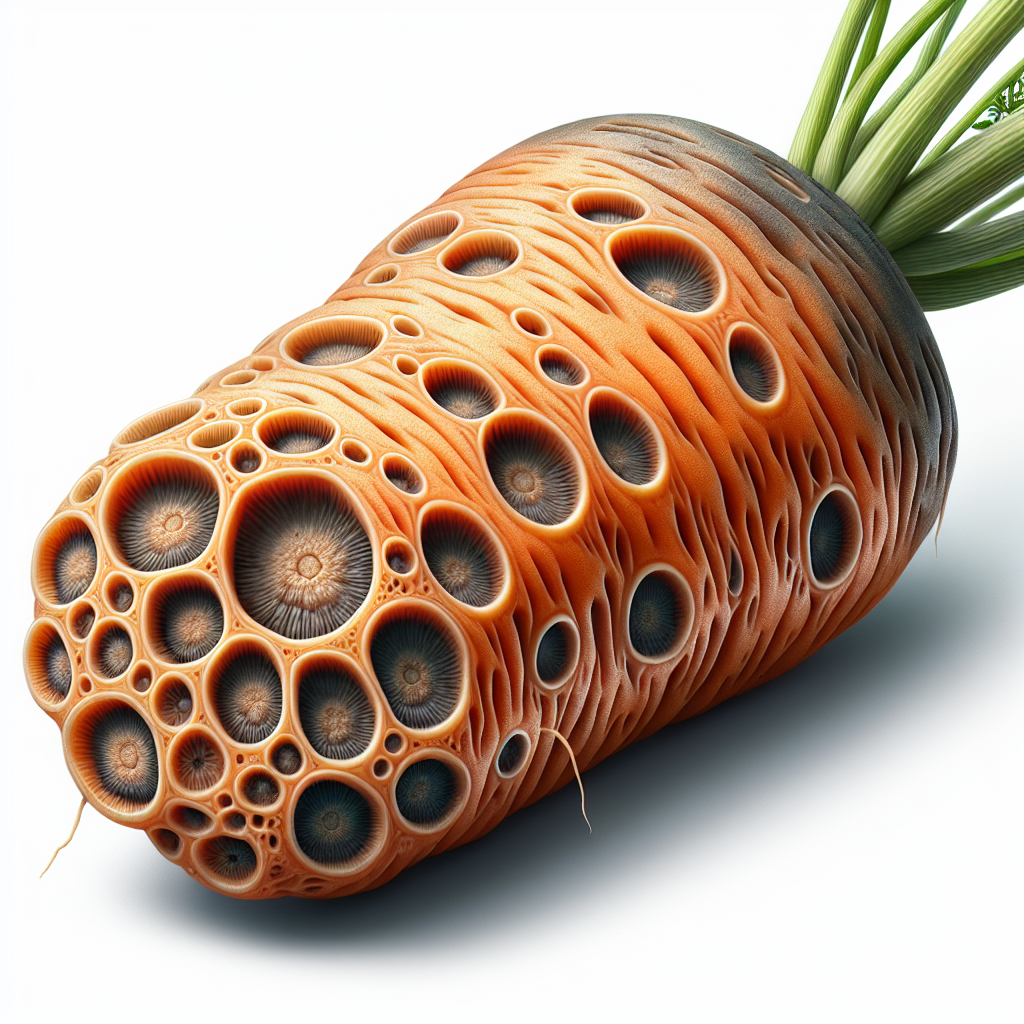
Introduction to Cavity spot
Cavity spot is a pervasive soilborne disease that strikes at the heart of root crop production, most notoriously impacting carrot crops worldwide. Caused primarily by the oomycete pathogens Pythium sulcatum and Pythium ultimum, this disorder manifests as small, sunken lesions on the roots, resembling cavities or pits that mar the otherwise smooth skin of mature roots. First identified in the early 20th century in Europe, cavity spot has since spread globally, affecting commercial fields, small farms, and home gardens alike.
The economic toll is substantial: in severe outbreaks, cavity spot can render up to 50-70% of marketable carrots un saleable due to their unsightly appearance, even though the roots remain edible. Beyond carrots, it threatens parsnip, parsley, celery, and occasionally potato crops. Unlike many foliar diseases, cavity spot develops underground, making early detection challenging and emphasizing the need for proactive soil management.
Farmers often confuse cavity spot with abiotic disorders like growth cracks or root-knot nematodes, but its distinct oval lesions and association with wet conditions set it apart. This guide provides definitive diagnostic criteria, lifecycle insights, and proven organic strategies to diagnose, manage, and prevent cavity spot. By understanding its biology and triggers, growers can protect yields and maintain premium market quality. For small farms optimizing every acre, mastering cavity spot control is essential—check out this Soil Health Mastery blog post for integrated approaches.
Identifying Symptoms & Damage
Early detection of cavity spot hinges on recognizing subtle initial signs before they escalate into widespread damage. Symptoms typically emerge 4-8 weeks after planting, starting as small, water-soaked spots on the upper root or lower stem, just below the soil line. These lesions are initially 2-5 mm in diameter, lens-shaped or oval, with smooth, sunken margins and a light brown to gray center.
As the disease progresses, lesions coalesce, enlarging to 10-20 mm or more, forming characteristic 'cavities' that give the disease its name. Affected tissue sloughs off, creating pitted depressions up to 1 cm deep. In advanced cases, roots exhibit multiple cavities scattered irregularly, often concentrated on the side exposed to compacted soil. Severely infected roots may fork, crack, or develop secondary rot, but internal flesh usually remains firm and healthy—no blackening or soft rot like root rot.
Damage assessment reveals cavity spot's cosmetic devastation: even minor pitting disqualifies roots from fresh market standards, slashing grades by 30-80%. Yield losses stem not from plant death but from unmarketable produce. Stunting occurs in heavy infections, with plants showing yellowing foliage and wilting due to girdling lesions on petioles or crowns.
Differential diagnosis is crucial. Distinguish from Phytophthora rot (darker, irregular lesions with zoospore mats) or mechanical damage (jagged edges). Lab confirmation involves plating root sections on selective media to isolate Pythium. Scout fields at thinning or early harvest, digging sample roots from wetter zones. For visual guides, compare with Pythium symptoms in related crops like onion.
Lifecycle and Progression of Cavity spot
Cavity spot's lifecycle revolves around resilient oospores in soil, enabling long-term survival without a host. Pythium spp. thrive as soil saprophytes, producing thick-walled oospores that persist for years in organic debris, cysts, or encysted zoospores. Under favorable conditions—cool, wet soils (15-20°C)—oospores germinate, releasing biflagellate zoospores that swim to root hairs or wounds.
Infection occurs via epidermal penetration, colonizing cortical tissues without vascular invasion. Lesions form within 48-72 hours post-infection, expanding via mycelial growth and repeated zoospore release. Disease progression peaks during rapid root elongation (spring/early summer), slowing in hot, dry conditions. Sporangia form in saturated soils, perpetuating the cycle.
A single infection cycle spans 7-14 days, with polycyclic epidemics in prolonged wet weather. Overwintering structures ensure inoculum buildup, exacerbated by short rotations. In carrots, primary infections hit 4-6 leaf stage plants, secondary spread via splashing or tools. Understanding this progression underscores prevention: disrupt oospore banks before planting.
Environmental Triggers & Risk Factors
Cavity spot epidemics correlate tightly with environmental stressors, primarily soil moisture and compaction. Pathogens activate in soils holding >20% moisture at 55-65°F (13-18°C), optimal for zoospore motility. Over-irrigation, poor drainage, or heavy rains create anaerobic pockets ideal for Pythium.
Soil compaction from machinery, tight rotations, or clay textures restricts root aeration, stressing plants and favoring infection. Low calcium exacerbates susceptibility—carrots need >1,000 ppm exchangeable Ca; deficiencies cause cortical cracking, entry courts for pathogens. High organic matter (>3%) fuels saprophytic growth, while pH 6.0-7.0 suits Pythium.
Risk spikes after clover or grass cover crops, which boost soil moisture retention. Continuous carrot monoculture amplifies inoculum. Assess fields with penetrometers (resistance >300 psi risky) and tension meters. Mitigate via raised beds, cover cropping with mustard biofumigants, and gypsum for Ca.
Organic Control & Treatment Plans
Organic management targets the Pythium lifecycle holistically, integrating cultural, biological, and physical tactics. No curative fungicides exist organically, so focus on suppression.
Cultural Controls: Rotate out of Apiaceae for 3-4 years with brassicas or grains to starve oospores. Improve drainage with 12-18 inch raised beds, incorporating 20-30 tons/acre compost for structure. Apply gypsum (2-5 tons/acre) pre-plant to boost Ca, confirmed by soil tests. Avoid overwatering—maintain -10 to -20 kPa tension.
Biological Controls: Seed-treat with Trichoderma virens or Bacillus subtilis (OMRI-listed products like RootShield or Serenade). Drench at planting with Streptomyces lydicus (Actinovate). Incorporate compost teas with lactic acid bacteria weekly. Mustard green manures release biofumigants suppressing Pythium.
Physical/Resistance Tactics: Use resistant varieties like 'Cellobunch' or 'Nelson'. Solarize soil 4-6 weeks pre-plant (clear plastic, 50-60°C kills oospores). Flame weeding or steam sterilization for high-value beds.
Integrated Plan: Year 1: Rotate + solarize. Plant + bio drench. Scout biweekly, rogue infected plants. Year 2+: Monitor Ca, rotate strictly. Expect 70-90% control with compliance. Combine with spring pest patrol strategies for root protection.
Preventing Cavity spot in the Future
Long-term prevention builds resilient agroecosystems. Implement 4-year rotations: Year 1 non-hosts (e.g., lettuce, grains), Year 2 brassicas, Year 3 legumes, Year 4 carrots. Test soil annually for Ca, pH, compaction.
Enhance biology with mycorrhizal inoculants and cover crops like tillage radish to fracture compaction. Precision irrigation (drip) minimizes wet spots. Mulch with straw post-harvest to suppress splash dispersal. Clean equipment to prevent movement.
Farm plans should include cavity spot risk mapping—GIS overlay moisture, texture, history. Educate crews on hygiene. Track progress: aim <5% incidence. Sustainable prevention yields ROI, as detailed in Soil Health Mastery.
Crops Most Affected by Cavity spot
Carrots top the list, with 80-100% infection rates in susceptible fields—varieties like 'Nantes' hit hardest. Parsnips suffer similar pitting, often more severe due to deeper roots. Celery shows petiole lesions, reducing bunch quality. Parsley roots pit, affecting culinary markets.
Secondary hosts include potato (minor stem cankers), beet (rare surface spots), and turnip. Focus vigilance on Apiaceae family. In mixed rotations, isolate carrots from celery blocks.