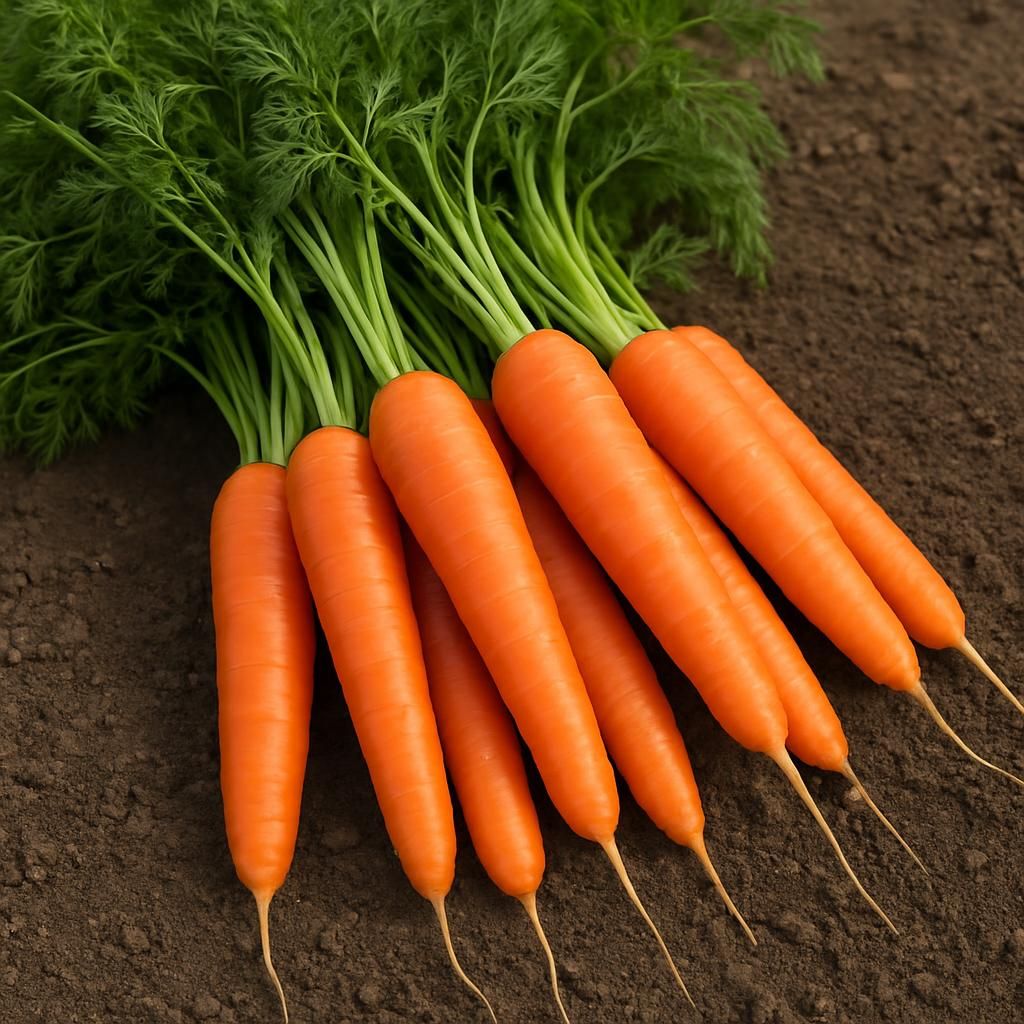
Introduction to Carrot (Scarlet Nantes)
Scarlet Nantes is one of the most popular carrot varieties worldwide due to its reliable germination, tender texture, and sweet flavor profile. This early-maturing cultivar typically reaches harvest readiness in 60–70 days, making it an excellent choice for succession planting and short-season climates. Its bright orange, blunt-tipped roots average 5–7 inches in length and maintain excellent internal color with minimal core development. Because of its adaptability and market appeal, Scarlet Nantes remains a staple for both fresh-market sales and home consumption.
Botanical Profile of Carrot (Scarlet Nantes)
Carrot (Scarlet Nantes) belongs to the Apiaceae family and is a biennial plant cultivated as an annual for its edible taproot. The variety produces smooth, cylindrical roots with minimal tapering and a small, indistinct core. Foliage consists of feathery, deeply divided leaves that form a moderate canopy, typically reaching 10–14 inches in height. Flowers, when allowed to develop in the second year, form compound umbels of small white blooms that attract beneficial pollinators.
Soil, pH, and Climate Requirements for Carrot (Scarlet Nantes)
Carrot (Scarlet Nantes) demands loose, well-drained soil free of stones and compaction to produce straight, uniform roots. The variety performs best in full sun with consistent moisture and cool temperatures. Ideal growing conditions are summarized below:
| Parameter | Ideal Range | Notes |
|---|---|---|
| Soil Type | Sandy loam to loam | Avoid heavy clay; incorporate organic matter |
| Soil pH | 6.0–6.8 | Slightly acidic to neutral; lime if below 5.8 |
| Soil Temperature | 45–85 °F (7–29 °C) | Optimal germination 55–75 °F (13–24 °C) |
| Air Temperature | 55–75 °F (13–24 °C) | Cool-season crop; tolerates light frost |
| Spacing | 2–3 inches between plants | Rows 12–18 inches apart |
| Depth | ¼–½ inch | Sow shallow; keep seedbed moist |
Step-by-Step Planting & Propagation
- Prepare the bed by removing stones and breaking up any compacted layers to at least 12 inches deep.
- Sow seeds directly ¼–½ inch deep in moist soil when temperatures reach 55 °F (13 °C).
- Thin seedlings to 2–3 inches apart once they reach 2 inches tall to prevent crowding.
- Maintain even moisture during the 7–14 day germination period; avoid letting the surface crust.
- For continuous harvest, sow new rows every 2–3 weeks until 8–10 weeks before the first expected frost.
Care & Maintenance regimes for Carrot (Scarlet Nantes)
Consistent moisture and balanced nutrition are critical for root quality. The following schedule provides a professional framework:
| Growth Stage | Watering Schedule | Fertilizer Application | Pruning / Thinning |
|---|---|---|---|
| Germination (0–14 days) | Light daily misting to keep surface moist | None; pre-plant compost only | None |
| Seedling (2–4 weeks) | 1 inch per week; avoid waterlogging | Side-dress with low-nitrogen compost tea | Thin to 2–3 inches |
| Vegetative (4–8 weeks) | 1–1.5 inches per week | Light potassium-rich organic fertilizer at week 6 | Remove any competing weeds |
| Root Bulking (8+ weeks) | Maintain even moisture | Cease nitrogen; use compost tea only if deficiency appears | No pruning required |
Mulch lightly with clean straw after thinning to conserve moisture and suppress weeds. Avoid high-nitrogen fertilizers that promote excessive foliage at the expense of root development.
Pests, Diseases & Organic Management
Common pests include carrot rust fly, wireworms, and aphids. Diseases such as Alternaria leaf spot and root rot can reduce quality. Use floating row covers immediately after sowing to exclude carrot rust fly. Rotate crops on a 3-year cycle and incorporate well-aged compost to suppress soil-borne pathogens. Beneficial nematodes and diatomaceous earth provide additional organic control options.
Harvesting, Curing & Optimal Storage
Harvest when roots reach ½–¾ inch diameter at the shoulder for peak sweetness. Loosen soil with a fork and pull gently to avoid breakage. Remove tops immediately, leaving ½ inch of stem, and rinse lightly. Cure at 32–40 °F (0–4 °C) with 95 % humidity for 4–6 hours to reduce field heat. Store in perforated plastic bags or moist sand at 32–38 °F (0–3 °C) for up to 4–6 months.
Companion Planting for Carrot (Scarlet Nantes)
Carrot (Scarlet Nantes) pairs well with onion, leek, and radish to deter pests. Avoid planting near dill or parsley as they may cross-attract carrot rust fly. Interplant with lettuce or spinach for efficient space use and soil shading. Tomato and cucumber also make compatible neighbors in mixed beds.