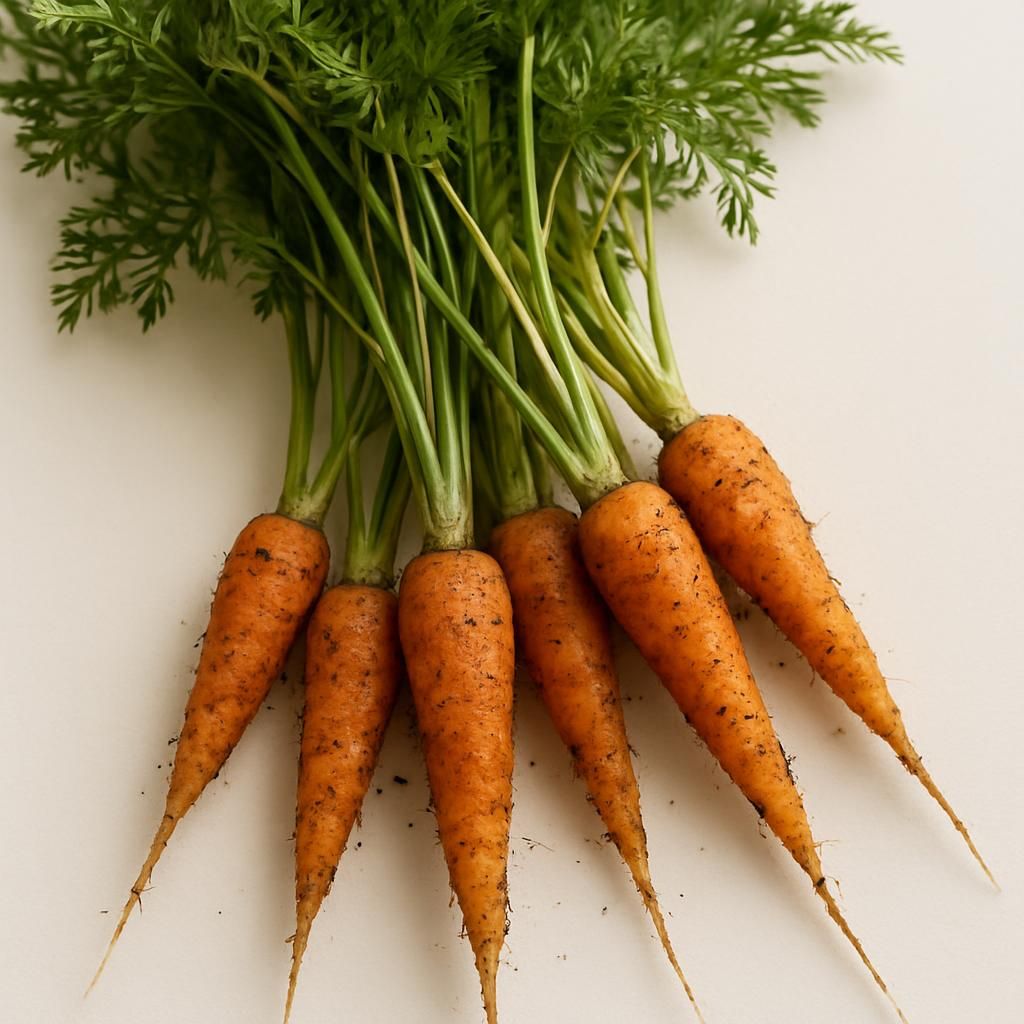
Introduction to Carrot (Little Finger)
Little Finger is a petite Nantes-type carrot bred for earliness, sweetness, and reliability in restricted spaces. Its blunt-tipped, slender roots reach marketable size in as little as 50–60 days, making it a favorite among market gardeners and home growers seeking quick turnover. The variety maintains excellent flavor even in cooler soils and resists forking better than many Imperator types. Because of its compact habit, Little Finger is ideal for high-density planting in raised beds, containers, and window boxes.
Botanical Profile of Carrot (Little Finger)
Little Finger belongs to the Apiaceae family and shares the same species as all cultivated carrots. The plant produces a rosette of finely divided, feathery leaves that emerge from a central crown. The edible portion is a swollen taproot composed of xylem and phloem tissues that accumulate sugars during the growing season. Unlike some storage carrots, Little Finger roots remain tender and coreless even at full maturity. Flowers, if allowed to develop in the second year, form typical white umbels that attract beneficial insects.
Soil, pH, and Climate Requirements for Carrot (Little Finger)
Carrots demand deep, friable, stone-free soil to develop straight roots. Little Finger tolerates slightly heavier soils than longer varieties but still requires excellent structure to prevent forking and splitting.
| Parameter | Ideal Range | Notes |
|---|---|---|
| Soil Type | Sandy loam to loam | Avoid compacted clay; incorporate compost |
| Soil pH | 6.0–6.8 | Below 5.8 increases risk of bitter roots |
| Temperature Range | 16–24 °C (60–75 °F) day; 10–16 °C night | Bolting occurs above 30 °C |
| Soil Temperature at Planting | 7–24 °C (45–75 °F) | Germination stalls below 5 °C |
| Organic Matter | 3–5 % | High OM improves moisture retention |
| Drainage | Excellent | Raised beds or deep containers recommended |
| Spacing | 5 cm between plants, 20–25 cm rows | High-density planting maximizes yield |
Step-by-Step Planting & Propagation
- Prepare the bed by removing stones and breaking clods to a depth of at least 30 cm. Incorporate well-aged compost at 5–7 cm depth.
- Create shallow furrows 6 mm deep. Sow seeds thinly or use pelleted seed for precision.
- Cover lightly with fine soil or vermiculite; firm gently to ensure seed-soil contact.
- Keep the surface consistently moist until germination (7–14 days). Avoid crusting by using a fine mist or floating row cover.
- Thin seedlings to 5 cm when they reach 5 cm tall. Use the thinnings in salads.
- For succession planting, sow every 3 weeks until 8–10 weeks before first frost.
Care & Maintenance regimes for Carrot (Little Finger)
Consistent moisture and balanced fertility are critical. Over-fertilization, especially with nitrogen, produces excessive foliage at the expense of roots.
| Growth Stage | Watering Schedule | Fertilizer Application | Pruning/Thinning |
|---|---|---|---|
| Germination–2 weeks | Light daily misting to keep surface moist | None | None |
| Seedling (2–4 wks) | 2–3 cm per week; even moisture | Side-dress with 5-10-10 at 3 weeks | Thin to 5 cm spacing |
| Vegetative | 2.5–3.5 cm per week; mulch to conserve | Light compost tea every 3–4 weeks | Remove any flowering stalks immediately |
| Root Bulking | Maintain even moisture; avoid fluctuation | Avoid high-N; use potassium-rich feed | Weed carefully to prevent root damage |
| Pre-harvest | Reduce slightly 7–10 days before harvest | None | None |
Pests, Diseases & Organic Management
Carrot rust fly, Aphids, and Wireworms are the primary insect concerns. Rust fly larvae tunnel into roots; floating row covers provide the most effective barrier. Root-knot nematodes can cause galling; solarization and marigold rotations reduce populations. Fungal issues such as Alternaria leaf spot and powdery mildew appear in humid conditions. Remove infected foliage and improve airflow. Practice strict 2–3 year rotation away from other Apiaceae crops.
Harvesting, Curing & Optimal Storage
Harvest when roots reach 1–1.5 cm diameter at the shoulder, typically 50–65 days after sowing. Loosen soil with a fork and pull gently to avoid breakage. Remove tops immediately, leaving 1 cm of stem. Do not wash unless preparing for immediate use. Store in perforated plastic bags at 0–2 °C and 95 % relative humidity for up to 4 months. For long-term storage, pack in damp sand or sawdust in a root cellar.
Companion Planting for Carrot (Little Finger)
Carrots pair well with onion, leek, and radish to deter carrot rust fly. Tomato and pepper provide light shade in hot climates. Avoid planting near dill and parsley as they may cross-attract pests. Lettuce and spinach make excellent living mulches that conserve moisture and suppress weeds. For more companion strategies, see Summer Companion Planting: 10 Organic Pairings to Boost Small Farm Resilience.