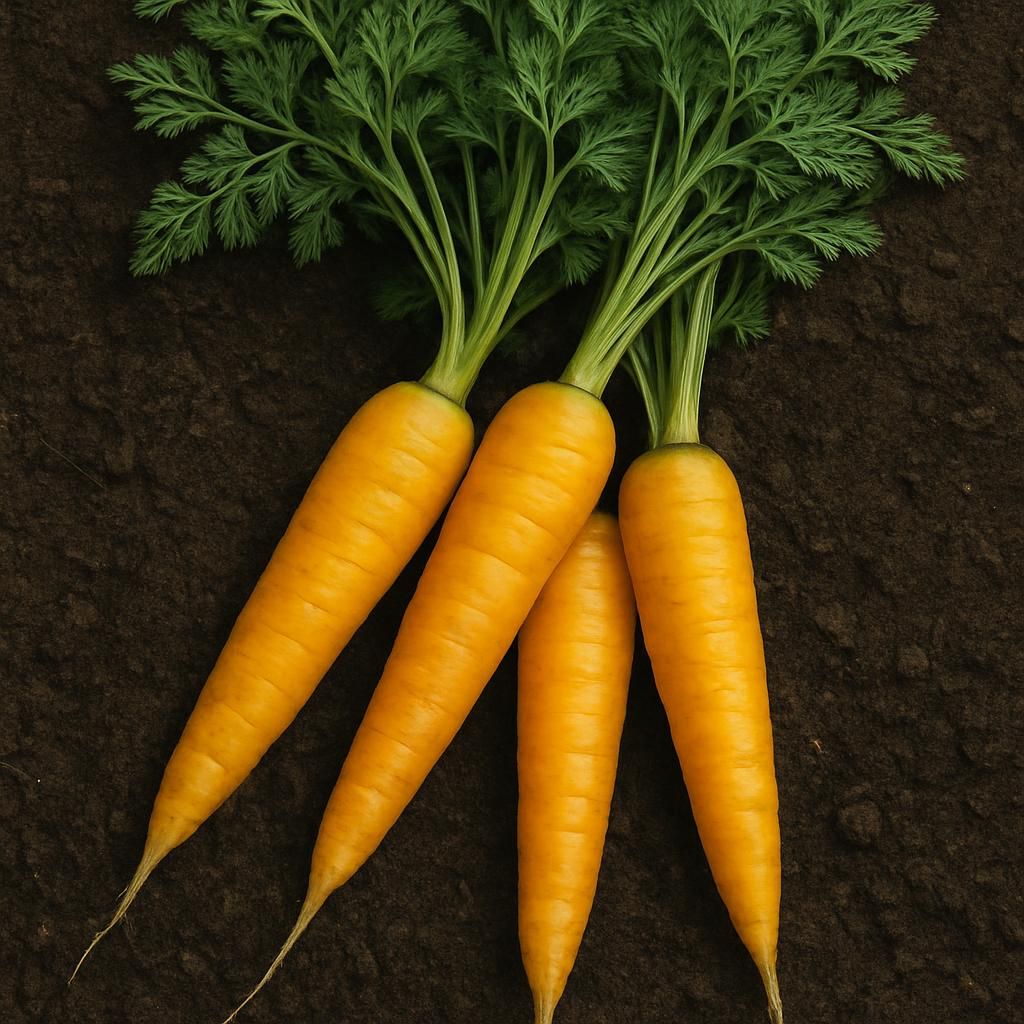
Introduction to Carrot (Amarillo)
Carrot (Amarillo) is a distinctive yellow-orange heirloom variety of Carrot known for its sweet, almost tropical flavor and vibrant color. Developed for both home gardeners and small-scale commercial growers, Amarillo carrots offer excellent storage life and strong resistance to common root defects. This comprehensive guide covers every stage from seed selection through optimal storage, delivering practical, research-backed recommendations tailored to professional standards.
Botanical Profile of Carrot (Amarillo)
Amarillo belongs to the Apiaceae family and exhibits the typical taproot morphology of Daucus carota. The roots develop a bright yellow-orange pigmentation due to elevated levels of xanthophylls and beta-carotene. Foliage consists of finely divided, feathery leaves forming a rosette that supports photosynthesis and nutrient transport. The variety matures in 65–75 days and produces uniformly tapered roots 15–20 cm long with a smooth exterior that minimizes soil adhesion.
Soil, pH, and Climate Requirements for Carrot (Amarillo)
Successful cultivation begins with well-drained, loose soil free of stones and compaction. Amarillo carrots thrive in sandy loam or loamy sand with high organic matter content. The following table summarizes ideal growing conditions:
| Parameter | Ideal Range/Value | Notes |
|---|---|---|
| Soil Type | Sandy loam to loamy sand | Stone-free to prevent forking |
| Soil pH | 6.0–6.8 | Slightly acidic to neutral |
| Soil Temperature | 15–24 °C (59–75 °F) | Optimal for germination and root expansion |
| Air Temperature | 16–24 °C (61–75 °F) day; 10–15 °C night | Avoid prolonged heat above 27 °C |
| Organic Matter | 3–5 % | Improves moisture retention and structure |
| Drainage | Excellent | Raised beds recommended in heavy soils |
Step-by-Step Planting & Propagation
- Perform a soil test and amend with well-rotted compost or aged manure four weeks before sowing.
- Create raised beds 20–25 cm high to ensure drainage and root straightness.
- Sow seeds 5–7 mm deep in rows spaced 30–40 cm apart; thin seedlings to 5–7 cm within rows once true leaves appear.
- Maintain consistent moisture during the 7–14 day germination period; use floating row covers to moderate temperature and deter pests.
- Direct seeding is preferred; transplanting risks taproot damage and forking.
Care & Maintenance regimes for Carrot (Amarillo)
Consistent moisture and balanced nutrition are critical for straight, sweet roots. The table below outlines recommended schedules:
| Growth Stage | Watering Schedule | Fertilizer Application | Pruning/Thinning |
|---|---|---|---|
| Germination (0–14 d) | Light daily misting to keep surface moist | None; pre-plant compost sufficient | None |
| Seedling (2–4 wk) | 2–3 cm per week; avoid waterlogging | Side-dress with low-nitrogen organic fertilizer at 3 weeks | Thin to 5–7 cm spacing |
| Vegetative (4–8 wk) | 2.5–4 cm per week; deep infrequent irrigation | Light potassium-rich feed at 6 weeks | Remove weeds; avoid foliage damage |
| Root Bulking (8+ wk) | 3–5 cm per week; reduce 2 weeks before harvest | Cease nitrogen; apply seaweed extract | None |
Pests, Diseases & Organic Management
Common threats include Aphids, Carrot rust fly (not in list—new), Root-knot nematodes, and Alternaria leaf spot. Implement floating row covers immediately after sowing to exclude adult flies. Rotate with Onion or Garlic to disrupt pest life cycles. Apply neem oil or insecticidal soap at the first sign of aphid colonies. Maintain soil health with compost tea drenches to suppress fungal pathogens.
Harvesting, Curing & Optimal Storage
Harvest when roots reach full color and diameter, typically 65–75 days after sowing. Loosen soil with a fork and pull gently to avoid breakage. Remove tops 1 cm above the shoulder and wash roots in cool water. Cure by air-drying in a shaded, well-ventilated area for 2–4 hours. Store at 0–2 °C and 95–100 % relative humidity for up to 5 months. Avoid storing near Ethylene-producing fruits (new link) to prevent bitterness.
Companion Planting for Carrot (Amarillo)
Pair Amarillo carrots with Tomato, Lettuce, Onion, and Radish to improve space efficiency and deter pests. Avoid planting near Dill (new) or Parsnip (new) which may cross-pollinate or compete. Interplant with Marigold to repel nematodes and enhance biodiversity. Summer Companion Planting: 10 Organic Pairings to Boost Small Farm Resilience provides additional strategies for optimizing bed layouts.