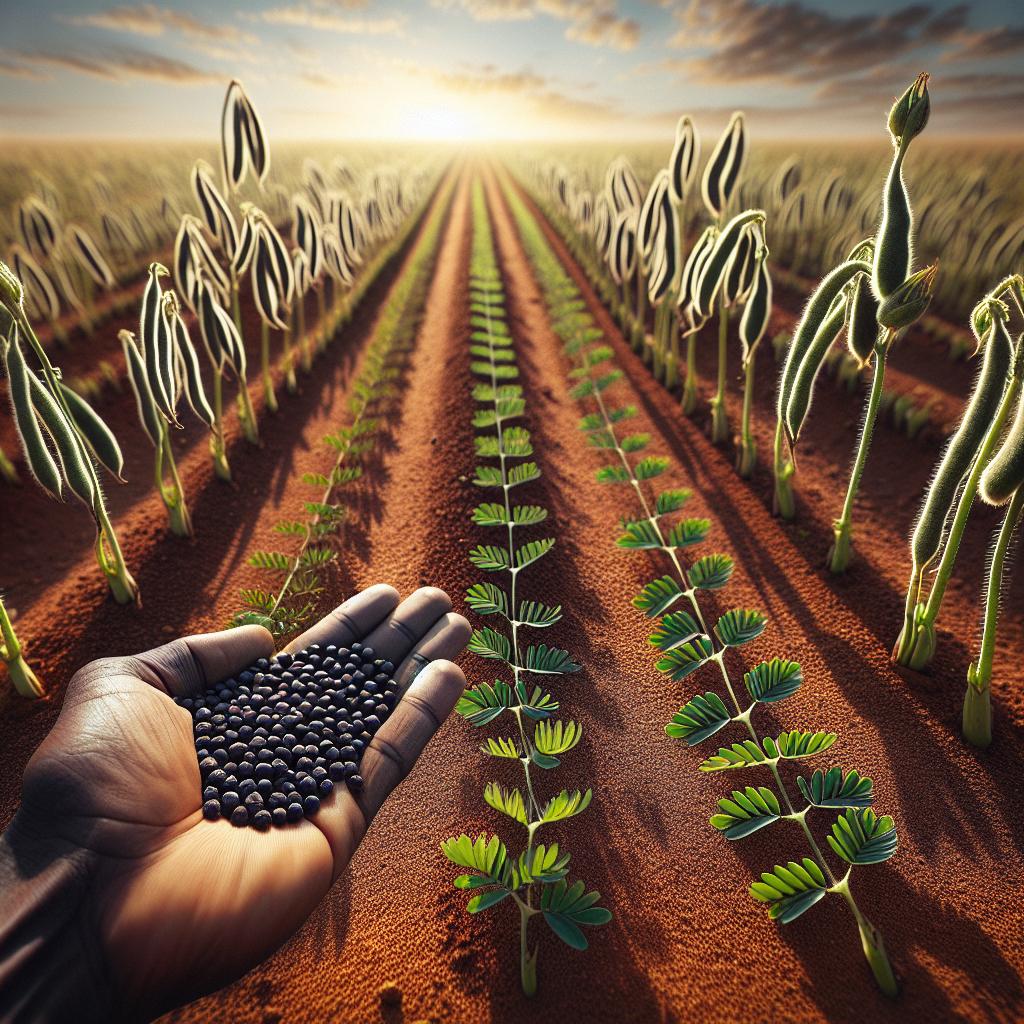
Introduction to Desi Chickpeas
Among cultivated chickpeas, the desi type is generally considered the older and more genetically diverse market class, with strong adaptation to semi-arid agriculture. Seeds are usually smaller than kabuli types, with rough seed coats ranging from brown and tan to dark green, reddish, or nearly black, and the plants often show better tolerance to heat, moisture stress, and marginal soils than larger-seeded forms such as Kabuli chickpeas.
This crop has deep agricultural history in the Fertile Crescent and South Asia, where it became a cornerstone pulse in rainfed rotations after cereals. In many traditional systems, desi chickpeas are planted on residual soil moisture after the monsoon or cool-season rains, making them a classic "stored moisture" crop. Their value is not limited to edible seed: they contribute biologically fixed nitrogen, break cereal disease cycles, supply protein-rich haulms for livestock, and improve farm resilience where water is scarce.
From a production standpoint, desi chickpeas reward growers who think like dryland agronomists rather than lush-garden irrigators. They prefer a cool establishment period, moderate vegetative growth, then a dry finish during pod maturation. Excess fertility, waterlogging, or humid canopy conditions often reduce yield and sharply increase disease pressure. For broader soil-building concepts in pulse rotations, see soil health strategies.
Botanical Profile of Desi Chickpeas
This annual grain legume belongs to the Fabaceae family. Plants are typically erect to semi-spreading, usually 30-60 cm tall under dryland conditions, though fertile soils and cool seasons can push taller growth. The stems are branched, angular, and covered with glandular hairs that exude organic acids, giving the foliage a slightly sticky texture. Leaves are pinnate with many small serrated leaflets, and flowers are usually white, pinkish, or pale blue depending on genotype.
The root system is dominated by a sturdy taproot with many lateral roots that can exploit subsoil moisture when structure is good and compaction is low. Effective nodulation with Mesorhizobium ciceri or closely related chickpea rhizobia is central to performance. If the correct rhizobia are absent, plants may remain pale, grow slowly, and rely too heavily on soil nitrogen.
Pods are short, inflated, and generally contain one seed, sometimes two. Desi types differ from kabuli types in several market-important traits:
- smaller, more angular seeds
- thicker, rougher seed coat
- darker seed color
- often greater hardiness under moisture stress
- typically stronger adaptation to low-input systems
- commonly used for split dal, flour, roasted snacks, and animal feed
Phenologically, desi chickpeas move through germination, vegetative branching, flowering, pod set, seed filling, and dry-down. The most sensitive stages are emergence, early nodulation, flowering, and pod filling. Stress at emergence reduces stand density irreversibly. Stress at flowering causes blossom drop. Stress during filling shrinks seed size and lowers market grade.
Soil, pH, and Climate Requirements for Desi Chickpeas
The best soils are well-drained loams, sandy loams, clay loams with stable structure, or black soils that drain internally and do not remain saturated. Desi chickpeas can tolerate relatively poor soils better than many pulses, but they do not tolerate waterlogging. Even 24-48 hours of saturated topsoil around the crown can trigger root decline, yellowing, and infection by Fusarium, Pythium, Rhizoctonia, or Collar rot organisms.
Target soil pH is 6.0-8.0, with an optimum around 6.5-7.5. They perform reasonably in mildly alkaline ground, but problems rise in highly sodic or saline soils where emergence and nodulation suffer. Below pH 5.5, aluminum or manganese stress and poor rhizobial activity can suppress growth. If pH is low, liming should be done months ahead of sowing rather than at planting.
A practical soil profile for strong production includes:
- friable seed zone with no crusting tendency
- bulk density low enough to permit taproot penetration
- moderate phosphorus availability
- adequate sulfur and zinc where deficient
- low residual nitrate, so nodulation is encouraged
- minimal standing water risk
Climate is the defining factor. Desi chickpeas prefer cool to mild temperatures during vegetative growth, generally 15-25b0C, and a dry atmosphere during flowering and maturity. Seeds can germinate in cooler soils, but rapid, even emergence is best when soil temperatures are roughly 10-18b0C. Light frost may be tolerated by some adapted lines after establishment, yet severe frost at flowering can sterilize blossoms and deform pods.
Rainfall needs are modest compared with many crops. Roughly 350-650 mm seasonal moisture can be enough depending on stored soil water, evaporative demand, and cultivar duration. The most dangerous pattern is not drought alone but alternating wet and warm periods that create lush growth and high disease pressure. In irrigated systems, keep in mind that chickpeas are not "high-moisture legumes." They perform best when soil water is carefully rationed.
The crop is highly sensitive to humidity during flowering and podding. Extended leaf wetness, dew-heavy conditions, dense canopies, and poorly ventilated fields favor Ascochyta blight, Botrytis gray mold, and foliar rots. This is why desi chickpeas often excel in dry continental or post-rainy-season climates.
Step-by-Step Planting & Propagation
Propagation is by seed only. Transplanting is rarely worthwhile because chickpeas resent root disturbance and direct seeding gives better root architecture.
Select high-quality seed. Use clean, mature seed with high germination, uniform size, and freedom from bruchid damage, shriveling, and seedborne disease. Large, bold seed often establishes more vigorously, but use locally adapted desi cultivars first and foremost.
Choose disease-safe ground. Avoid fields that recently carried chickpeas or other susceptible pulses with root disease history. A 3-4 year rotation out of chickpea is strongly recommended, especially in areas with Fusarium wilt, Dry root rot, or Ascochyta.
Prepare a firm, fine seedbed. Clods and loose fluff reduce seed-soil contact and lead to patchy emergence. However, over-pulverized soil can crust after rain. Aim for a bed where a seed can be placed evenly at depth into moisture.
Inoculate seed if needed. If chickpeas have not been grown successfully in the field before, coat seed with a chickpea-specific rhizobium inoculant shortly before sowing. Protect inoculated seed from direct sunlight and sow promptly.
Treat seed where disease pressure is known. In organic systems, biological seed treatments based on Trichoderma or Bacillus may help suppress damping-off and root pathogens. In conventional systems, registered fungicidal seed treatments are often used, but always follow local regulations.
Time sowing precisely. Plant when there is enough stored soil moisture for full germination and early root extension, but not so early that seedlings face prolonged waterlogging or extreme cold. In Mediterranean climates this may be late winter to early spring; in South Asian systems it is often post-monsoon on receding moisture.
Set sowing depth correctly. Place seed 4-8 cm deep depending on soil type and moisture. In lighter soils under dry conditions, sow toward the deeper end. In heavy or cool soils, shallower placement helps emergence. Avoid depths over 8 cm unless conditions clearly justify it.
Use appropriate spacing. Rows are commonly 25-45 cm apart for grain production. Within-row spacing often ends up 5-10 cm between plants. Higher density can increase yield in clean, dry environments, but overly dense stands increase foliar disease under humid conditions.
Calibrate seeding rate by seed size and target stand. A common goal is roughly 30-45 established plants per square meter, though this varies by environment and branching habit. In harsh dryland systems, slightly lower density can reduce competition for limited soil water.
Roll lightly if needed. On stony or uneven ground, a light post-seeding roll can improve harvestability and seed-soil contact, provided soil is not wet enough to compact.
Emergence usually occurs in 7-14 days depending on temperature and moisture. If seedlings are uneven, dig up ungerminated seed. A healthy germinating seed should be firm and white internally. Rotten, brown, or mushy seed indicates excess moisture, pathogen activity, or low seed vigor.
Care & Maintenance regimes for Desi Chickpeas
The central management principle is steady but not excessive growth. Desi chickpeas should look sturdy, gray-green to medium green, and moderately compact. Very dark green, lush, succulent plants are often over-fertilized or overwatered and are more vulnerable to lodging and disease.
Water management: Desi chickpeas need the most reliable moisture from sowing through establishment and again from flowering into early pod fill. Ideal soil moisture is moist but aerated, not saturated. In practical terms, the root zone should hold together when squeezed but break apart easily with light pressure. If water glistens in the soil, if footprints smear, or if the surface remains cold and sticky for days, it is too wet.
Critical irrigation guidance:
- Pre-sowing irrigation can be useful to charge the root zone, followed by seeding into stored moisture.
- After emergence, water only when the top 5-8 cm has dried and plants begin using deeper reserves.
- During branching, mild water deficit is less harmful than overwatering.
- At flowering and pod set, avoid severe stress that causes flower abortion.
- During late maturity, reduce or stop irrigation so pods dry cleanly and disease pressure stays low.
Signs of underwatering include dull foliage, slowed branching, midday droop that persists into evening, excessive flower drop, and small flat pods with poorly filled seed. Signs of overwatering include yellow lower leaves, soft stems at the base, patchy stunting, root browning, fungal growth at the collar, and fields where plants die in low spots first.
Fertility: Because this is a legume, nitrogen should be modest. Excess applied nitrogen delays nodulation and stimulates rank growth. If soils are very poor, a small starter nitrogen dose may help early vigor, but many successful crops receive little to none. Phosphorus is far more important, especially in low-P soils, because it supports early root growth, energy transfer, and nodulation. Sulfur, zinc, boron, and molybdenum may also matter depending on local deficiencies.
A sound nutrient approach includes:
- soil test before planting
- prioritize phosphorus and sulfur where low
- avoid heavy manure immediately before sowing
- maintain balanced micronutrients, especially zinc in calcareous soils
- verify nodulation 4-6 weeks after emergence by digging plants and checking for pink active nodules
Weed control: Chickpeas are not especially competitive early on. The first 30-45 days after emergence are critical. Keep the field clean with stale seedbed techniques, shallow inter-row cultivation, or mulching in garden-scale systems. Do not cultivate deeply once roots spread, as chickpeas have brittle branches and shallow feeder roots near the surface.
Canopy management: Avoid excessive canopy density. Good airflow is a disease management tool. In irrigated plots, water early in the day so foliage dries quickly. Drip irrigation is preferable to overhead irrigation wherever possible.
Pests, Diseases & Organic Management
The major production losses in desi chickpeas usually come from diseases rather than insects, especially under cool, wet, or humid conditions.
Key diseases:
- Ascochyta blight: causes dark lesions on leaves, stems, and pods, often with concentric rings and black fruiting bodies. It spreads in splashing rain and infected seed. Manage with resistant cultivars, clean seed, long rotation, wide spacing in humid regions, and strict destruction of infected residue.
- Fusarium wilt: plants yellow, wilt, and die, often one-sided at first. Cutting the stem may reveal brown vascular discoloration. Management relies on rotation, resistant lines, and avoiding infested fields.
- Dry root rot and Collar rot: often worse under stress and warm soils after irregular rainfall. Plants suddenly collapse, roots become dry and decayed, and crowns may girdle. Prevent with vigorous establishment, seed treatment, and moisture balance.
- Botrytis gray mold: favored by dense, humid canopies; causes fuzzy gray growth and flower or pod abortion.
Common insect pests:
- pod borers such as Helicoverpa spp., which chew flowers and pods and feed directly on seed
- Aphids, which cluster on tender shoots and can transmit viruses
- Cutworms at establishment
- Bruchids in stored grain rather than the field in many regions
Organic management framework:
- Start with certified or carefully selected clean seed.
- Rotate away from chickpea for at least 3 years, longer if disease history is severe.
- Use wider row spacing where humidity is high.
- Encourage early vigor but avoid excessive nitrogen.
- Scout twice weekly from pre-flowering onward.
- Remove heavily diseased plants in small plots before sporulation spreads.
- Use neem, Bt, or entomopathogenic products against young pod-borer larvae where locally permitted and timed correctly.
- Preserve beneficial insects with flowering borders and reduced broad-spectrum sprays.
- Dry grain thoroughly before storage to prevent bruchid buildup.
For beneficial insect support, border plantings of Coriander would be useful in many systems, but since that page is unavailable here, practical alternatives include flowering herbs and strips of Sunflower placed far enough away not to shade the crop. In mixed gardens, Garlic along bed edges may help diversify pest habitat, though it should not be expected to "repel" all chickpea pests on its own.
When scouting, inspect the underside of leaves, the first flower clusters, and developing pods. Economic damage happens quickly once larvae enter pods. Organic insecticides work best on very small larvae before they are protected inside pod tissue.
Harvesting, Curing & Optimal Storage
Harvest timing depends on intended use. For dry grain, wait until most plants are yellow-brown, pods are dry, seeds are hard, and leaves have largely dropped. Moisture in the standing crop should be low enough that pods crack cleanly rather than bend. If harvested too early, seeds wrinkle and store poorly; too late, pods may shatter and weathering can stain seed coats.
In small-scale systems, plants can be cut when 80-90% of pods are mature and windrowed or laid on clean tarps to finish drying. In mechanized systems, direct combining is possible if the field is even and weeds are controlled. Because lower pods may sit close to the ground, smooth land preparation and rolling before emergence can greatly reduce harvest loss.
Ideal grain moisture for safe storage is generally around 10-12% or lower, depending on storage conditions. In humid climates, aim toward the lower end. A practical test is that seeds are fully hard, cannot be dented by a fingernail, and shatter cleanly when struck. For precise storage, use a grain moisture meter.
After threshing:
- clean out chaff, dust, cracked seed, and insect-damaged seed
- dry further in thin layers with forced air or shaded ventilation if moisture is borderline
- avoid intense direct sun for prolonged periods if seed is intended for planting
- cool grain before sealing in bins or bags
Storage hazards include bruchid beetles, moisture migration, mold, and rodent damage. Use airtight containers for small lots, clean jute or woven polypropylene sacks for dry short-term storage, or sealed bins for larger volumes. Keep storage rooms below about 15b0C where possible and dry enough to prevent condensation. If insects are a chronic problem, periodic inspection is essential. Freezing seed lots for several days can help sanitize small household quantities before long-term storage.
For seed-saving, select only plants that were healthy, true to type, and matured uniformly. Because chickpea is largely self-pollinating, varietal purity is easier to maintain than in many outcrossing crops, though off-types should still be rogued out before harvest.
Companion Planting for Desi Chickpeas
Companion planting with desi chickpeas works best when the companion does one of three things: suppresses weeds without excessive competition, supports beneficial insects, or occupies a different rooting and nutrient niche. The crop itself is relatively short and open-canopied, so companions must not overtop it early or create stagnant humidity.
The most useful companions are often edge or border species rather than plants intermingled tightly within the row. Good choices include Garlic, Onion, Sunflower, and Carrot. All four can fit into diversified gardens or small farms if spacing is managed sensibly.
- Garlic: works well on bed margins where its upright habit does not heavily shade chickpeas. It occupies a narrow footprint and can help diversify pest ecology.
- Onion: similar to garlic in growth form and useful as a border or alternating bed crop. Keep enough distance to allow airflow and cultivation access.
- Carrot: compatible in loose soils because it uses a different root zone architecture and can share space in adjacent rows in garden systems.
- Sunflower: best used as a north-side windbreak or insectary strip rather than mixed closely into the stand, since shading can reduce chickpea yield if placed poorly.
Avoid aggressive, thirsty neighbors or crops that demand frequent irrigation. Heavy feeders with sprawling vines can outcompete young chickpeas and raise humidity around the canopy. Likewise, other legumes are usually poor companions in tight plantings because they share similar pest and disease risks without providing enough ecological contrast.
In rotation design, desi chickpeas pair especially well after cereals such as wheat or barley because residue structure, nutrient demand, and disease cycles complement each other. A cereal-chickpea sequence remains one of the most agronomically sound dryland patterns in the world.