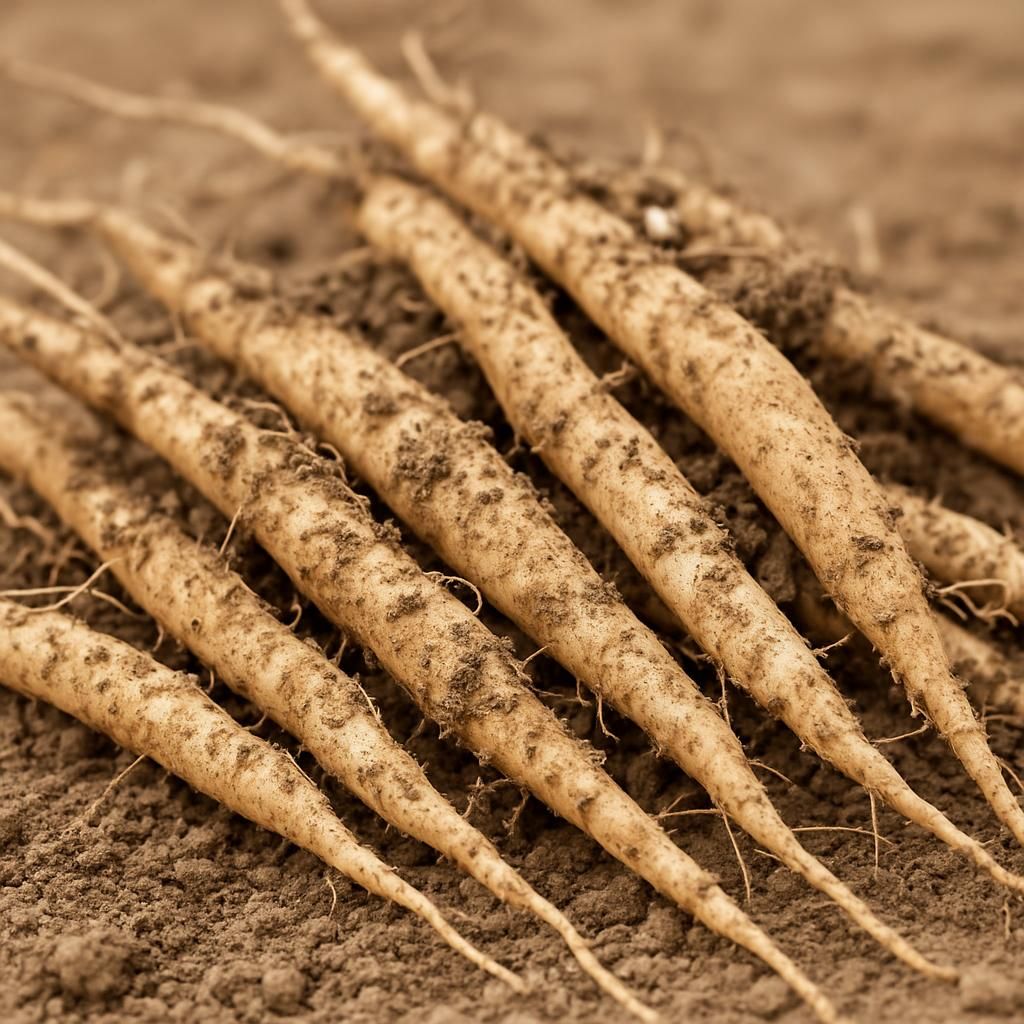
Introduction to Ashwagandha Root
Withania somnifera, commonly known as Ashwagandha Root, has been cultivated for over 3,000 years as a cornerstone of Ayurvedic medicine. The plant produces a deep taproot system that stores withanolides, alkaloids, and sitoindosides responsible for its adaptogenic properties. Modern growers value Ashwagandha Root for its drought tolerance, low input requirements, and strong market demand in herbal, nutraceutical, and pharmaceutical sectors.
Commercial viability stems from both root and leaf biomass. Dry root yields average 300-800 kg/ha under rainfed conditions and 900-1,200 kg/ha with supplemental irrigation. The crop completes its cycle in 5-6 months, allowing rotation with legumes or cereals. Its tolerance to marginal soils makes it ideal for semi-arid and subtropical smallholder systems.
Botanical Profile of Ashwagandha Root
Ashwagandha Root is a short, woody shrub reaching 30-150 cm in height. Stems are erect, branched, and covered in fine stellate hairs. Leaves are ovate to elliptic, 5-10 cm long, arranged oppositely. Small, greenish-yellow, bell-shaped flowers appear in axillary clusters from late summer through autumn. The fruit is a small, orange-red berry enclosed in a papery calyx. The economically important portion is the fleshy, spindle-shaped taproot that can extend 30-40 cm deep.
The species is diploid (2n=48) and predominantly self-pollinated, though some outcrossing occurs via small bees. Genetic diversity is highest in Indian landraces, with selections available for higher withanolide content and improved root architecture. Ashwagandha Root exhibits both annual and short-lived perennial behavior depending on climate and management.
Soil, pH, and Climate Requirements for Ashwagandha Root (MUST INCLUDE A MARKDOWN TABLE OF IDEAL CONDITIONS)
Ashwagandha Root thrives on well-drained, sandy loam to light red soils with low to moderate fertility. Heavy clay or waterlogged soils cause root rot and stunted growth. The plant tolerates a wide pH range but performs best on slightly alkaline soils.
| Parameter | Ideal Range | Notes |
|---|---|---|
| Soil Type | Sandy loam to light red loam | Avoid heavy clays and saline-alkaline soils |
| Soil pH | 7.0 - 8.0 | Mildly alkaline preferred |
| Temperature | 20-35 °C daytime | Tolerates up to 40 °C; frost sensitive |
| Annual Rainfall | 500-900 mm | Drought tolerant once established |
| Altitude | 0-1,500 m | Performs well in subtropical plains |
| Organic Matter | 1.5-3.0 % | Moderate levels sufficient |
The crop requires full sun exposure (minimum 6-8 hours daily). High humidity combined with poor air circulation increases disease pressure. In regions receiving less than 500 mm annual rainfall, supplemental irrigation at critical stages (flowering and root bulking) improves both biomass and withanolide concentration.
Step-by-Step Planting & Propagation
Propagation is achieved primarily through seed. Select certified, high-withanolide seed lots with germination rates above 80 %. Soak seeds in warm water for 12-18 hours or treat with 0.2 % potassium nitrate to break dormancy.
- Prepare the field by deep plowing (20-25 cm) followed by two to three harrowings to achieve fine tilth.
- Incorporate 8-10 t/ha well-rotted farmyard manure or compost two weeks before sowing.
- Sow seeds in rows 45-60 cm apart at a depth of 1-1.5 cm. Seed rate is 4-6 kg/ha for direct sowing or 2-3 kg/ha when transplanting seedlings.
- Optimal sowing window is June-July in subtropical India or spring in Mediterranean climates after last frost.
- Maintain soil moisture at field capacity until germination (7-14 days). Thin seedlings to 15-20 cm within rows once they reach 10 cm height.
Transplanting 30-45 day-old seedlings raised in nursery beds reduces weed competition and improves uniformity. Avoid planting in fields previously cropped with solanaceous species to minimize nematode carryover.
Care & Maintenance regimes for Ashwagandha Root (MUST INCLUDE A MARKDOWN TABLE OF WATER, FERTILIZER, AND PRUNING SCHEDULES)
Ashwagandha Root is a low-maintenance crop once established. Weed control during the first 45 days is critical. Hand weeding or shallow hoeing at 20 and 40 days after sowing is recommended. Mulching with dry leaves or straw conserves moisture and suppresses weeds.
| Growth Stage | Irrigation Frequency | Fertilizer Application | Pruning/Maintenance |
|---|---|---|---|
| 0-30 days (Seedling) | Light watering every 4-5 days | 20 kg N, 40 kg P₂O₅, 20 kg K₂O/ha basal | None |
| 30-60 days (Vegetative) | Every 7-10 days if no rain | Top-dress 20 kg N at 45 DAS | Remove basal leaves showing yellowing |
| 60-120 days (Flowering & Root Bulking) | Every 12-15 days | Optional 10 kg N if deficiency observed | Pinch terminal shoots to encourage branching |
| 120-180 days (Maturity) | Withhold irrigation 3 weeks before harvest | None | Remove diseased or damaged branches |
Excess nitrogen promotes vegetative growth at the expense of root development. Apply phosphorus and potassium at planting to support root expansion. Foliar sprays of 0.5 % zinc sulfate at 60 and 90 days can correct micronutrient deficiencies common in sandy soils.
Pests, Diseases & Organic Management
Ashwagandha Root faces relatively few serious pests under dryland conditions. The most common insects are Aphids, Spider mites, and Jassids. Root-knot nematodes (Root-knot nematodes) can reduce yields in sandy soils previously planted with solanaceous crops.
Major diseases include Alternaria leaf spot, Cercospora leaf spot, and Root rot caused by Rhizoctonia and Fusarium. Organic management relies on cultural practices and approved inputs.
- Use disease-free seed and practice 3-4 year crop rotation with cereals or legumes.
- Apply neem oil (0.5 %) or insecticidal soap at early signs of aphid or mite infestation.
- Incorporate Trichoderma viride or Pseudomonas fluorescens at 2.5 kg/ha during land preparation to suppress soil-borne pathogens.
- Remove and destroy infected plant debris at season end to reduce overwintering inoculum.
Monitor fields weekly during humid periods. Early detection allows targeted spot treatments that preserve beneficial insect populations.
Harvesting, Curing & Optimal Storage
Ashwagandha Root reaches physiological maturity 150-180 days after sowing when leaves begin to yellow and berries turn red. Harvest by carefully digging around the plant to avoid root breakage. Shake off soil and separate roots from aerial parts.
Wash roots under running water to remove adhering soil, then sun-dry for 4-6 days until moisture content drops below 10 %. For premium quality, dry in shaded, well-ventilated structures at 35-40 °C to preserve withanolides. Sort roots by size and grade; thicker taproots command higher market prices.
Store dried roots in clean, jute or cloth bags in a cool, dry warehouse (temperature <25 °C, RH <60 %). Protect from rodents and insects. Properly cured roots retain active compounds for 18-24 months. Powdered root should be vacuum-packed to prevent oxidation.
Companion Planting for Ashwagandha Root
Ashwagandha Root integrates well with drought-tolerant legumes and aromatic herbs that improve soil structure and deter pests. Recommended companions include Chickpeas, Lentils, Coriander, and Marigold.
Legumes fix atmospheric nitrogen, reducing external fertilizer needs. Marigold and coriander release root exudates that suppress nematodes and attract beneficial insects. Avoid planting near Tomato or Potato due to shared susceptibility to nematodes and fungal wilts.
Intercropping Ashwagandha Root with Sesame or Sunflower in alternate rows provides additional income and improves microclimate humidity control. Maintain 30-45 cm spacing between rows of the main crop and companions to prevent competition for light and nutrients.
For further reading on strategic crop pairings, see Summer Companion Planting: 10 Organic Pairings to Boost Small Farm Resilience. Additional botanical details are available on the Wikipedia page for Withania somnifera.