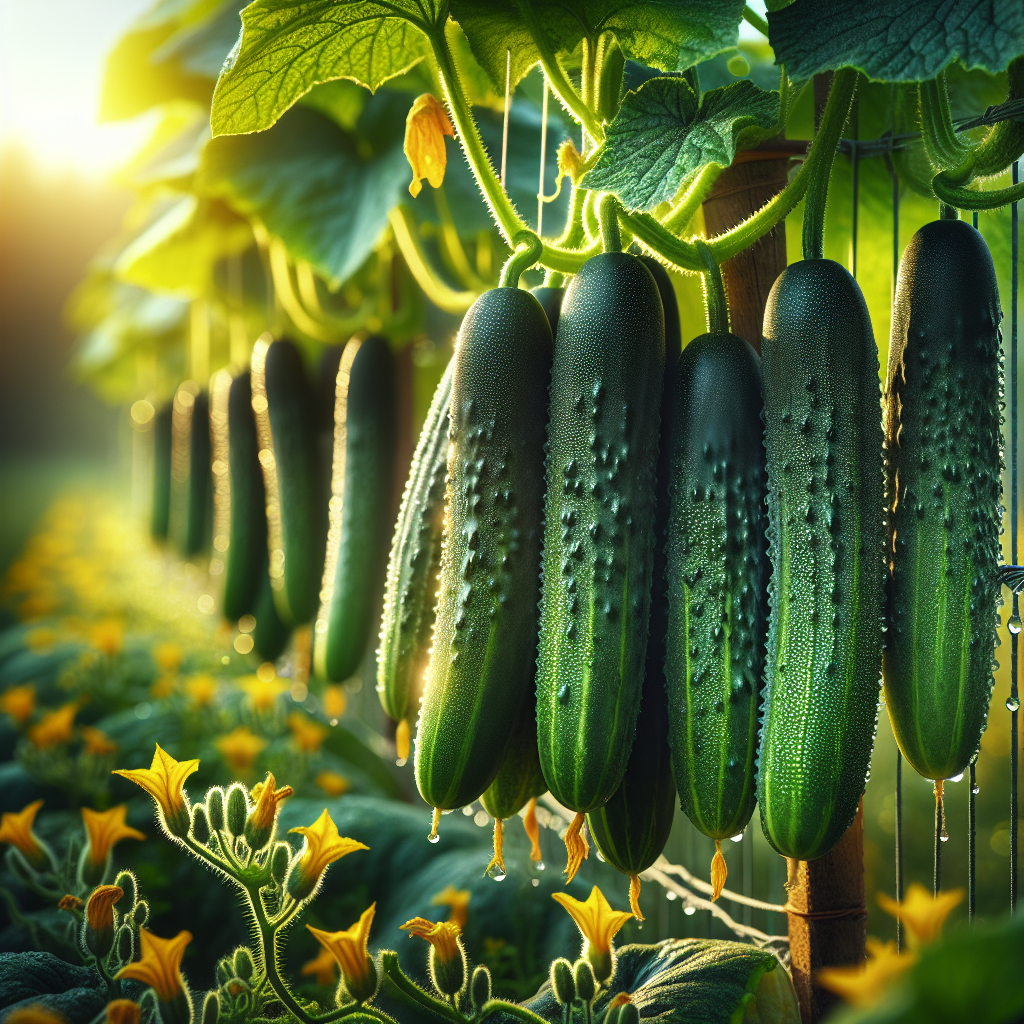
Introduction to Persian Cucumber
Persian cucumbers (Cucumis sativus 'Persian') represent a premium cultivar distinguished by their petite size, averaging 5-6 inches long and 1-1.5 inches in diameter, with dark green skin that's tender enough to eat unpeeled. Unlike standard slicing cucumbers, they contain fewer cucurbitacins, the compounds responsible for bitterness, making them ideal for fresh salads, pickling, or snacking. Historically, this variety traces its roots to Armenia in the Caucasus region, where it was selectively bred for superior taste and texture before gaining global popularity through Persian and Middle Eastern markets in the 20th century. Today, they're a staple in California agriculture, where commercial growers favor them for their uniform shape, high productivity (up to 20-30 fruits per plant), and resistance to bolting under heat stress. Gardeners appreciate their space-efficient vining habit, which suits trellises or containers, yielding harvests in just 50-55 days from seed. For SEO-optimized success, focus on warm-season planting and consistent moisture to maximize this gourmet crop's potential.
Botanical Profile of Persian Cucumber
Persian cucumbers belong to the Cucurbitaceae family, sharing lineage with melons, squash, and pumpkins, but stand out as a parthenocarpic variety—meaning they can set fruit without pollination, producing seedless cucumbers in greenhouse or netted environments. Botanically, they exhibit an indeterminate growth pattern, with vigorous vines reaching 6-10 feet, adorned with large, lobed leaves (up to 8 inches across) that provide ample shade to suppress weeds and retain soil moisture. Flowers are monoecious, featuring separate male and female blooms on the same plant; female flowers have a miniature cucumber at their base. Stems are angular with trifurcate tendrils for climbing, and roots form a shallow but extensive network, delving 12-18 inches deep while spreading laterally up to 3 feet. Unique to this cultivar are its thin, non-warty skin and small seed cavity, even in pollinated fruits, contributing to a 95% edible yield. Compared to Marketmore 76 Cucumber, Persian types have shorter internodes for denser fruit set and superior heat tolerance, thriving at 85-95°F without bitter pith development. Historical breeding emphasized disease resistance, particularly to cucumber mosaic virus (CMV), making them a resilient choice for organic systems.
Soil, pH, and Climate Requirements for Persian Cucumber
Persian cucumbers demand well-draining, fertile loam or sandy loam soils rich in organic matter, with ideal texture allowing 1-2 inches of water percolation per hour to prevent root rot. Aim for a pH of 6.0-6.8; below 5.8, nutrient lockout occurs, stunting growth, while above 7.2, iron and manganese deficiencies manifest as yellowing young leaves. Incorporate 2-4 inches of aged compost or well-rotted manure pre-planting to achieve 3-5% organic matter, boosting cation exchange capacity (CEC) for nutrient retention. Climate-wise, they flourish in USDA zones 4-11 as annuals, preferring daytime temps of 70-90°F and nights above 60°F; frost kills seedlings instantly, so use row covers if nights dip below 55°F. They excel in full sun (8+ hours daily) but tolerate light shade, with high humidity (60-70%) enhancing fruit quality—dry air above 40% RH triggers bitterness. For optimal yields, maintain soil moisture at 60-70% field capacity (feels like a wrung-out sponge); use a tensiometer targeting -10 to -20 centibars. In hot climates, mulch with straw (3 inches thick) to keep roots cool (below 85°F) and conserve water, reducing evaporation by 50%. Avoid heavy clay soils prone to waterlogging, as Persian roots are sensitive to oxygen deprivation. See our Soil Health Mastery for budget-friendly amendments.
Step-by-Step Planting & Propagation
Start Persian cucumber seeds indoors 3-4 weeks before the last frost, sowing ½ inch deep in 72°F soil using biodegradable pots to minimize transplant shock. Germination occurs in 3-7 days at 75-85°F; provide bottom heat and 14-16 hours of light via grow lamps. Harden off seedlings over 7-10 days before transplanting. Direct sow outdoors post-frost when soil hits 65°F, spacing seeds 12 inches apart in rows 4-6 feet apart, or 18-24 inches for bushier plants. For trellising, plant 12 inches apart along nylon netting (5x5-inch mesh) installed 5-6 feet high. Propagation via cuttings is viable: take 4-6 inch stem tips from healthy vines, dip in rooting hormone, and pot in perlite-vermiculite mix under high humidity (mist daily). Transplant at 2-3 true leaf stage, burying stems to the first node for adventitious root development. Inoculate roots with mycorrhizal fungi (e.g., Glomus intraradices) at planting to enhance phosphorus uptake by 30%. Thin seedlings to strongest plants, ensuring 2-3 feet between vines for airflow. For succession planting, sow every 2 weeks through midsummer to extend harvest.
Care & Maintenance regimes for Persian Cucumber
Water deeply (1-2 inches weekly) to maintain even soil moisture, checking by inserting a finger 2 inches deep—dry means irrigate; soggy signals overwatering, evident by yellowing lower leaves and mushy stems. Drip irrigation is superior, delivering water to roots while keeping foliage dry to deter powdery mildew. Fertilize at planting with balanced 10-10-10 (2 lbs per 100 sq ft), then side-dress with nitrogen-rich fish emulsion (5-1-1) every 3 weeks post-fruit set, targeting 50-75 ppm N. Trellis vines promptly to promote straight fruits and reduce rot; prune suckers below first fruit cluster for better airflow. Mulch aggressively to suppress weeds and regulate temperature. Monitor for magnesium deficiency (interveinal chlorosis) and apply Epsom salts (1 tbsp/gallon foliar spray). Pinch vine tips at 6-8 feet to focus energy on fruiting. In containers (5+ gallon pots), use soilless mix amended with 20% compost and trellis vertically for space efficiency.
Pests, Diseases & Organic Management
Common pests include Cucumber beetles (striped and spotted), which vector Bacterial wilt—handpick adults and use row covers until flowering; apply neem oil (1 tsp/gallon) weekly as repellent. Aphids cluster on undersides; blast with water or introduce ladybugs (1,000/acre). Squash bugs suck sap, causing wilting—trap under boards overnight and crush eggs. Powdery mildew (Podosphaera xanthii) appears as white patches; prevent with 3-foot spacing and potassium bicarbonate spray (1 tbsp/gallon + 1 tsp soap). Downy mildew (Pseudoperonospora cubensis) thrives in wet conditions—apply copper fungicide preemptively and choose resistant strains. Bacterial wilt shows sudden vine collapse; rogue infected plants immediately. Rotate crops 3-4 years away from cucurbits. Neem and BT (Bacillus thuringiensis) provide broad-spectrum organic control without residues.
Harvesting, Curing & Optimal Storage
Harvest at 4-6 inches (immature stage) every 1-2 days to encourage continuous production; twist gently or cut with pruners to avoid vine damage. Yields peak 45-60 days post-planting, with 10-20 cukes per plant. For pickling, harvest at 2-4 inches. Cure by washing in cool water with 1 tsp bleach/5 gallons, then air-dry. Store at 50-55°F and 95% RH for 10-14 days (whole) or 7 days (sliced); avoid below 45°F to prevent chilling injury (pitting). Refrigerate in perforated bags to extend shelf life to 3 weeks. Seed saving: isolate plants ½ mile or bag females, harvest overripe fruits, ferment pulp 2-3 days, dry seeds at <10% moisture.
Companion Planting for Persian Cucumber
Pair Persian cucumbers with nitrogen-fixers like peas to boost soil fertility, as their shallow roots complement vining habits without competition. Onion family members repel cucumber beetles via sulfur compounds, planting 1 foot away. Nasturtium acts as trap crop for Aphids, drawing pests from vines while adding edible flowers. Avoid potatoes, which attract blight and compete for nutrients. Dill enhances pollination but plant distantly to prevent cross-attraction of pests.