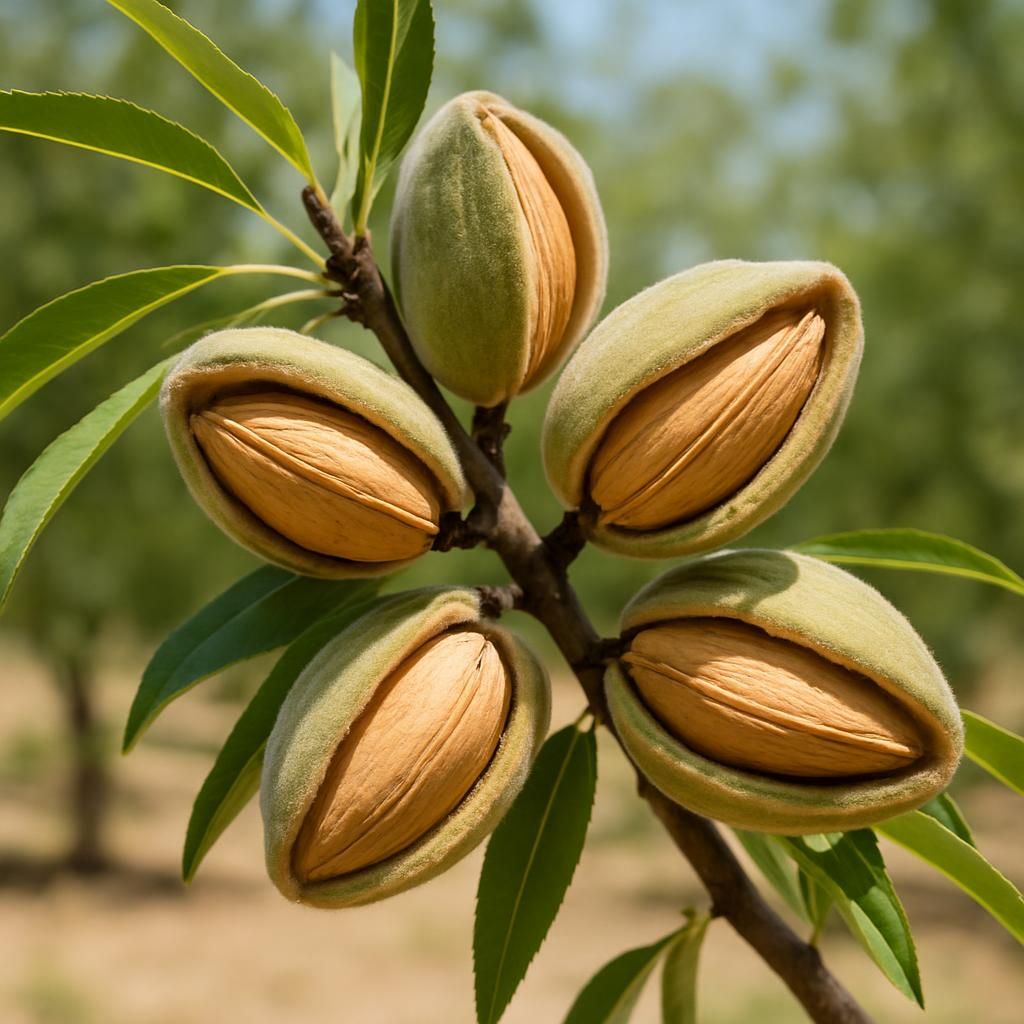
Introduction to Almond (Nonpareil)
Nonpareil almond trees produce the thin-shelled nuts that dominate global markets because of their high kernel-to-shell ratio, uniform size, and sweet flavor profile. Originating from selections made in California in the late 1800s, the cultivar now accounts for roughly 40 percent of the world’s almond acreage and is favored by both commercial growers and serious home orchardists. Its early bloom and reliable heavy yields make it the benchmark against which all other almond varieties are measured.
Successful cultivation requires well-drained soils, full sun exposure, and a reliable water supply, especially during kernel fill. With proper management, mature orchards can produce 2,000–3,000 pounds of kernels per acre under commercial conditions and still deliver excellent flavor and appearance for direct-to-consumer sales.
Botanical Profile of Almond (Nonpareil)
Nonpareil belongs to the Rosaceae family and is botanically classified as Prunus dulcis. The tree is deciduous, reaching 15–30 feet in height with an upright, vase-shaped canopy that allows excellent light penetration. Self-incompatibility necessitates cross-pollination with compatible cultivars such as Mission Almond or Carmel Almond for consistent set.
Flowers are pale pink to white, emerging in late February to early March in Mediterranean climates. The resulting drupe contains a single seed (kernel) surrounded by a thin, paper-like shell that splits cleanly at maturity. Leaves are lanceolate, finely serrated, and dark green, turning yellow in autumn before abscission.
Soil, pH, and Climate Requirements for Almond (Nonpareil)
Nonpareil almonds perform best on deep, well-drained sandy loam to loam soils with at least 4–6 feet of rooting depth. Heavy clay or poorly drained sites invite Phytophthora and root rot issues. Soil pH should be maintained between 6.0 and 7.5; lime may be incorporated before planting if pH falls below 5.8.
The cultivar is adapted to USDA zones 7–9 and requires 250–400 chilling hours. Annual rainfall of 15–25 inches is adequate only when supplemented by irrigation. Late-spring frosts below −2 °C during bloom can destroy 80–100 % of the crop, so site selection must avoid frost pockets.
| Parameter | Ideal Range | Notes |
|---|---|---|
| Soil Texture | Sandy loam to loam | Minimum 4 ft rooting depth |
| Soil pH | 6.0–7.5 | Adjust with lime if <5.8 |
| Organic Matter | 2–4 % | Improves water and nutrient holding |
| Annual Rainfall | 15–25 in (supplement with irrigation) | 35–45 in total water requirement |
| Temperature Range | −7 °C to 38 °C | Frost protection critical at bloom |
| Chilling Hours | 250–400 hours below 7 °C | Ensures uniform bloom and leaf-out |
| Growing Season Length | 180–220 frost-free days | Kernel fill requires consistent warmth |
Step-by-Step Planting & Propagation
- Site Preparation: Conduct soil tests and amend with 2–3 tons of compost per acre plus phosphorus and potassium according to soil analysis. Rip or trench to 3 ft depth on compacted sites.
- Cultivar Selection: Plant Nonpareil at 60–70 % of the orchard and interplant compatible pollinizers such as Mission Almond at 30–40 % density.
- Spacing: Standard spacing is 18–22 ft between rows and 16–20 ft within rows for 110–150 trees per acre. High-density systems at 12 × 18 ft are feasible with mechanical hedging.
- Planting Time: Bare-root trees are planted December–February in Mediterranean climates. Container stock may be planted year-round but requires extra irrigation.
- Planting Technique: Dig holes twice the width of the root ball. Position graft union 2–3 inches above final soil grade. Backfill, firm soil, and water thoroughly to settle roots.
- Irrigation at Planting: Apply 10–15 gallons per tree immediately after planting and maintain consistent moisture for the first 8–10 weeks.
Care & Maintenance regimes for Almond (Nonpareil)
Young trees need 15–25 gallons of water per tree per week during the first two summers. Mature orchards require 3.5–4.0 acre-feet annually, applied via micro-sprinklers or drip. Nitrogen is the primary nutrient; apply 60–80 lbs N per acre in split applications from March through June. Boron and zinc foliar sprays at 0.5 lb per acre are standard in most California districts.
Pruning begins at planting by heading the central leader to 36–42 inches. In the second dormant season, select 3–4 permanent scaffold branches. Annual dormant pruning removes 15–20 % of canopy volume to maintain light penetration and reduce disease pressure.
| Growth Stage | Water Schedule | Fertilizer (N-P-K) | Pruning Action |
|---|---|---|---|
| Dormant (Dec–Feb) | 0.5–0.75 in/week if no rain | 20-10-10 at 40 lbs N/acre | Structural pruning; remove dead wood |
| Bloom–Petal Fall | 1.0–1.25 in/week | 15-15-15 at 20 lbs N/acre | Minimal; avoid heading bloom wood |
| Nut Development (Apr–Jun) | 1.5–2.0 in/week | 30-0-0 at 40 lbs N/acre | Summer prune vigorous shoots |
| Kernel Fill (Jul–Aug) | 1.25–1.5 in/week | 10-5-20 at 20 lbs N/acre | Remove water sprouts |
| Harvest–Postharvest | Reduce to 0.5 in/week | 0 lbs; apply compost 2–3 tons/acre | Dormant prune to open canopy |
Pests, Diseases & Organic Management
Key arthropod pests include Navel Orangeworm, Peach Twig Borer, mites, and scale insects. Cultural controls such as winter sanitation (removal of mummy nuts) reduce overwintering navel orangeworm populations by 60–80 %. Mating disruption dispensers deployed at 1 per acre provide season-long suppression.
Disease pressure is dominated by Hull Rot, Alternaria Leaf Spot, and Phytophthora root rot. Drip irrigation placed 12–18 inches from trunks and gypsum applications at 2 tons per acre reduce Phytophthora incidence. Copper-based sprays at 2 lb metallic copper per acre applied at 50 % leaf drop suppress bacterial canker and shot hole.
Harvesting, Curing & Optimal Storage
Nonpareil almonds reach physiological maturity when hulls split and kernels reach 5–6 % moisture. Shake or pole harvest begins in mid-August in the Sacramento Valley and early September in the San Joaquin Valley. Collect nuts within 24 hours to minimize exposure to Navel Orangeworm and rain-induced mold.
Field-dry nuts to 10–12 % moisture on clean tarps, then finish-cure in forced-air dryers at 32–35 °C until kernel moisture reaches 5–6 %. Store in sealed bins at 4–7 °C and 65–70 % RH to preserve flavor and prevent rancidity for up to 18 months.
Companion Planting for Almond (Nonpareil)
Inter-row cover crops such as Clover and Hairy Vetch fix nitrogen and improve soil structure while providing habitat for predatory insects. Marigold borders repel nematodes and enhance biodiversity. Avoid planting Tomato or Potato within 100 feet because they share susceptibility to Verticillium wilt. Strategic placement of Rosemary and Thyme hedgerows supplies pollen for beneficial wasps and improves microclimate humidity control.