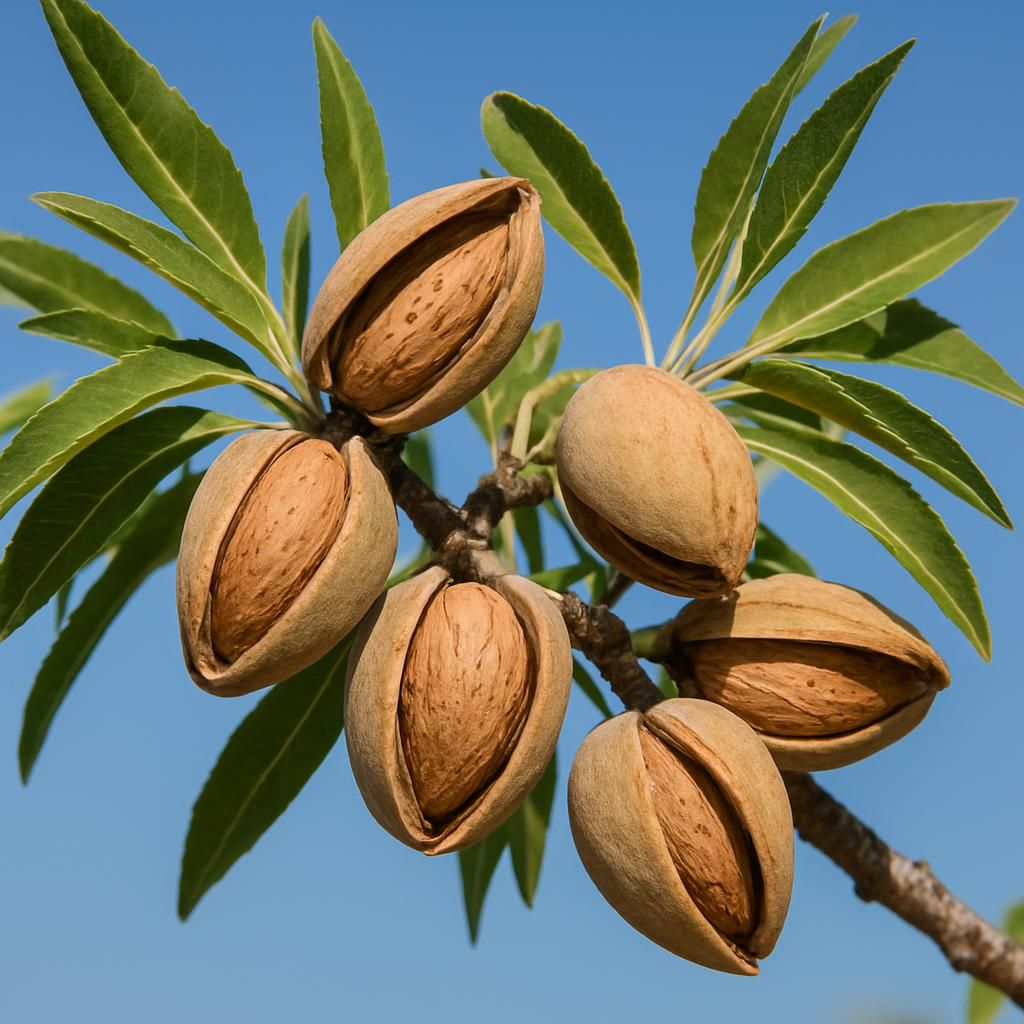
Introduction to Carmel Almond
The Carmel Almond cultivar (Prunus dulcis 'Carmel') has become a staple in commercial orchards across California’s Central Valley and similar Mediterranean climates worldwide. Developed for its late bloom period, it avoids early-spring frosts while delivering large, uniform kernels with high market value. Growers favor Carmel for its reliable yields, excellent shelling percentage, and adaptability to both traditional flood irrigation and modern micro-sprinkler systems. This guide provides professional-grade, actionable advice for establishing and managing Carmel Almond orchards from planting through post-harvest storage.
Botanical Profile of Carmel Almond
Carmel Almond belongs to the Rosaceae family and is botanically classified as Prunus dulcis 'Carmel'. The tree exhibits a semi-upright growth habit with moderate vigor, reaching 15–20 feet (4.5–6 m) at maturity when properly pruned. Leaves are lanceolate, dark green, and deciduous. Flowers are self-incompatible, requiring cross-pollination from compatible varieties such as Nonpareil Almond or Mission Almond. The fruit is a drupe; the edible seed (kernel) is protected by a hard, paper-shell endocarp. Carmel typically blooms 7–10 days after Nonpareil, reducing frost risk and extending the pollination window.
Soil, pH, and Climate Requirements for Carmel Almond
Carmel Almond demands well-drained, deep loamy or sandy loam soils with good aeration. Heavy clay or poorly drained sites lead to root diseases and reduced productivity. The cultivar performs best in regions with 300–500 chilling hours and hot, dry summers.
| Parameter | Ideal Range | Notes |
|---|---|---|
| Soil Type | Sandy loam to loam | Avoid heavy clay; improve drainage if needed |
| Soil pH | 6.0–7.5 | Slightly acidic to neutral |
| Soil Depth | Minimum 4–6 ft (1.2–1.8 m) | Deep rooting zone essential |
| Temperature (Growing) | 75–95 °F (24–35 °C) | Daytime heat required for kernel fill |
| Winter Chill | 300–500 hours below 45 °F (7 °C) | Ensures uniform bloom |
| Annual Rainfall | 8–20 inches (200–500 mm) | Supplemental irrigation mandatory |
| Frost Tolerance | Flowers damaged below 28 °F (-2 °C) | Late bloom reduces but does not eliminate risk |
Step-by-Step Planting & Propagation
- Site Selection: Choose full-sun locations with excellent air drainage to minimize frost pockets. Conduct soil tests for pH, salinity, and nematodes.
- Land Preparation: Rip soil to 3–4 ft depth, incorporate 10–15 tons/acre of well-rotted compost, and level for uniform irrigation.
- Planting Density: Standard spacing is 18–22 ft between rows and 14–18 ft within rows (approximately 140–180 trees/acre). High-density systems may use 12 × 18 ft.
- Nursery Stock: Select certified, virus-indexed bare-root or potted trees. Soak roots 1–2 hours before planting.
- Planting Window: Late fall through early winter in mild climates; early spring in colder regions once soil temperature exceeds 50 °F (10 °C).
- Planting Technique: Dig holes twice the width of the root ball. Position graft union 2–3 inches above soil line. Backfill with native soil amended with 10% compost. Water immediately to settle soil.
- Initial Irrigation: Apply 5–10 gallons per tree within 24 hours and maintain consistent moisture for the first 6–8 weeks.
Care & Maintenance regimes for Carmel Almond
Consistent irrigation, balanced nutrition, and annual pruning are critical for sustained high yields.
| Season | Water Schedule | Fertilizer (per mature tree) | Pruning Schedule |
|---|---|---|---|
| Dormancy (Nov–Jan) | None or light winter irrigation | 0.5–1 lb N as compost or organic blend | Dormant pruning: remove dead wood, shape scaffold |
| Bloom–Nut Set (Feb–Apr) | 15–20 gal/tree/week | 0.5 lb N split; apply boron foliar if needed | Minimal; tip prune new growth only |
| Kernel Fill (May–Jul) | 25–35 gal/tree/week | 1–1.5 lb N split applications; monitor K | Summer pruning for light penetration |
| Post-Harvest (Aug–Oct) | 10–15 gal/tree/week | 0.5 lb N; replenish K and Zn | Light hedging if canopy dense |
Pests, Diseases & Organic Management
Carmel Almond is susceptible to several key pests and diseases. Implement integrated pest management (IPM) combining monitoring, cultural practices, and approved organic inputs.
Common pests include Navel Orangeworm, Peach Twig Borer, mites, and scale insects. Monitor with pheromone traps and degree-day models. Release beneficial insects such as lacewings and predatory mites. Apply spinosad or Bacillus thuringiensis (Bt) during peak flight periods.
Major diseases are Hull Rot, Alternaria Leaf Spot, and Phytophthora Root Rot. Improve orchard sanitation by removing mummy nuts. Apply copper-based fungicides during dormancy and at 50% leaf drop. Use resistant rootstocks and avoid over-irrigation to suppress Phytophthora.
Harvesting, Curing & Optimal Storage
Carmel Almond reaches physiological maturity when hulls split and kernels reach 5–6% moisture. Shake trees mechanically in late August to early September. Sweep and pick up nuts within 24–48 hours to prevent rain damage or mold.
Curing: Spread nuts in thin layers (2–4 inches) on tarps or drying floors with forced air at 95–105 °F (35–40 °C) until kernel moisture drops below 6%. Turn frequently for uniform drying.
Storage: Store in cool (35–50 °F / 2–10 °C), dry (<65% RH) conditions. Use hermetic bags or controlled-atmosphere silos to maintain quality for 12–18 months. Monitor for Storage Beetles and maintain sanitation.
Companion Planting for Carmel Almond
Strategic companion planting enhances biodiversity, improves soil health, and supports beneficial insects. Sow cover crops such as Clover or Hairy Vetch between rows during winter to fix nitrogen and suppress weeds. Interplant Marigold and Nasturtium along orchard borders to deter nematodes and attract pollinators. Avoid planting Tomato or Potato nearby, as they may share soil-borne pathogens. Maintain a 6–8 ft weed-free strip under the canopy while allowing beneficial insect habitats in the middles.