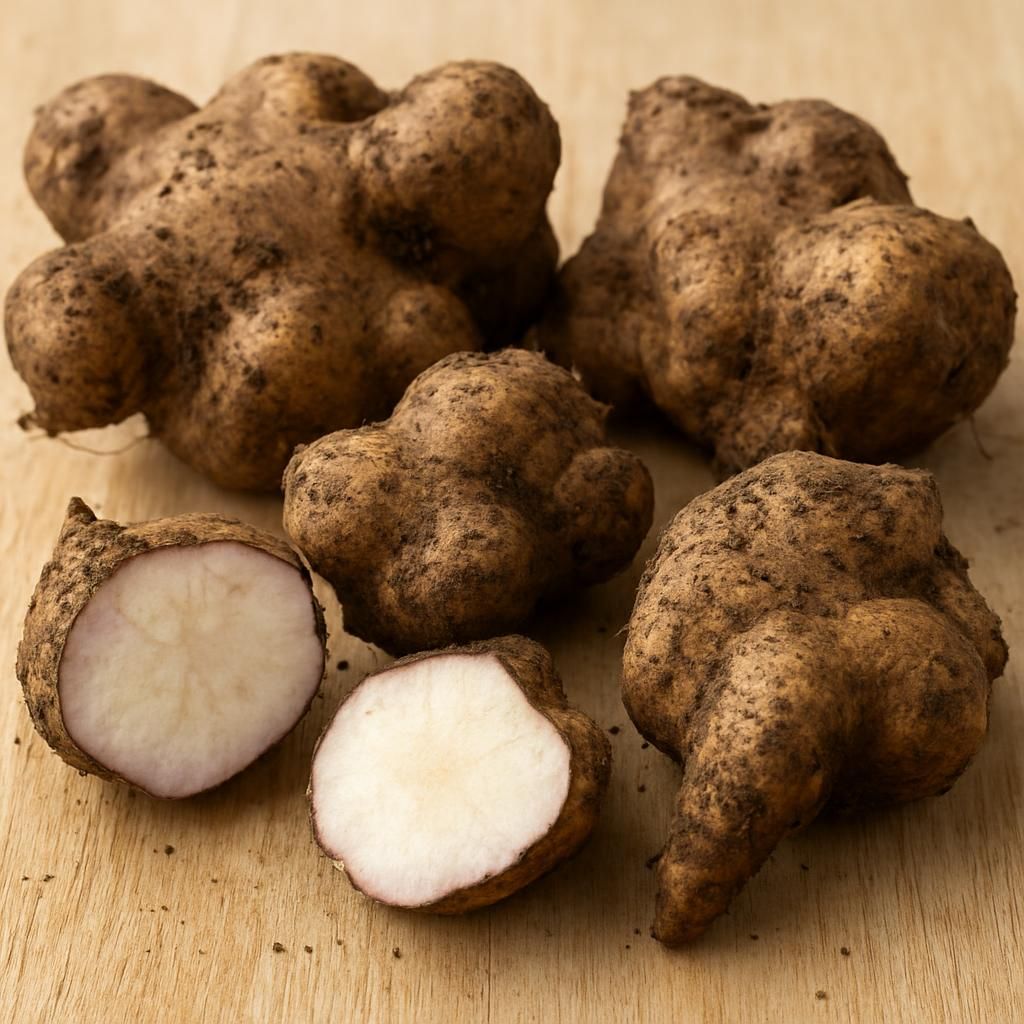
Introduction to Yam (Dioscorea trifida - Cush-cush)
Dioscorea trifida, known locally as Cush-cush, is a perennial climbing vine that produces small, irregularly shaped tubers with white, yellow, or purple flesh. Native to the Caribbean basin and northern South America, it has become an important food security crop in tropical and subtropical regions worldwide. The plant is valued for its sweet flavor, moderate starch content, and adaptability to smallholder farming systems. Unlike larger yam species such as Yam, Cush-cush tubers are typically harvested earlier and require less post-harvest processing.
Cush-cush yams are propagated vegetatively from tuber pieces or vine cuttings and trained on stakes or trellises to maximize photosynthesis and tuber development. The crop cycle generally lasts 7–10 months from planting to harvest. Because the plant is sensitive to waterlogging and frost, successful production depends on precise site selection and soil management. This guide covers every stage from botanical characteristics to storage, providing actionable recommendations for commercial and subsistence growers alike.
Botanical Profile of Yam (Dioscorea trifida - Cush-cush)
Dioscorea trifida belongs to the Dioscoreaceae family and is distinguished by its heart-shaped, deeply lobed leaves and slender twining stems that can reach 3–5 meters in length. The plant produces both aerial tubers (bulbils) in some cultivars and underground tubers that are the primary harvest. Tubers vary in shape from spindle-like to lobed and typically weigh 200–800 g at maturity. The flesh ranges from creamy white to deep purple depending on variety and soil conditions.
The root system is shallow and fibrous, making the crop susceptible to drought stress and mechanical damage during weeding. Flowers are small, greenish-yellow, and dioecious, although many cultivated varieties rarely flower under field conditions. Seed production is uncommon in commercial plantings; therefore, vegetative propagation remains the standard practice. Understanding these botanical traits is essential for optimizing spacing, support structures, and harvest timing.
Soil, pH, and Climate Requirements for Yam (Dioscorea trifida - Cush-cush)
Cush-cush yam demands well-aerated, fertile soils with excellent drainage to prevent tuber rot. The crop performs best on sandy loam to clay loam textures with high organic matter content. Soil pH should be maintained between 5.5 and 6.8 to optimize nutrient availability and minimize aluminum toxicity.
| Parameter | Ideal Range | Notes |
|---|---|---|
| Soil Texture | Sandy loam to clay loam | Avoid heavy clays without raised beds |
| Soil pH | 5.5–6.8 | Lime if below 5.3; avoid alkaline soils |
| Organic Matter | 3–5% | Incorporate compost or well-rotted manure |
| Temperature (Day) | 25–32 °C | Growth ceases below 18 °C |
| Temperature (Night) | 18–24 °C | Frost will kill vines |
| Rainfall / Irrigation | 1200–1800 mm/year | Even distribution critical during bulking |
| Altitude | 0–1200 m | Best yields at lower elevations |
Adequate sunlight (minimum 6 hours daily) and protection from strong winds are also important. In regions with pronounced dry seasons, supplemental irrigation is necessary during tuber initiation and bulking phases.
Step-by-Step Planting & Propagation
- Select healthy, disease-free tubers weighing 150–300 g. Cut into 50–80 g setts, each containing at least one viable bud.
- Cure setts in a shaded, well-ventilated area for 3–5 days to allow wound healing and reduce rot risk.
- Prepare planting beds or ridges 30–40 cm high and 90–120 cm apart. Incorporate 10–15 t/ha of compost or well-rotted manure.
- Plant setts 8–12 cm deep with the bud facing upward. Space plants 60–90 cm apart within rows.
- Install stakes or trellises immediately after planting to support vigorous vine growth.
- Mulch beds with 5–8 cm of dry grass or wood chips to conserve moisture and suppress weeds.
Planting is typically done at the onset of the rainy season when soil temperature exceeds 20 °C. In irrigated systems, planting can occur year-round provided temperatures remain within the optimal range.
Care & Maintenance regimes for Yam (Dioscorea trifida - Cush-cush)
Consistent moisture, balanced nutrition, and timely vine training are critical for high tuber yields. Over-fertilization, especially with nitrogen, promotes excessive foliage at the expense of tuber quality.
| Growth Stage | Watering Schedule | Fertilizer Application | Pruning / Training |
|---|---|---|---|
| Establishment (0–8 weeks) | Light irrigation every 3–4 days | 20 kg N, 40 kg P₂O₅, 40 kg K₂O per ha at planting | Remove weak shoots; train 2–3 main vines |
| Vegetative (8–16 weeks) | 25–30 mm/week; maintain even moisture | Side-dress 30 kg N at 10 weeks | Tie vines to stakes weekly; remove laterals |
| Tuber Bulking (16–28 weeks) | 30–35 mm/week; reduce 2 weeks before harvest | 40 kg K₂O at 18 weeks; optional micronutrients | Continue training; prune only damaged leaves |
| Maturation (28+ weeks) | Withhold irrigation 10–14 days prior | No additional fertilizer | Allow natural senescence |
Weed control should be manual or with shallow cultivation to avoid damaging shallow roots. Mulch replenishment at mid-season helps maintain soil moisture and temperature stability.
Pests, Diseases & Organic Management
Common pests include Aphids, Mealybugs, and Root-knot nematodes. Nematode populations can be reduced through crop rotation with Cassava or Sorghum and by incorporating neem cake or marigold residues. Fungal issues such as Anthracnose and Pythium root rot are managed by improving drainage and using disease-free planting material.
Organic sprays of neem oil or garlic-chili extracts provide effective control of soft-bodied insects. Yellow sticky traps help monitor and reduce whitefly and aphid pressure. Regular field scouting every 7–10 days allows early intervention before populations reach economic thresholds.
Harvesting, Curing & Optimal Storage
Cush-cush yams are ready for harvest when vines begin to yellow and tuber skins become firm, usually 7–10 months after planting. Carefully dig tubers with a garden fork to minimize mechanical injury. Immediately after harvest, cure tubers in a shaded, ventilated area at 28–32 °C and 80–85% relative humidity for 5–7 days to heal wounds and reduce post-harvest decay.
Store cured tubers in well-ventilated wooden crates or on raised platforms at 12–16 °C and 70–80% humidity. Under these conditions, tubers remain viable for 3–5 months. Avoid stacking more than two layers deep to prevent bruising. Regular inspection and removal of sprouted or rotting tubers extends storage life.
Companion Planting for Yam (Dioscorea trifida - Cush-cush)
Cush-cush yam benefits from intercropping with nitrogen-fixing legumes such as Cowpea or Pigeon pea that improve soil fertility and provide light shade. Marigold and Nasturtium repel nematodes and aphids when planted along bed edges. Avoid planting near Tomato or Potato to reduce shared disease pressure from Phytophthora.
Deep-rooted companions like Okra can be grown on the same trellis system, maximizing vertical space. In Caribbean smallholder systems, Cush-cush is traditionally interplanted with Banana or Plantain for mutual wind protection and microclimate regulation. Rotate plantings every 2–3 seasons with cereals or brassicas to break pest and disease cycles.