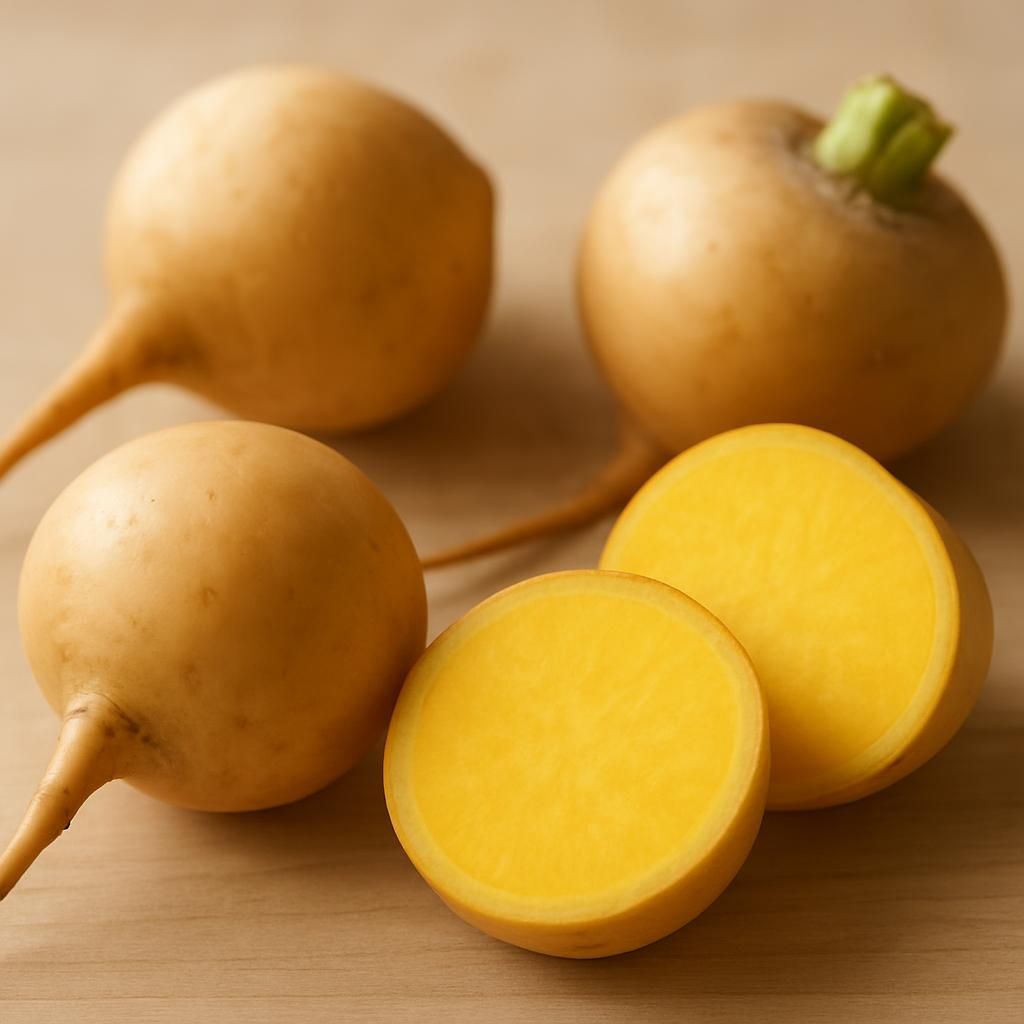
Introduction to Turnip (Golden Ball)
Golden Ball turnip is a classic yellow-fleshed variety favored by market gardeners and home growers for its sweet flavor, smooth texture, and exceptional storage life. Developed in Europe and widely adopted in temperate regions, this heritage cultivar produces uniform, globe-shaped roots with bright golden interiors that retain color and sweetness even after months in storage. Unlike many modern hybrids, Golden Ball offers reliable performance across varying soil conditions while resisting common brassica issues. Its dual-purpose nature—roots for fresh markets and tops for livestock feed—makes it a staple in diversified vegetable systems. Growers seeking dependable cool-season production and long-term root storage consistently rank Golden Ball among top-performing turnip varieties.
Botanical Profile of Turnip (Golden Ball)
Turnip (Golden Ball) belongs to the Brassicaceae family and is botanically classified as Brassica rapa subsp. rapa. The plant produces a swollen hypocotyl-root that develops into a smooth, round globe typically 8–12 cm in diameter with thin, light tan skin and vibrant yellow flesh. Foliage consists of deeply lobed, glaucous green leaves arranged in a basal rosette; petioles are slender and may show purple pigmentation at the base. The root system is relatively shallow, making the crop responsive to surface moisture and nutrient availability. Golden Ball is an annual or biennial depending on climate; under long-day conditions it may bolt and produce yellow, four-petaled flowers typical of the mustard family. Seed pods are siliques containing small, round, dark brown seeds. Compared with white-fleshed types such as Purple Top White Globe Turnip, Golden Ball exhibits slower bolting and superior flavor retention after frost.
Soil, pH, and Climate Requirements for Turnip (Golden Ball)
Golden Ball turnips perform best in fertile, well-drained loam or sandy loam soils with good structure and high organic matter. Heavy clay soils should be amended with compost or raised beds to prevent waterlogging and root deformation. The crop prefers cool temperatures between 10–20 °C for optimal root development; temperatures above 25 °C promote bitterness and bolting. Consistent moisture is critical during root enlargement, yet the variety tolerates moderate drought once established.
| Parameter | Ideal Range | Notes |
|---|---|---|
| Soil Type | Loam to sandy loam | Well-drained; avoid compacted clays |
| Soil pH | 6.0–7.0 | Slightly acidic to neutral; lime if below 5.8 |
| Temperature (day) | 15–20 °C | Optimal root sweetness and size |
| Temperature (night) | 5–10 °C | Prevents bolting |
| Soil Temperature | 10–18 °C at planting | Germination occurs at 7 °C minimum |
| Moisture | 25–30 mm/week | Consistent; avoid water stress at bulbing |
| Organic Matter | 3–5 % | Improves drainage and nutrient retention |
| Salinity Tolerance | Low | Sensitive to high salt levels |
Step-by-Step Planting & Propagation
Site selection begins with a sunny location receiving at least six hours of direct light. Prepare the seedbed by incorporating 5–7 cm of well-rotted compost and performing a deep cultivation to 25 cm. Conduct a soil test and correct pH to 6.0–7.0 using agricultural lime if necessary. Sow seeds directly 1–2 cm deep in rows 30–45 cm apart; thin seedlings to 8–10 cm in-row spacing once true leaves appear. For successive harvests, sow every 10–14 days from early spring through late summer in cool climates. In regions with mild winters, fall sowing 60–75 days before first frost yields sweet, storage-quality roots. Germination typically occurs in 5–10 days at soil temperatures above 10 °C. Protect young seedlings from flea beetles with floating row covers during the first three weeks. Avoid transplanting; direct seeding prevents root disturbance and forking.
Care & Maintenance regimes for Turnip (Golden Ball)
Maintain uniform soil moisture through drip irrigation or soaker hoses to prevent growth cracks and bitterness. Mulch with 5–8 cm of straw or leaf mold after thinning to suppress weeds and moderate soil temperature. Side-dress with a balanced organic fertilizer (NPK 5-5-5) at 200 kg/ha when roots reach marble size. Monitor for nitrogen excess, which favors leafy growth over root development. Hand-weed or use shallow cultivation between rows until canopy closure. Remove yellowing lower leaves to improve airflow and reduce disease pressure. In windy sites, consider low tunnels for wind protection during establishment.
| Growth Stage | Water Schedule | Fertilizer Application | Pruning/Thinning Schedule |
|---|---|---|---|
| Germination (0–14 days) | Light daily misting to keep surface moist | None; pre-plant incorporation sufficient | Thin to 8–10 cm when first true leaves emerge |
| Vegetative (2–5 weeks) | 20–25 mm/week; maintain even moisture | 100 kg/ha N at 3 weeks if deficiency appears | Remove weeds; no leaf pruning needed |
| Bulbing (5–9 weeks) | 25–30 mm/week; avoid fluctuations | Side-dress 150 kg/ha balanced organic at marble size | Thin any remaining doubles; remove damaged leaves |
| Pre-harvest (9–11 weeks) | Reduce to 15 mm/week to firm roots | None; excess N reduces storage life | Remove yellow basal leaves for airflow |
Pests, Diseases & Organic Management
Common insect pests include flea beetles, aphids, and cutworms. Floating row covers provide the most effective barrier against flea beetles during early growth. Encourage beneficial insects by planting nectar sources such as alyssum and dill. For aphids, release lady beetles or apply insecticidal soap at the first sign of colony formation. Cutworms can be controlled with collars around seedlings or Bacillus thuringiensis (Bt) baits. Disease pressure is generally low in well-drained soils, but clubroot, Alternaria leaf spot, and downy mildew may occur. Practice a minimum three-year rotation away from brassicas and maintain soil pH above 6.8 to suppress clubroot. Remove and destroy infected foliage promptly. Copper-based fungicides offer limited organic control for leaf spot diseases when applied preventively.
Harvesting, Curing & Optimal Storage
Golden Ball turnips reach harvest maturity 55–70 days after sowing when roots measure 8–10 cm in diameter. Harvest on a dry day by loosening soil with a fork and pulling gently to avoid bruising. Trim tops to 2 cm and roots to 1 cm. For immediate use, wash and store at 0–2 °C with 95 % relative humidity for up to three months. For long-term storage, cure roots at 10–15 °C and 85–90 % humidity for 5–7 days to heal harvest wounds, then move to 0–2 °C. In root cellars, layer roots in damp sand or sawdust; check monthly and remove any showing soft rot. Properly stored Golden Ball roots retain sweetness and color for 4–6 months.
Companion Planting for Turnip (Golden Ball)
Turnips benefit from proximity to nitrogen-fixing legumes such as peas and beans, which improve soil fertility without excessive vegetative growth. Aromatic herbs including thyme, rosemary, and nasturtium deter flea beetles and aphids through volatile compounds. Avoid planting near other brassicas to reduce shared pest and disease pressure. Interplanting with onion or garlic masks turnip scent and reduces insect attraction. Deep-rooted companions such as carrot or beet can be grown in alternate rows to maximize bed space without competition. After harvest, sow a green manure of clover or hairy vetch to rebuild soil organic matter and break pest cycles.