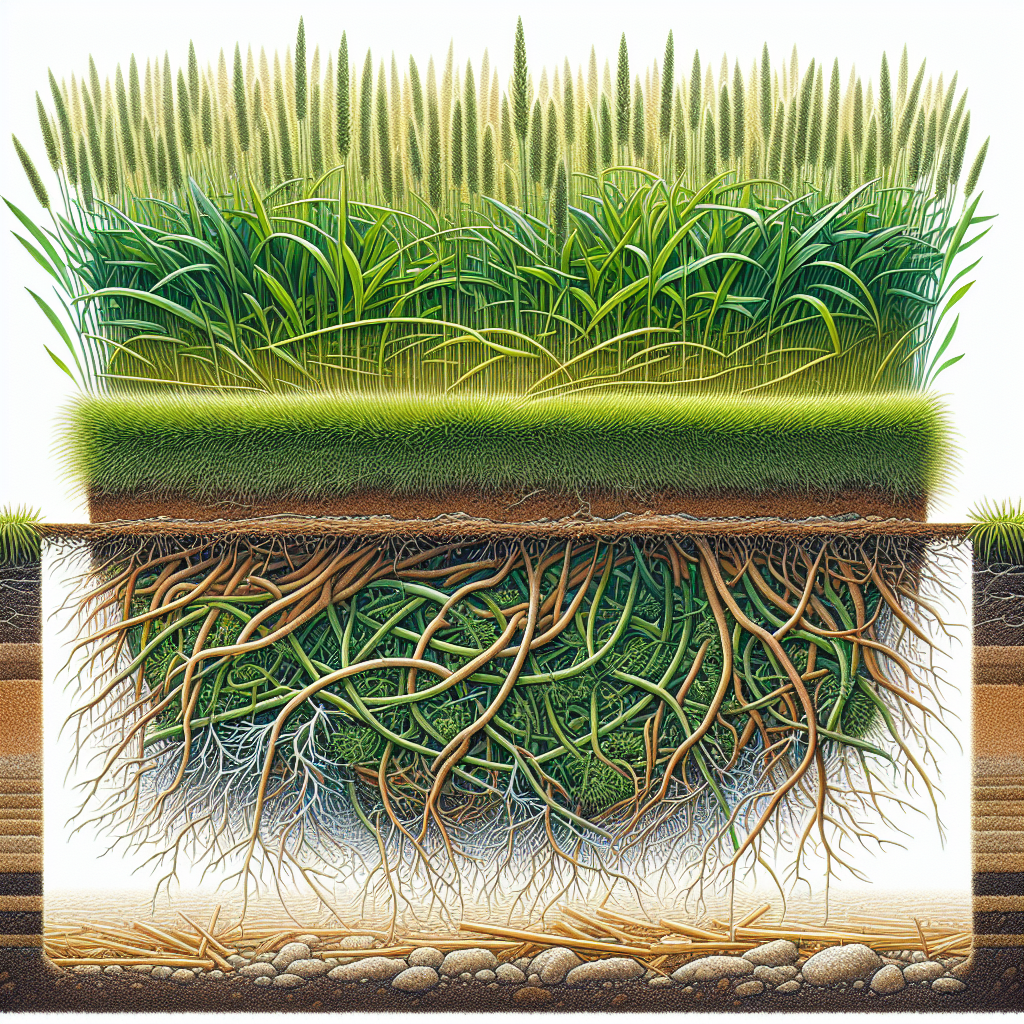
Introduction to turfgrass
Turfgrass species, such as Kentucky bluegrass (Poa pratensis), tall fescue (Festuca arundinacea), and bermudagrass (Cynodon dactylon), are perennial grassy weeds that pose significant challenges in agricultural settings. While valued in lawns and sports fields for their durability, in crop production they act as invasive competitors, smothering desirable plants like corn, wheat, and soybeans. Turfgrass thrives in disturbed soils, spreading rapidly through underground rhizomes and above-ground stolons, forming dense mats that reduce yields by up to 50% in severe infestations. This guide provides professional-grade diagnostics, organic management strategies, and prevention tactics tailored for farmers and agronomists battling turfgrass encroachment. Understanding its biology is key to reclaiming fields without resorting to synthetic chemicals. For small farms optimizing layouts, check this guide on zoning farm chaos into profit zones.
Turfgrass invasion often starts subtly in field edges or overgrazed pastures, escalating to full-field dominance within 2-3 seasons. Its deep root systems access water unavailable to shallow-rooted crops, exacerbating drought stress during dry spells. Economically, turfgrass costs U.S. farmers millions annually in lost productivity and control measures. Early detection and integrated management are essential for sustainable agriculture.
Identifying Symptoms & Damage
Diagnosing turfgrass infestations requires distinguishing it from crop grasses or other weeds. Look for fine to coarse leaf blades (0.5-5mm wide) with boat-shaped leaf tips in Poa species or V-shaped leaves in fescues. Bermudagrass features wiry stems and gray-green hue. Damage manifests as:
- Stunted crop growth: Turfgrass competes vigorously, yellowing nearby crops due to nutrient theft.
- Dense mats: Intertwined tillers and stolons form impenetrable covers, preventing seed germination.
- Patchy fields: Circular or irregular patches expand outward, often 6-12 inches per month.
- Root competition: Excavate soil to reveal extensive rhizome networks 6-12 inches deep.
Visual cues include seedheads in summer (spike-like inflorescences) and a fibrous root mass. Unlike broadleaf weeds, turfgrass lacks showy flowers. Test by pulling: turfgrass roots snap with resistance, unlike annual grasses. Associated issues include increased army worm activity, as grubs feed on turfgrass roots, indirectly harming crops. Use a magnifying glass for auricle identification—Poa has membranous auricles, fescue clasping.
Yield impacts: In potato fields, turfgrass reduces tuber size by 30%; in orchards, it shades young trees. Soil compaction worsens under mats, limiting aeration. Scout weekly during establishment phases.
Lifecycle and Progression of turfgrass
Turfgrass exhibits a perennial lifecycle with vegetative and reproductive phases. Germination occurs in spring (soil temps 50-65°F) from seeds or rhizome buds. Vegetative growth peaks in summer via tillering, with stolons/rhizomes elongating 1-2 feet annually. Flowering happens mid-summer, producing wind-dispersed seeds viable 2-3 years.
Overwintering occurs via crowns and roots, resuming growth at 40°F. Full maturity in 60-90 days; established stands persist 10+ years. Progression:
- Seedling stage (0-30 days): Rapid establishment.
- Vegetative expansion (1-6 months): Mat formation.
- Reproductive (summer): Seed set.
- Dormancy (winter): Root storage.
Multiple cohorts per year in warm climates. Dormancy breaks with moisture. This resilience demands season-long management. Compare to root-knot nematodes, which exploit weakened turfgrass-infested soils.
Environmental Triggers & Risk Factors
Turfgrass flourishes under specific conditions:
- Soil: Prefers pH 6.0-7.5, fertile loams; tolerates compaction.
- Climate: Cool-season (Poa, Festuca) in temperate zones; warm-season (Cynodon) in tropics.
- Triggers: Overgrazing, tillage, irrigation mimicking lawn conditions.
- Risks: Contaminated seed, equipment transfer, field margins near lawns.
Drought, poor fertility favor invasion over crops. Minimum tillage fields see 20% higher incidence. Proximity to clover cover crops aids spread. Monitor post-harvest residues.
Organic Control & Treatment Plans
Organic management targets lifecycle stages without synthetics:
Cultural Controls:
- Mow high (3-4 inches) to shade seedlings.
- Overseed competitive crops like rye.
- Solarization: Cover with plastic 4-6 weeks summer.
Mechanical:
- Repeated tillage disrupts rhizomes (3x/year).
- Flaming: 2,000°F propane torches kill tops.
Organic Herbicides:
- Vinegar (20% acetic acid) + citrus oil: Spot-spray.
- Clove oil + cinnamon oil formulations.
- Corn gluten meal: Pre-emergent (20 lbs/1,000 sq ft).
Biological:
- Beneficial nematodes (Heterorhabditis) target grubs.
- Grazing geese or chickens.
Integrated Plan:
- Scout/map infestations.
- Cultural prep (fall).
- Mechanical disruption (spring).
- Organic spray (summer).
- Monitor/repeat.
Success rates: 70-90% first year, 95% year 2. Combine with aphids controls if secondary pests surge. For misidentification risks, see this plant ID blog.
Preventing turfgrass in the Future
Prevention beats cure:
- Clean equipment/seeds: Hot water wash machinery.
- Barriers: Mulch field edges 6 inches deep.
- Crop rotation: Legumes smother grasses.
- Cover crops: Thick rye stands.
- Soil health: Balanced fertility reduces invasion.
Perennial no-till with covers cuts incidence 80%. Scout borders quarterly. Eradicate satellite patches immediately.
Crops Most Affected by turfgrass
Turfgrass plagues row crops and orchards:
- Grains: Corn, wheat—yield losses 20-40%.
- Vegetables: Potato, onion—root competition.
- Legumes: Soybeans, peas—shading.
- Orchards: Apple, mango—young tree suppression.
Worst in reduced-tillage systems. Orchards lose establishment vigor.