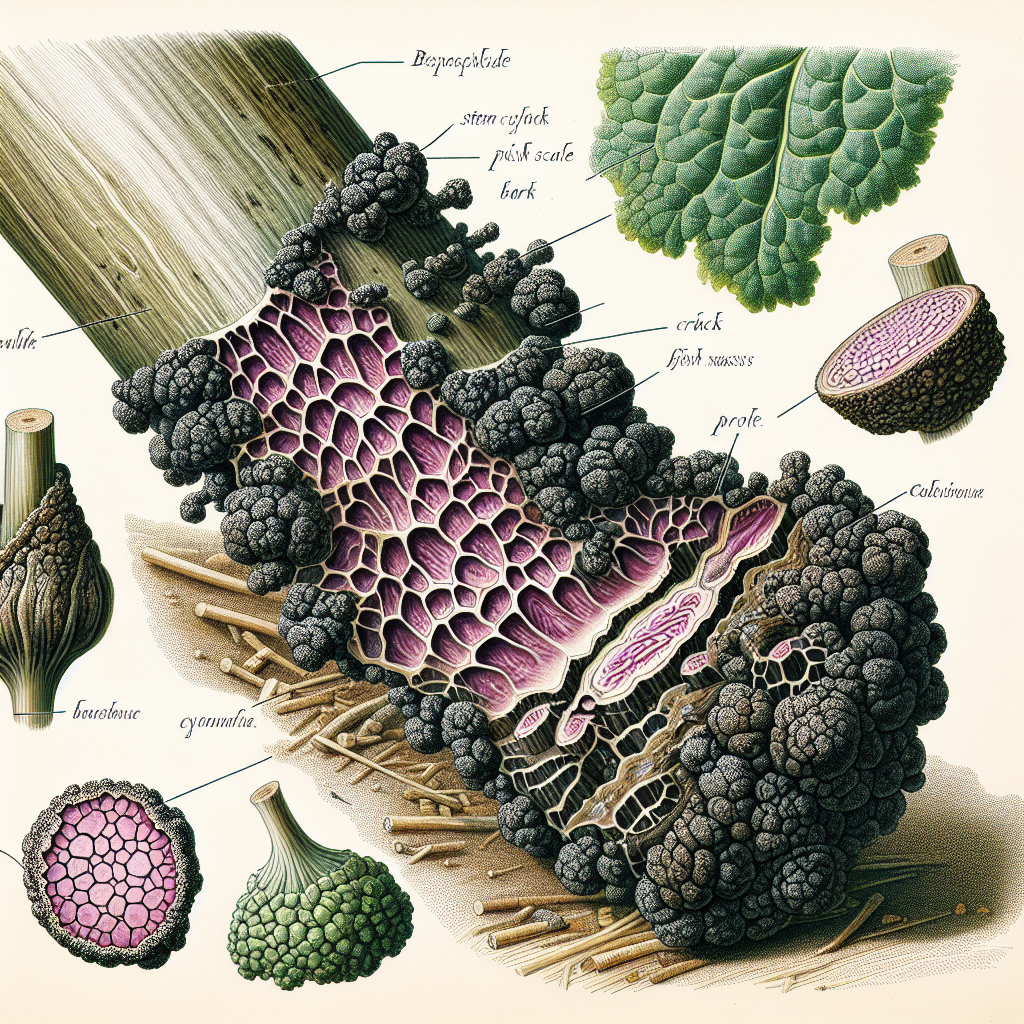
Introduction to Stem canker
Stem canker represents one of the most destructive fungal diseases in agriculture, particularly targeting brassica crops and causing significant yield losses worldwide. Caused primarily by pathogens like Leptosphaeria maculans (anamorph Phoma lingam), this disease manifests as dark, sunken lesions on stems, branches, and leaf petioles, eventually girdling the vascular tissue and leading to plant death. First identified in the early 20th century, stem canker has become a global concern due to its persistence in crop residues and soil, thriving in cool, moist conditions common in temperate growing regions.
Farmers often confuse stem canker with other stem diseases like collar rot or root rot, but its hallmark is the elongated, lens-shaped cankers with black pycnidia that produce pink spore masses under wet conditions. In severe outbreaks, losses can exceed 50-70% in susceptible varieties, making proactive management essential. This guide provides professional-grade diagnostic criteria, lifecycle insights, organic treatments, and prevention strategies to safeguard your crops. Understanding stem canker empowers growers to implement integrated pest management (IPM) approaches, minimizing chemical use while maximizing yields. For small farms, early intervention is key to profitability, especially in high-value brassica production. Read our comprehensive Fall Companion Planting Guide for synergistic planting tips that reduce disease pressure naturally.
Identifying Symptoms & Damage
Accurate diagnosis begins with recognizing the progressive symptoms of stem canker. Initial signs appear as small, pale brown spots on leaves or cotyledons, often 2-5 mm in diameter, which expand into larger lesions with grayish-white centers dotted by black pycnidia. On stems, these develop into characteristic cankers: elongated, sunken areas up to 10-20 cm long, dark brown to black, with cracked bark and a fish-scale appearance from splitting tissue.
As the disease advances, stems girdle at the canker site, causing above-ground wilting, yellowing of lower leaves, and lodging. Infected plants produce smaller heads in cabbage or broccoli, with internal stem discoloration visible upon splitting. Secondary symptoms include pinkish spore oozing during rain, aiding spore dispersal. Damage is most evident at the base of stems near soil level, distinguishing it from upper-stem issues like Phytophthora.
Economic impact is profound: in cabbage fields, yield reductions of 30-100% occur, with marketable head size dropping by 50%. Broccoli and cauliflower show stunted curds and hollow stems. Differentiate from black rot by the absence of V-shaped leaf lesions and fishy odor. Use a hand lens to confirm pycnidia, and submit samples to local extension services for confirmation. Regular scouting every 7-10 days during cool, wet periods is critical for small-scale growers.
Lifecycle and Progression of Stem canker
Stem canker follows a polycyclic lifecycle, overwintering as pycnidia in infected debris or as stromata in stem bases. Primary inoculum releases ascospores from pseudothecia in spring, carried by wind up to 5 km, infecting cotyledons and leaves during prolonged leaf wetness (over 8 hours at 15-20°C). Pycnidiospores then spread via rain splash within rows, penetrating wounds or stomata to form new cankers.
Progression spans 4-6 weeks from infection to visible symptoms, with latent periods favoring cool temperatures (10-20°C). Summer sees systemic spread internally via vascular tissue, emerging as mature cankers in fall. One lesion can produce millions of spores, amplifying epidemics. In residue-heavy fields, survival exceeds 3-4 years, linking to Rhizoctonia complexes.
Understanding this cycle informs timing: monitor post-rain periods and remove debris to break the chain. In brassicas, basipetal spread from leaves to stems accelerates girdling.
Environmental Triggers & Risk Factors
Stem canker thrives in cool (8-22°C), humid climates with >80% relative humidity and free moisture on tissues. Wet springs with frequent rains (>10 mm events) trigger ascospore release, while dense canopies from excessive nitrogen exacerbate splash dispersal. Poor drainage, compacted soils, and overhead irrigation heighten risk by prolonging leaf wetness.
Key factors include continuous brassica cropping, which builds inoculum; susceptible varieties like early cabbage types; and mechanical injury from cultivation. High residue from no-till systems without burial sustains pathogens. Regions like the Pacific Northwest or UK report annual epidemics under these conditions. Powdery mildew often co-occurs, weakening plants further.
Organic Control & Treatment Plans
Organic management emphasizes cultural, biological, and minimal barrier methods. Step 1: Sanitation - Destroy all debris post-harvest by deep plowing (15-20 cm) or flaming to kill 90% of pycnidia. Step 2: Rotation - Avoid brassicas for 3-4 years, intercropping with wheat or corn. Step 3: Resistant Varieties - Plant hybrids like 'Genesis' cabbage or 'Arcadia' broccoli with partial resistance.
Biologicals: Apply Coniothyrium minitans or Trichoderma spp. at 10^9 CFU/g rates pre-planting to parasitize sclerotia. Sprays: Use copper octanoate (OMRI-listed) at 2-3 L/ha every 10-14 days during wet periods, rotating with Bacillus subtilis (Serenade) for resistance management. Timing: Start at first leaf spots.
Treatment Protocol: Scout weekly; prune cankers 10 cm below, sterilize tools in 10% bleach. For outbreaks, rogue 20m buffers around foci. Integrate compost teas with aerated Streptomyces for suppressive soils. Efficacy reaches 70-85% with compliance. Avoid wounding during cultivation.
Preventing Stem canker in the Future
Prevention hinges on IPM: Select certified, disease-free seed; space plants 45-60 cm for airflow; use drip irrigation to minimize wetness. Apply lime to maintain soil pH 6.5-7.0, reducing pathogen activity. Mulch with straw (5-10 cm) to suppress splash.
Monitor with weather stations for >48 hours leaf wetness, triggering preventives. Foster biodiversity with hedgerows of marigold to disrupt spore clouds. Soil solarization in summer kills 80% inoculum. Long-term: Build soil organic matter >4% via cover crops like clover for resilience. Annual rotation and residue management yield 90% control.
Crops Most Affected by Stem canker
Stem canker primarily devastates Brassicaceae: Cabbage (up to 80% loss), broccoli (stunted heads), cauliflower (curd distortion), Brussels sprouts, kale (Lacinato Kale (Dino Kale)), turnip (Purple Top White Globe Turnip), radish (Daikon Radish), mustard, and canola (Canola (Rapeseed)). Oilseed rape suffers blackleg phase globally. Secondary hosts include soybeans and wild crucifers, serving as reservoirs. Focus protection on these high-value crops.