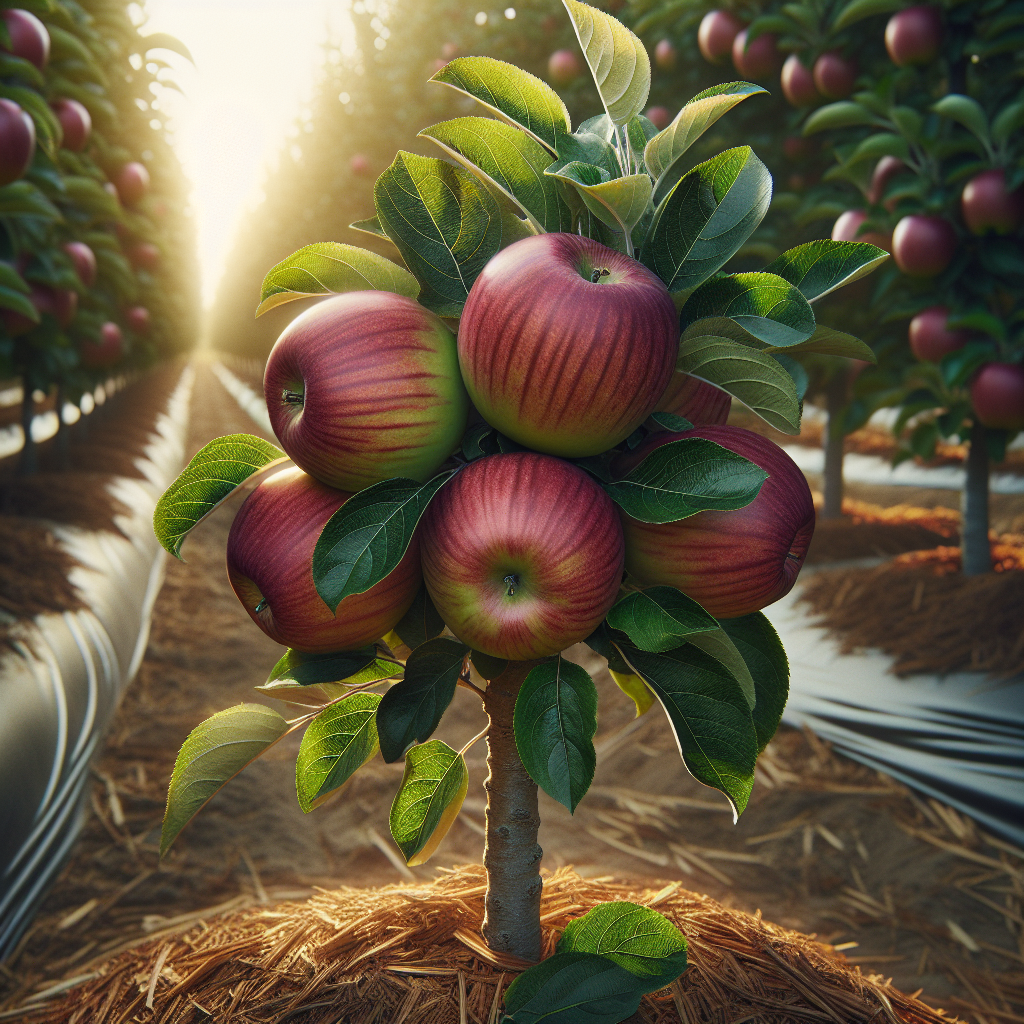
Introduction to Spartan Apple
Developed in British Columbia in the early 20th century and introduced commercially in the 1930s, this cultivar became popular for its attractive dark red to purplish skin, reliable cropping, and pleasant dessert quality. It is widely considered a McIntosh-type apple in character, though usually firmer, denser, and better colored than its famous parent line. Growers value it for fresh eating, farm-gate sales, and home orchards where flavor matters as much as appearance.
The tree is generally moderately vigorous, precocious on dwarfing rootstocks, and capable of producing heavily if crop load is managed well. Fruit quality is strongly influenced by sunlight exposure, crop balance, and harvest timing. If allowed to overcrop, apples can size poorly, coloration may be uneven, and return bloom the following year may decline. For broader species-level background, see our Apple guide.
Spartan is best suited to regions with a definite winter chill, moderate summer heat, and relatively dry late-season weather. In maritime or humid districts, its disease management needs rise significantly, particularly around Apple Scab and Powdery Mildew. Where the climate is favorable, however, it can reward growers with handsome fruit that stores reasonably well and develops a rich, sweet flavor shortly after harvest.
Botanical Profile of Spartan Apple
This cultivar belongs to the rose family, Rosaceae, and is a grafted selection of Malus domestica. Like nearly all commercial apples, it is not grown true from seed. Trees are propagated by grafting a Spartan scion onto a chosen rootstock, which largely determines final height, anchorage, precocity, and tolerance of certain soil conditions.
Tree habit is usually upright-spreading to somewhat compact, depending on rootstock and pruning system. Annual shoots can be moderately vigorous in young trees, then settle into a more balanced framework as the canopy matures. Fruiting occurs on spurs and short laterals, so pruning must preserve productive wood while maintaining light penetration. Excessively hard winter pruning often stimulates vegetative growth at the expense of fruiting.
Leaves are elliptic to ovate, medium green, and susceptible to foliar disease under high humidity or poor airflow. Blossoms open in spring as pink buds maturing to white flowers, typically in the mid-season bloom window. That makes pollination planning easier than with very early or very late cultivars, but Spartan still requires compatible pollen from another apple cultivar flowering at the same time. It is not reliably self-fertile.
Fruit is usually medium-sized, round to round-conic, with a dark crimson to nearly solid maroon overcolor when grown in full sun. The flesh is white, crisp when properly harvested, juicy, and sweet with mild acidity and a fragrant, vinous note. Compared with some modern ultra-crisp cultivars, the flesh can soften sooner in storage, so timing and temperature control matter. Typical harvest is mid-season to mid-late season depending on region, often after McIntosh and around the broad harvest window of many cool-climate dessert apples.
Rootstock choice is critical. On M9 or similar dwarfing stocks, trees are early-bearing and easy to manage but need permanent support and consistent irrigation. On M26, they are somewhat larger and still precocious, though susceptible to some site limitations. Semi-dwarf stocks such as MM106 give a larger tree with broader adaptability but require more space and stronger pruning discipline. Standard trees are rarely preferred in modern production because harvest, spraying, and pruning become less efficient.
Soil, pH, and Climate Requirements for Spartan Apple
This cultivar performs best in deep, well-drained loam or sandy loam with moderate organic matter and good internal aeration. Ideal topsoil depth is at least 45-60 cm, with no hardpan or persistent perched water table. Apple roots need oxygen as much as water; when soil remains saturated for several days, feeder roots decline, nutrient uptake falters, and trees become vulnerable to root diseases and stress.
Target soil pH is 6.0 to 6.8, with 6.2 to 6.5 being especially workable for balanced nutrient availability. In soils below pH 5.8, calcium and magnesium may become limiting and root performance can suffer. In alkaline soils above pH 7.2, iron, manganese, and zinc availability often drops, leading to pale foliage, weak shoot growth, and reduced fruit quality. If pH is too low, incorporate agricultural lime several months before planting based on a soil test. If too high, sulfur amendments can help, but correction is slower and more difficult in calcareous ground.
Drainage is non-negotiable. Spartan does not tolerate wet feet well. A useful field test is to dig a hole 45 cm deep, fill it with water, and observe drainage after the soil is fully wetted. If water remains after 24 hours, drainage is marginal for apples unless planting is done on raised berms or ridges. In heavy clay, adding surface organic matter helps structure over time, but do not simply fill the planting hole with compost alone, which can create a bathtub effect.
For moisture, aim to keep the active root zone evenly moist but never waterlogged. During active growth, a soil moisture level near field capacity in the upper 20-30 cm is ideal. In practical terms, soil should feel cool and slightly damp when squeezed, forming a weak ball that breaks apart easily. If it is sticky, shiny, and airless, it is too wet. If it is powdery at 10-15 cm depth, trees are entering moisture stress. Young Spartan trees under drought often show reduced shoot extension, smaller leaves, and fruitlets dropping during early summer. Chronic overwatering shows up as yellowing foliage, poor terminal growth, lenticel swelling on fruit, and sometimes a sour smell in compacted soil.
Climate-wise, Spartan prefers cool temperate regions with sufficient winter chilling, generally 800-1,200 chill hours or more, though exact needs vary by site and rootstock interactions. It colors best where days are sunny and nights cool during ripening. Very hot inland sites can produce softer flesh, sunburn, and less refined flavor unless irrigation and canopy management are excellent. Spring frost is a risk because blossoms and king bloom are sensitive once flower clusters separate. Sites with slight air drainage, such as gentle slopes rather than frost pockets, improve reliability.
Full sun is essential for color and sugar accumulation. A minimum of 8 hours of direct sun is recommended, but commercial-quality fruit color usually comes from all-day exposure and a well-managed canopy. Wind exposure should be moderate; some air movement reduces disease pressure, yet very exposed sites can damage blossoms, disrupt pollinator activity, and increase limb breakage in heavily cropped years.
Step-by-Step Planting & Propagation
Propagation is almost always by grafting. If you are producing your own trees, collect dormant one-year scion wood from healthy, true-to-type Spartan trees in winter. Store wrapped scions just above freezing until bench grafting in late winter or field grafting in spring. Whip-and-tongue grafting onto compatible rootstocks is common for nursery production because it gives strong cambial contact and uniform young trees. For most growers, however, buying certified disease-free nursery stock is the better route.
Choose feathered one-year trees or well-formed two-year trees from a reputable nursery. Inspect roots carefully: healthy roots are fibrous, light-colored inside when cut, and free from galls, black lesions, or sour odor. Reject any tree with trunk wounds, cankers, or poorly healed graft unions.
Plant while dormant, typically in early spring in cold regions or late autumn to winter in milder temperate climates where soil remains workable. Avoid planting in waterlogged ground or when the soil is so wet that digging smears the sidewalls of the hole.
Step-by-step planting process:
- Soil test 3-6 months ahead. Correct pH, phosphorus, potassium, calcium, and magnesium before planting because incorporation is easiest before trees go in.
- Control perennial weeds in a 1-1.5 meter strip where the row will be established. Grass competition is especially damaging to young apples because it captures moisture and nitrogen near the surface.
- Lay out spacing according to rootstock. Dwarf Spartan on M9 may be spaced about 0.9-1.5 m within row and 3-4 m between rows in high-density systems. Semi-dwarf trees may need 3.5-5 m between trees and wider alleys.
- Install posts and trellis before or at planting if using dwarf stocks. Do not wait until trees are loaded with fruit.
- Dig a hole only as deep as the root system and at least twice as wide. Spread roots naturally rather than forcing them downward.
- Set the tree so the graft union remains 8-12 cm above final soil level. If the union is buried, the scion may root, defeating rootstock size control.
- Backfill with native soil, breaking large clods. Do not heavily amend the hole itself; instead improve the wider site.
- Water thoroughly after planting to settle soil around roots. A newly planted tree typically needs 10-20 liters at planting depending on soil texture and root size.
- Mulch 5-8 cm deep with wood chips or similar organic material, keeping mulch 8-10 cm away from the trunk to prevent crown rot and rodent habitat.
- Head the tree if needed to establish scaffold height and train immediately to the intended system, such as tall spindle, central leader, or slender spindle.
Pollination planning is crucial. Spartan needs pollen from another compatible cultivar blooming in the same window. Crabapples used as pollenizers can also work if bloom overlaps well. Bee activity must be supported with pollinator presence and low insecticide risk during bloom. Poor pollination causes misshapen fruit, low fruit set, and irregular crop distribution.
For young trees, remove most or all fruit in the first year after planting and limit crop in year two if vigor is weak. Early cropping on a small framework can permanently stunt canopy development.
Care & Maintenance regimes for Spartan Apple
Training and pruning determine long-term productivity. Spartan benefits from a central leader system that keeps the canopy narrow enough for light penetration. In the first 3-4 years, focus on branch angle, scaffold placement, and leader dominance rather than heavy fruiting. Limbs with crotch angles of roughly 60-75 degrees are strong and fruitful; narrow upright branches should be spread or removed.
Dormant pruning should be moderate. Remove dead, diseased, crossing, and heavily shaded wood. Thin out congested fruiting spurs where necessary, especially in older trees, to reduce biennial tendency and improve fruit size. Summer pruning can be useful on vigorous trees to improve light and color, but avoid overdoing it in hot climates where fruit sunburn is possible.
Irrigation should be tailored to tree age, soil texture, and evapotranspiration. Young trees often need 10-20 liters per watering 2-3 times per week in sandy soil during warm weather, but only once every 5-7 days in heavier loam if moisture is retained well. Mature bearing trees commonly require the equivalent of 25-40 mm of water per week during active fruit sizing, adjusted for rainfall. The most critical periods are bloom through cell division, early fruit set, and the 6-8 weeks before harvest when fruit size and soluble solids are being built. Severe moisture deficits during these stages cause smaller fruit, premature drop, and weak return bloom.
The best practice is drip irrigation with one or more emitters adjusted as the root zone expands. Avoid frequent shallow watering that keeps only the surface wet. Roots should be encouraged to occupy a broad, oxygenated volume of soil. Conversely, continuously saturated drip zones invite Phytophthora and nutrient imbalance.
Nutrition should be based on soil and leaf analysis, not guesswork. Young non-bearing trees need enough nitrogen to build framework, but excessive nitrogen produces lush, disease-prone growth and poor fruit color later. A practical benchmark in many orchards is to aim for 20-30 cm of annual extension growth on mature bearing trees; much more suggests over-vigorous nutrition or overly hard pruning. Nitrogen is commonly applied in split spring doses, while potassium and phosphorus are managed primarily through preplant amendments and maintenance applications as tests indicate.
Calcium deserves special attention because it supports firmness, storage life, and resistance to physiological disorders. Even where soil calcium is adequate, fruit calcium can be low if trees are excessively vigorous or crops are imbalanced. Foliar calcium sprays through the season are often used in quality-focused orchards. Boron and zinc may also be required in small but important amounts where deficiencies are known.
Thinning is essential because Spartan can set heavily. Hand thinning or chemical thinning should aim to leave one fruit per cluster, spaced roughly 15-20 cm apart along fruiting wood, depending on tree vigor and target fruit size. Thin early, ideally within 4-6 weeks after bloom. Early thinning improves cell number, fruit size, color, and next year's flower bud formation. If clusters are left crowded, fruit remain small, limbs overload, and the tree may alternate bear.
Weed management should maintain a vegetation-free strip around the tree row, especially for the first 3-5 years. Mulch helps, but monitor Vole activity. In-row competition from sod can reduce nitrogen, water availability, and young tree growth dramatically.
Orchard floor management between rows often includes mowed grass or mixed cover. Leguminous covers such as Clover can support pollinators and contribute some nitrogen cycling, but keep vigorous covers away from the immediate trunk zone. For broader ground-building ideas, the principles in soil health strategies are highly relevant to orchard systems.
Pests, Diseases & Organic Management
Spartan is not the easiest cultivar in humid climates because it is notably susceptible to Apple Scab and can also be affected by Powdery Mildew. In areas with wet springs, an organic program must be preventive, not reactive. Good airflow, sanitation, and timely protective sprays matter more than any single cure.
Apple Scab, caused by Venturia inaequalis, appears first as olive-brown lesions on leaves and fruit. Lesions on fruit later become corky, cracked, and cosmetically damaging. Overwintering infected leaves are a major inoculum source. Organic control starts with leaf litter management: shred fallen leaves with a mower, promote decomposition with nitrogen where appropriate, and remove severely infected debris in small orchards. Canopy thinning to speed drying after rain is critical. Sulfur and lime sulfur programs are standard organic tools, though timing must match infection periods and care is needed to avoid phytotoxicity under certain conditions.
Powdery Mildew causes silvery or white fungal growth on shoots, leaf curling, and weak blossom clusters. The pathogen overwinters in infected buds, so dormant and early-season pruning out of mildewed terminals lowers pressure. Excess nitrogen worsens the problem by encouraging susceptible, succulent growth.
Fire Blight is a bacterial disease that can devastate apples in warm, humid bloom periods. Watch for blackened blossoms, shepherd's-crook shoot tips, and amber ooze. Prune infected wood well below visible symptoms, disinfecting tools between cuts when pressure is high. Avoid excessive nitrogen and severe pruning that stimulate rank growth. Select rootstocks carefully because some are more vulnerable than others.
Cedar Apple Rust may occur where junipers are nearby, causing bright leaf spots and fruit blemishes. Sanitation and varietal planning help, though site pressure varies widely.
Key insect pests include Codling Moth, Apple Maggot, Aphids, Leafrollers, Scale, and Mites. Codling Moth larvae tunnel into fruit, leaving frass at entry points. Organic management usually combines monitoring traps, sanitation, mating disruption where feasible, and well-timed biological or approved organic insecticides. Apple Maggot causes internal tunneling and dimpling; sticky traps and orchard sanitation reduce populations. Aphids distort new growth and encourage sooty mold through honeydew. Strong water sprays, beneficial insects, and balanced fertility can keep colonies below damaging levels.
Organic orchard success depends on integrated practices:
- Remove dropped fruit promptly to break pest cycles.
- Prune for light and airflow.
- Avoid overhead irrigation late in the day.
- Encourage beneficial insects with flowering borders and companion species.
- Monitor weekly from tight cluster through harvest.
- Use traps to time interventions rather than spraying by calendar alone.
Rodents and deer can also be serious. Use trunk guards against Vole and Rabbit damage, especially in winter. Deer fencing is often more reliable than repellents where browsing pressure is high.
Harvesting, Curing & Optimal Storage
Harvest timing is one of the biggest determinants of quality. Spartan is often at its best when picked mature but not overripe. If harvested too early, flavor is underdeveloped and flesh can be starchy. If left too long, fruit may lose crispness, become softer in storage, and bruise more easily. Indicators include full varietal color, ease of separation with a slight upward twist, browning seed color, background color shift, and starch conversion where testing is available.
Fruit should be harvested in multiple passes if color and maturity are uneven, especially in larger trees or shaded canopies. Pick gently, keeping stems attached. Stem punctures from careless handling can ruin nearby fruit in storage. Never pull straight down, which can tear spurs and reduce future yield.
Unlike crops that require true curing, apples mainly need prompt cooling. Field heat should be removed as soon as possible after harvest. Ideal storage is near 0-1°C with 90-95% relative humidity. At lower humidity, fruit shrivels; at warmer temperatures, respiration rises and texture declines faster. Good air circulation is important, but avoid direct airflow that dehydrates fruit.
Sort before storage. Keep only sound fruit free from insect entry, bruises, scab cracking, or rot lesions. Spartan stores moderately well, but not as long as the very best modern storage cultivars. In ordinary cold storage, expect several weeks to a few months of useful quality depending on harvest maturity and handling. Fruit for immediate fresh sale often benefits from a short post-harvest rest, as flavor can become rounder and sweeter after a brief storage period.
For small-Scale growers, ventilated crates or shallow picking bins are preferable to deep containers that compress lower layers. Wash only just before sale or use, not before storage, unless commercial sanitation and drying protocols are in place.
Companion Planting for Spartan Apple
Companion planting around apple trees works best when it serves orchard functions: pollinator support, pest disruption, erosion control, and reduced weed pressure without creating intense root competition at the trunk. The most useful companions are low-growing, manageable, and beneficial to insects that prey on orchard pests.
Yarrow is valuable because its broad flower heads attract parasitic wasps, hoverflies, and predatory insects. It fits well on orchard margins or in managed strips where it will not overwhelm young trees. Thyme is another excellent option for sunny, well-drained sites; its dense, aromatic growth can help suppress weeds and its flowers support pollinators. Nasturtium can function as a sacrificial attractant for Aphids in mixed plantings and also brings pollinators, though it should be managed so it does not create humid tangles against trunks. Clover is widely used in alleys or diverse orchard floors to improve soil structure, feed pollinators, and soften compaction, but mow it regularly and keep a clear mulch ring around young trees.
Avoid planting aggressive, thirsty species directly in the tree root zone. Companions should sit outside the immediate trunk flare area, with the first 30-60 cm around the trunk kept clear. Also avoid tall, dense plants that reduce airflow or create rodent shelter right against the tree base.
A practical design is a mulched tree row, a lightly managed flowering strip offset from the trunk line, and a mowed living alley between rows. That arrangement supports beneficial ecology while preserving the water and nutrient priority that young Spartan trees need. In humid districts, always favor companion plantings that enhance biodiversity without crowding the canopy or slowing leaf drying after rain.