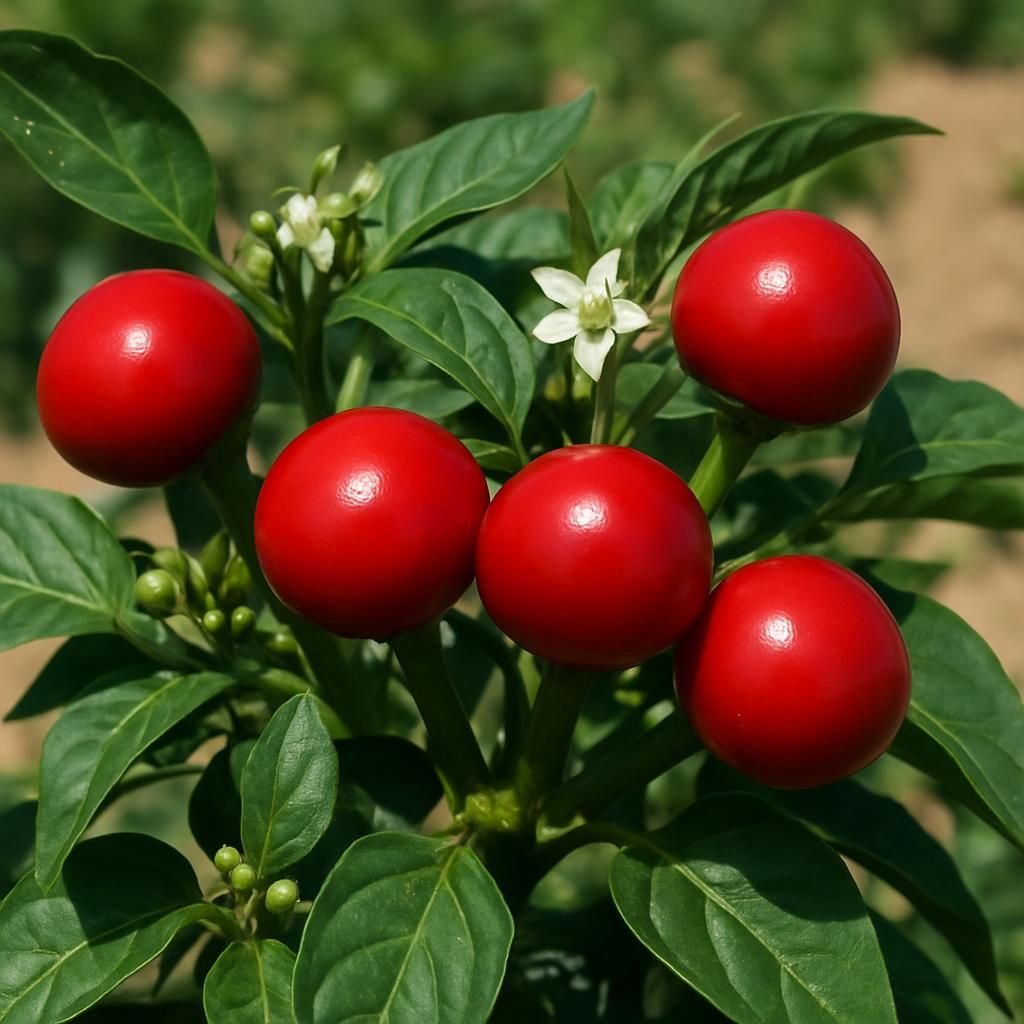
Introduction to Salem Gundu Chili
Salem Gundu Chili is a signature specialty crop of Tamil Nadu's Salem district, known for its perfectly spherical pods, thick walls, and vibrant scarlet hue when fully ripe. The variety delivers consistent Scoville heat levels between 40,000–80,000 SHU, making it a preferred choice for both fresh markets and the production of premium chili powders and pastes. Its compact plant habit and high fruit set under tropical conditions have made it a staple for smallholder farmers seeking reliable income from short-duration chili cultivation.
The crop thrives in the semi-arid zones of southern India where temperatures remain consistently warm and soils are well-drained. Growers value Salem Gundu Chili for its resistance to fruit cracking during monsoon transitions and its ability to retain color and pungency during sun-drying. This guide delivers professional-grade, actionable advice for producing high-quality Salem Gundu Chili using sustainable practices.
Botanical Profile of Salem Gundu Chili
Salem Gundu Chili belongs to the species Chili Pepper (Capsicum annuum). The plants are determinate to semi-determinate, reaching 60–90 cm in height with a bushy canopy. Leaves are ovate-lanceolate, medium green, and slightly pubescent. Flowers are small, white, and solitary, appearing 35–45 days after sowing.
The defining feature is the fruit: nearly perfect spheres 2.5–3.5 cm in diameter with thick, fleshy pericarp and 3–4 locules. Immature fruits are dark green, turning glossy red at physiological maturity. The variety exhibits moderate branching and sets 80–120 fruits per plant under optimal management. Seeds are flat, cream-colored, and number 60–80 per fruit.
Soil, pH, and Climate Requirements for Salem Gundu Chili
Salem Gundu Chili performs best in deep, well-drained sandy loam to clay loam soils rich in organic matter. The plant is sensitive to waterlogging; raised beds or ridges are essential in heavy soils.
| Parameter | Ideal Range | Notes |
|---|---|---|
| Soil Type | Sandy loam to clay loam | Well-drained; avoid saline or compacted soils |
| Soil pH | 6.0 – 7.0 | Slightly acidic to neutral; lime if below 5.8 |
| Temperature (Day) | 25 – 35 °C | Optimal fruit set occurs at 28–32 °C |
| Temperature (Night) | 18 – 22 °C | Below 15 °C reduces flowering |
| Annual Rainfall | 600 – 900 mm | Supplemental irrigation required in dry spells |
| Relative Humidity | 60 – 75 % | Higher humidity increases disease pressure |
| Altitude | 0 – 800 m | Performs well in plains and lower hills |
Step-by-Step Planting & Propagation
- Seed Selection & Treatment: Source certified Salem Gundu Chili seeds. Treat with Trichoderma viride (5 g/kg) and Pseudomonas fluorescens (10 g/kg) for 30 minutes before sowing.
- Nursery Preparation: Raise seedlings in 98-cell pro-trays or raised nursery beds using sterilized coco-peat and vermicompost (3:1). Sow 2–3 seeds per cell at 0.5 cm depth.
- Germination: Maintain 28–30 °C and 70–80 % humidity. Seeds germinate in 6–8 days. Thin to one seedling per cell at the two-leaf stage.
- Hardening: Reduce watering and expose seedlings to full sun 7–10 days before transplanting.
- Field Preparation: Prepare 30 cm high raised beds 90 cm wide. Incorporate 10–12 t/ha well-rotted FYM or vermicompost plus 50 kg neem cake per hectare.
- Transplanting: Transplant 35–40 day-old seedlings at 60 × 45 cm spacing (row × plant) during evening hours. Water immediately after planting.
Care & Maintenance regimes for Salem Gundu Chili
Consistent moisture, balanced nutrition, and timely pruning are critical for maximum yield and quality.
| Growth Stage | Irrigation Schedule | Fertilizer Application (per ha) | Pruning & Training |
|---|---|---|---|
| Seedling (0–30 DAS) | Light watering every 2 days in nursery | Basal: 25 kg N, 50 kg P₂O₅, 25 kg K₂O + 5 t FYM | Remove lower leaves touching soil |
| Vegetative (30–60 DAS) | 25–30 mm every 4–5 days | 30 kg N at 30 DAS; 20 kg N + 25 kg K₂O at 45 DAS | Pinch growing tip at 30 cm to encourage branching |
| Flowering (60–90 DAS) | 20–25 mm every 3–4 days; avoid water stress | 20 kg N + 25 kg K₂O + 10 kg MgSO₄ at 60 DAS | Remove weak basal shoots; stake if needed |
| Fruiting (90+ DAS) | 30 mm every 5–6 days; reduce before harvest | Foliar 2 % KNO₃ at 75 and 90 DAS; 10 kg K₂O at 90 DAS | Remove diseased fruits immediately |
Mulch beds with 5–7 cm paddy straw or black polythene to conserve moisture and suppress weeds. Side-dress nitrogen only when leaf color indicates deficiency.
Pests, Diseases & Organic Management
Major pests include Aphids, Thrips, Spider mites, and Fruit and shoot borers. Common diseases are Anthracnose, Bacterial spot, Powdery mildew, and Chili leaf curl disease.
Organic Management Protocol:
- Install yellow sticky traps at 25–30 per hectare for aphids, thrips, and whiteflies.
- Spray neem oil (3 ml/L) + 1 ml sticker every 10–12 days from 20 DAS onward.
- Release Trichogramma chilonis @ 50,000/ha at flowering for borer control.
- Apply Pseudomonas fluorescens (10 g/L) and Beauveria bassiana (5 g/L) alternately for disease suppression.
- Remove and destroy infected fruits and leaves to break disease cycles.
Harvesting, Curing & Optimal Storage
Harvest Salem Gundu Chili at full red ripe stage for drying or at mature green stage for fresh market. Pick every 4–5 days to encourage continuous fruiting. Average yield under good management is 12–18 t/ha fresh or 2.5–3.5 t/ha dry.
Curing: Spread fruits in single layer on clean tarpaulins under direct sun for 5–7 days, turning twice daily. Target moisture content of 8–10 % for storage.
Storage: Store dried pods in jute bags lined with polythene inside cool, dry rooms (temperature <25 °C, RH <60 %). Use silica gel sachets to prevent moisture re-absorption. Properly cured and stored Salem Gundu Chili retains color and pungency for 10–12 months.
Companion Planting for Salem Gundu Chili
Salem Gundu Chili benefits from strategic companions that improve soil health, deter pests, and optimize space.
- Marigold planted as border rows repels nematodes and attracts beneficial insects.
- Thai Basil intercropped at 1:4 ratio improves flavor and reduces thrips damage.
- Onion and Garlic act as natural insect repellents when planted in alternate rows.
- Coriander sown as trap crop draws aphids away from chili.
- Avoid planting near Eggplant and Tomato to reduce shared disease pressure.
For more on seasonal planning and soil health strategies, see The Forgotten Art of Fall Soil Revival: 8 Organic Strategies for Small Farm Resilience.