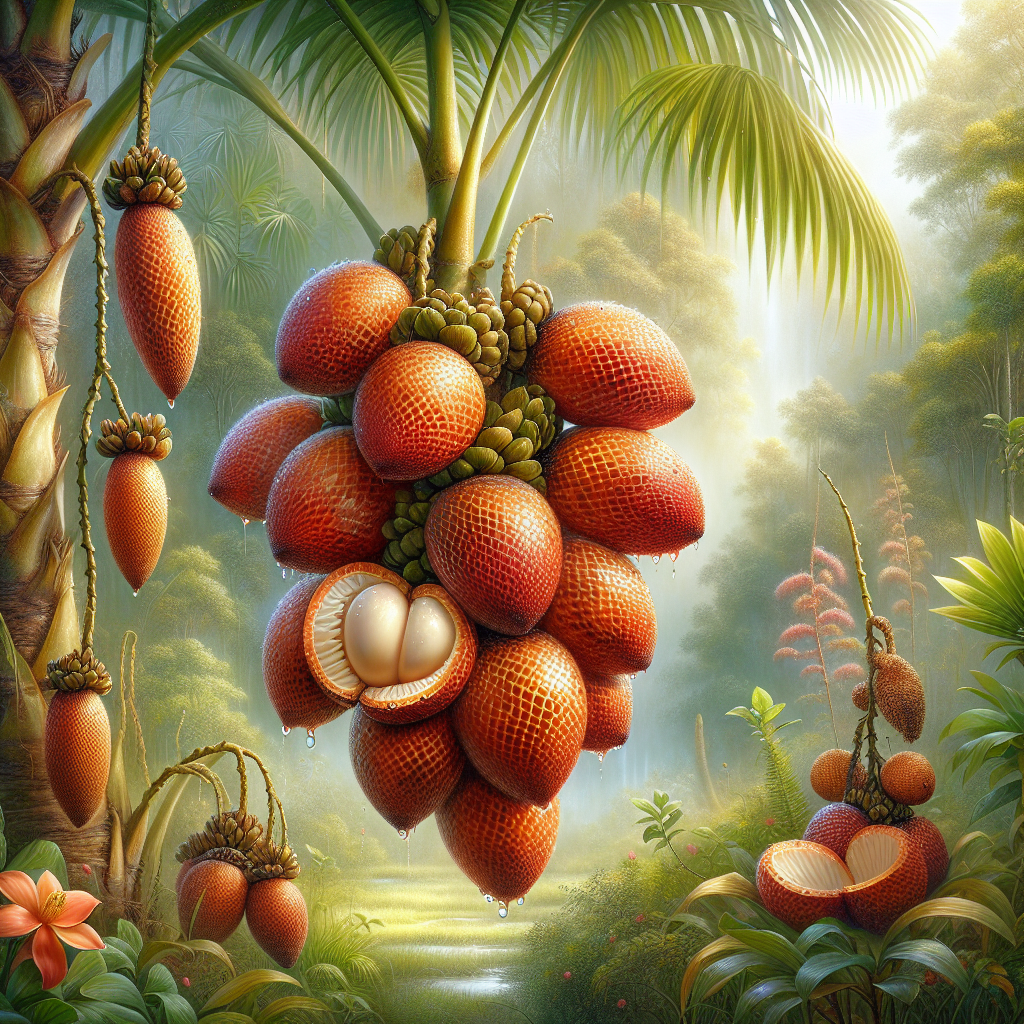
Introduction to Salak Bali
Salak Bali, often called snake fruit due to its reddish-brown, scale-like skin resembling a snake, is a standout tropical crop originating from Bali, Indonesia. Scientifically classified as Salacca zalacca var. Bali, this palm produces clustered fruits with creamy, tangy flesh surrounding large seeds, boasting a unique pineapple-banana-pine nut flavor profile that commands premium market prices. Unlike common palms, Salak Bali thrives in shaded, humid understories, making it perfect for intercropping in orchards or small farm agroforestry systems.
Farmers value Salak Bali for its year-round harvest potential—up to 50 kg per mature clump—and resilience to poor soils, though optimal management yields superior quality. Bali's cultivar excels with larger fruits (3-5 cm long) and higher sugar content (18-22° Brix) compared to generic salak varieties. This guide delivers professional-grade protocols for propagation, pest control, and post-harvest handling, drawing from Balinese farming traditions refined for global tropical growers. Expect first fruits in 3-5 years from suckers, with productive life spanning 25+ years. For small farms, Salak Bali offers ROI through local markets, exports, and value-added products like jams or dried snacks.
Botanical Profile of Salak Bali
Salak Bali belongs to the Arecaceae family, genus Salacca, characterized by its short, spineless trunk (rarely exceeding 2 m) and long, arching fronds up to 4 m with hooked spines on leaf sheaths for natural defense. It forms dense clumps from 3-12 suckers, reaching 4-6 m wide at maturity. Dioecious (separate male/female plants), it requires 1 male per 10-20 females for pollination via wind or insects; hermaphroditic variants exist but are less common.
Fruits develop in infructescences of 1-2 kg, each containing 20-50 oval fruits covered in tight, imbricate scales. Ripe fruits are deep red-brown, with 3-4 lobes of translucent, juicy flesh around a single large seed. Nutritionally, Salak Bali shines: 80% water, 12-15% carbs, rich in potassium (300 mg/100g), vitamin C, and antioxidants like beta-carotene. Growth is slow initially but accelerates post-establishment, with peak production at 8-12 years. Compared to pineapple, Salak offers similar acidity but superior shelf life due to its protective scales.
Soil, pH, and Climate Requirements for Salak Bali
Salak Bali demands well-drained, loamy soils rich in organic matter—sandy clay loams with 2-4% humus perform best, avoiding waterlogging that triggers root rot. Ideal pH is 5.5-6.8; test and amend acidic soils with lime (1-2 tons/ha) or alkaline with sulfur. Incorporate 20-30 tons/ha compost pre-planting for microbial activity and nutrient retention.
Tropical lowland climate is essential: 24-32°C average, no frost tolerance below 10°C. Rainfall of 1500-3000 mm/year evenly distributed, or irrigation supplementing dry spells (500-800 mm). High humidity (70-90%) and partial shade (30-50% light interception) mimic forest floors; full sun scorches young plants. Elevation up to 600 m suits Bali's cultivar. For heatwaves, reference strategies in Why Summer Heatwaves Are Silently Killing Small Farm Yields - And 7 Organic Strategies to Fight Back. Windbreaks from banana or coconut palms protect spiny fronds.
Step-by-Step Planting & Propagation
Propagation: Primarily via suckers (offsets) for true-to-type Bali genetics—select 1-2 year-old, 500g+ shoots with intact roots. Seed propagation is unreliable due to low germination (20-30%) and long juvenile phase (7+ years). Tissue culture offers disease-free clones but requires lab access.
- Site Prep: Clear land, plow to 50 cm, form raised beds (1x1 m, 30 cm high) spaced 4-5 m apart for clumps (100-150 plants/ha).
- Planting Hole: Dig 50x50x50 cm, mix soil with 10 kg compost, 200g rock phosphate, 100g wood ash.
- Planting: Trim fronds to 1 m, plant suckers at soil line, firm soil, mulch 10 cm with rice hulls or coconut coir.
- Irrigation: Water deeply (20-30 L/plant) weekly first year; drip systems ideal.
- Staking: Support young clumps against wind.
Transplant in rainy season; survival rate >95% with shading nets (50% shade). Fertilize at planting: 100g NPK 15-15-15 per plant.
Care & Maintenance regimes for Salak Bali
Irrigation: Maintain soil moisture without saturation—40-60% field capacity. Drip irrigate 20-40 L/plant/week in dry months.
Fertilization: Annual regime: Year 1-3: 200g N, 150g P2O5, 250g K2O + 50 kg manure/clump. Mature: 500g N, 300g P, 800g K split 3x/year. Foliar Ca-B sprays monthly prevent cracking.
Pruning: Remove 20-30% old fronds annually post-harvest; thin suckers to 4-6 vigorous per clump. Desucker aggressively to focus energy on fruiting.
Weeding/Mulching: Mulch 10-15 cm thick, renew yearly; slash weeds mechanically.
Pollination Boost: Plant 5-10% males; hand-pollinate if needed by transferring pollen.
Monitor via soil tests quarterly; adjust for Mg deficiencies common in sandy soils.
Pests, Diseases & Organic Management
Pests: Mealybugs cluster on infructescences—neem oil (2%) weekly. Scale insects on fronds: release Cryptolaemus montrouzieri ladybugs. Fruit-piercing moths: kaolin clay barriers. Rodents gnaw fruits—traps or marigold borders.
Diseases: Phytophthora root rot in wet soils—improve drainage, drench with Trichoderma (5g/L). Anthracnose on fruits: copper oxychloride pre-monsoon. Leaf spots (Alternaria)—remove debris, potassium phosphite sprays.
Organic IPM: Companion with ginger repels nematodes; beneficial nematodes for soil pests. See Why 90% of Small Farms Fail at Pest Management - And 8 Organic Fixes That Actually Work for protocols. Scout weekly; thresholds: 5% infested fruits.
Harvesting, Curing & Optimal Storage
Harvest when 70-80% scales loosen (6-8 months post-anthesis); clip bunches at peduncle, yield 20-50 kg/clump/year. Handle gently to avoid scale damage. Grade: Export (50g+ fruits), local (<50g).
Curing: Shade-dry 2-3 days at 25-30°C, 85% RH to toughen scales.
Storage: 13-15°C, 85-90% RH: 4-6 weeks shelf life. Controlled atmosphere (3% O2, 5% CO2) extends to 8 weeks. Avoid ethylene exposure.
Post-harvest losses <5% with proper sorting; process rejects into puree.
Companion Planting for Salak Bali
Salak Bali's shade tolerance suits understory planting: Dwarf Cavendish Banana for windbreaks and K recycling; Ginger or Turmeric in interrows suppress weeds/nematodes. Thai Basil deters flies. Avoid legumes (N competition) or heavy feeders like cassava. Gliricidia hedges fix N, mulch prunings. Benefits: 20-30% yield boost, diversified income. Read Why Companion Planting Feels Like Guesswork for Small Farms - And How AI Makes It Foolproof for optimization.