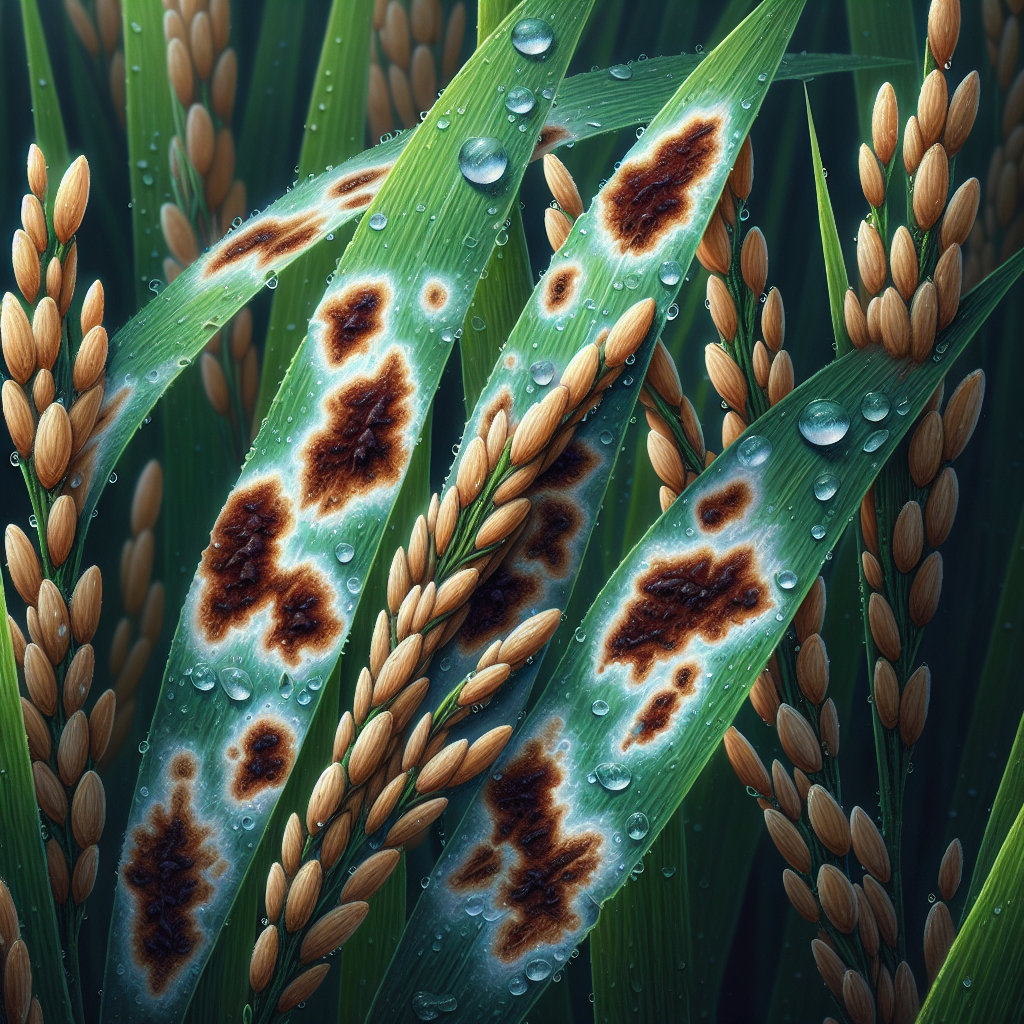
Definitive Diagnostic and Management Guide for Brown Spot
Introduction to brown spot
Brown spot, scientifically known as rice brown spot caused by the fungus Bipolaris oryzae (formerly Helminthosporium oryzae), is one of the most destructive foliar diseases impacting global rice production. First identified in Japan in the late 19th century, it has since become ubiquitous in rice-growing areas worldwide, particularly in Asia, Africa, and Latin America where rice is a staple crop. This disease thrives in environments with poor soil fertility, especially nitrogen deficiency, and high humidity, leading to yield reductions of up to 50% in severe epidemics.
Farmers often confuse brown spot with other leaf spot diseases like Cercospora leaf spot, but its distinct elliptical lesions with alternating light and dark borders set it apart. In small-scale and commercial farming, brown spot not only reduces photosynthesis through leaf necrosis but also affects grain quality, causing discoloration and reduced milling recovery. Understanding its biology is crucial for timely intervention. For more on optimizing farm management, check this insightful blog post on why timing kills small farm profits.
Economic impacts are profound: in India alone, brown spot causes annual losses exceeding millions of tons of rice. Climate change, with erratic rainfall and warming temperatures, is intensifying outbreaks. This guide provides professional-grade diagnostics, lifecycle insights, organic treatments, and prevention strategies tailored for sustainable agriculture. Whether you're growing Basmati Rice or Jasmine Rice, mastering brown spot control ensures healthier yields and profitability.
Identifying Symptoms & Damage
Early detection is key to managing brown spot. Initial symptoms appear 30-40 days after transplanting on lower leaves as small, circular to oval spots (1-3 mm) with grayish-white centers and brown margins. As the disease progresses, lesions elongate into characteristic elliptical brown spots, 0.5-1.5 cm long, with light brown centers surrounded by dark brown borders—a hallmark feature.
Advanced stages show lesions merging into large blighted areas, covering entire leaves, leading to premature senescence. On sheaths and glumes, spots are smaller but cause grain discoloration, reducing head rice recovery by 10-20%. Severe infections result in 20-45% yield loss, with tiller reduction and poor panicle exertion.
Differentiate from Alternaria leaf spot by the zonate pattern and from nutrient deficiencies by microscopic confirmation: conidia are fusiform, 5-7 septate, olive-brown. Damage extends beyond yield; infected grains fetch lower market prices due to brown discoloration. In wheat, similar symptoms may indicate Septoria leaf spot, but rice-specific diagnostics via PCR confirm B. oryzae.
Scout fields weekly from tillering stage, using a 10x hand lens for spore identification. Yield impacts are highest in rainfed lowland rice, where up to 90% leaf area can be affected, slashing harvests by half.
Lifecycle and Progression of brown spot
Bipolaris oryzae is a hemibiotrophic ascomycete with a complex lifecycle. Primary inoculum overwinters as mycelia or conidia in rice debris, seeds, and alternate hosts like barley or wild grasses. Spores germinate in free water (8-24 hours at 25-30°C), penetrating leaves via stomata or wounds.
The pathogen colonizes mesophyll, causing biotrophic phase (chlorosis) before switching to necrotrophy, producing toxins like ophiobolin A that kill host tissue. Conidiophores emerge from lesions under humid conditions (>90% RH), releasing 3-celled to multi-septate conidia dispersed by wind and splash.
Disease cycle repeats every 7-10 days, with 10-15 cycles per season. Sexual stage (Cochliobolus miyabeanus) forms pseudothecia in debris, producing ascospores for long-distance spread. Progression accelerates post-flowering, peaking at 50-90% humidity and 28°C.
Infected seeds perpetuate via embryo infection, with 5-20% carryover. Understanding this polycyclic nature informs timing of controls, targeting early lesions to break the cycle.
Environmental Triggers & Risk Factors
Brown spot epidemics surge under specific conditions: high humidity (85-100%), temperatures 20-35°C, and prolonged leaf wetness (>12 hours). Nitrogen-deficient soils heighten susceptibility, as low-N rice shows thinner cuticles. Poor drainage, dense planting (>40 hills/m²), and excessive tillering create microclimates for spore germination.
Rainfed ecosystems face highest risk during monsoon floods, while irrigated fields suffer from over-fertilization imbalances. Susceptible varieties like IR8 amplify damage; older cultivars show tolerance. Alternate hosts (sorghum, corn) nearby increase inoculum.
Soil pH <5.5 and low phosphorus/potassium exacerbate issues. Climate variability, with cloudy weather, extends wetness periods, boosting secondary spread. Risk assessment: score fields on NH₄⁺ levels, planting density, and prior debris.
Organic Control & Treatment Plans
Organic management integrates cultural, biological, and botanical strategies. Cultural: Destroy stubble by deep plowing (15-20 cm) to bury inoculum. Use clean seeds treated with hot water (52°C/10 min) or trichoderma. Apply balanced NPK (100:50:50 kg/ha split doses) to bolster resistance.
Biological: Seed-treat with Trichoderma harzianum (10 g/kg) or Pseudomonas fluorescens (10 g/kg). Foliar sprays of Bacillus subtilis (5 g/L) every 10 days from tillering suppress 40-60%. Introduce antagonistic fungi like Gliocladium virens.
Botanicals: Neem oil (5 ml/L) + garlic extract inhibits spore germination by 70%. Cow urine (5%) fermented with cow dung provides potassium-rich foliar nutrition. Bicarbonate sprays (5 g/L + sticker) alter pH, curbing growth.
Integrated Plan: Scout weekly; apply first spray at 5% severity, repeat 2-3 times 10 days apart. Rotate with soybeans to disrupt cycles. Biopesticides reduce severity by 50% without residues, ideal for export rice.
Preventing brown spot in the Future
Prevention hinges on IPM: Plant resistant varieties like IR36, BRRI dhan28 (tolerance >70%). Time transplants to avoid peak monsoon. Maintain 20-25 cm row spacing for airflow. Fertilize judiciously: basal P-K, split N.
Crop rotation with onion or garlic (1:1) cuts inoculum 80%. Flood fields intermittently to dry foliage. Use certified seeds (<0.1% infection). Monitor via traps for early warning.
Long-term: Breed hybrids with qBSR11 gene. Soil solarization (6 weeks summer) kills soilborne stages. Community-level debris management prevents regional spread. These reduce incidence 70-90%, ensuring sustainable yields.
Crops Most Affected by brown spot
Primarily rice (Oryza sativa), with upland and lowland ecologies hardest hit. Minor hosts: wheat, oats, sorghum, pearl millet, and grasses. In rice, Basmati and lowland indica suffer most; japonica less. Global hotspots: India, Bangladesh, Vietnam, Philippines. Emerging threats in quinoa under warming climates.