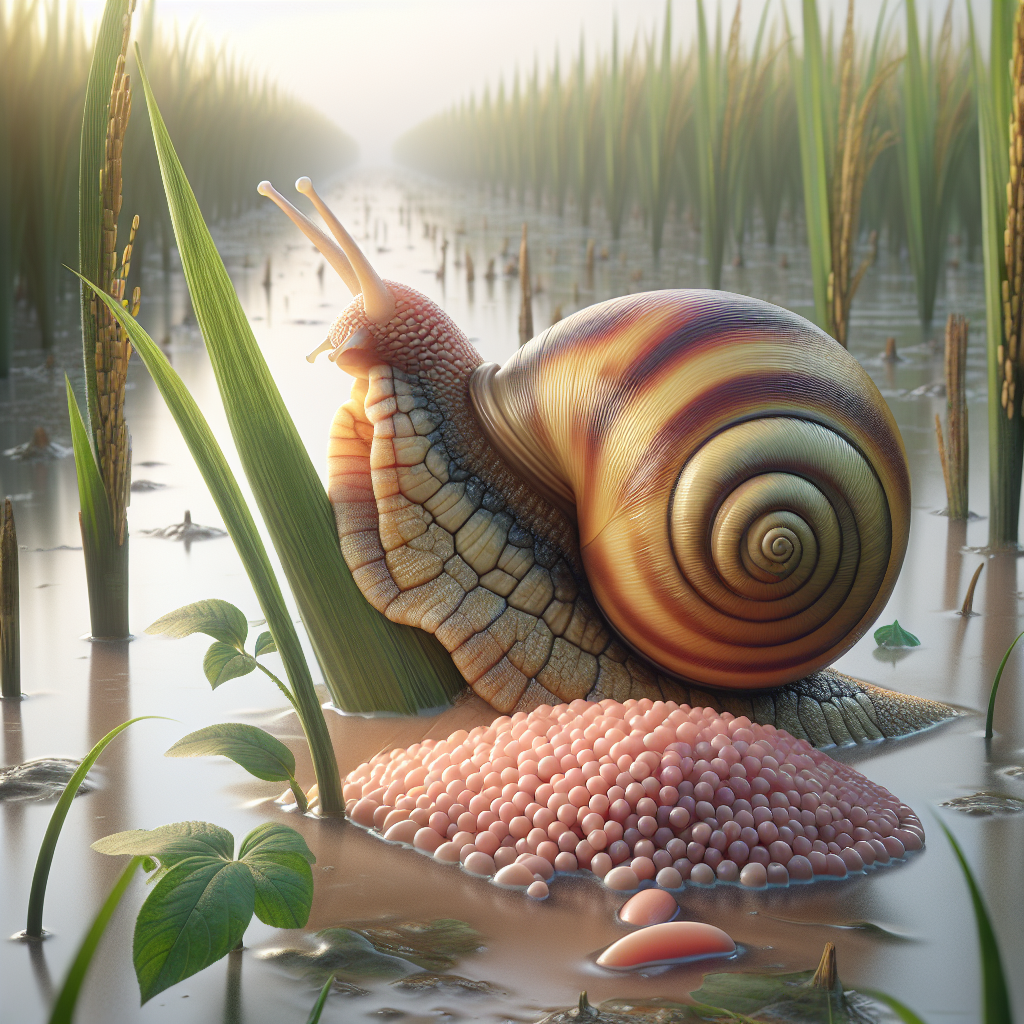
Introduction to Golden apple snail
The golden apple snail, scientifically known as Pomacea canaliculata, ranks among the world's most destructive invasive pests in agriculture, particularly targeting wetland crops like rice. Introduced as an aquarium pet and food source in the 1980s, this amphibious snail rapidly escaped into farmlands across Southeast Asia, the Philippines, Vietnam, and beyond, where it now infests millions of hectares. Adults can grow up to 10 cm in shell diameter, featuring a striking golden or greenish shell with dark spiral bands, distinguishing them from native apple snails.
These snails are prolific breeders, with females laying up to 1,000 pink eggs per clutch multiple times a year, enabling explosive population growth in irrigated fields. Their rasping radula shreds tender seedlings, leading to complete stand losses in young crops. In rice production alone, golden apple snails cause annual damages exceeding $1 billion globally, making them a top priority for integrated pest management (IPM) in tropical and subtropical regions. Early detection and targeted controls are essential, as unchecked infestations can wipe out entire plantings. For detailed insights on affected staples, see our guide on Rice. Learn more about proactive strategies in Spring Pest Patrol: Organic AI Strategies to Shield Your Crops from Common Invaders.
Farmers must recognize that golden apple snails thrive in flooded conditions, aestivating in mud during dry periods to survive. Their hermaphroditic nature and air-breathing ability allow colonization of diverse aquatic habitats, from paddies to ditches. This guide provides definitive diagnostics, lifecycle insights, and proven organic management to safeguard yields.
Identifying Symptoms & Damage
Golden apple snail damage is unmistakable in early-season crops, starting with mass defoliation of seedlings. Look for cleanly severed stems at the soil line, as adults clip plants with their toothed radula, leaving ragged chew marks unlike the holes from slugs and snails or caterpillars. Floating masses of bright pink egg clusters (1-2 cm diameter, 200-500 eggs each) on rice stems, levees, or weeds signal active infestation—these hatch in 5-15 days depending on temperature.
Affected plants exhibit stunted growth, yellowing, and death, with entire field sections bare within days. Snails preferentially target 0-20 day-old rice seedlings, consuming up to 15 cm² of leaf area per night per individual. In severe cases, 100% seedling mortality occurs, forcing replanting and yield losses of 50-100%. Submerged shells or live snails crawling on plants during evenings confirm presence.
Secondary signs include mucilaginous trails on foliage and soil, and reduced tillering in survivors. Differentiate from cutworms by the absence of soil-covered cuttings and presence of shells. In taro or lotus, damage appears as excavated corms and floating leaf debris. Scout fields weekly post-flooding, using quadrats (1m²) to count snails and eggs. Thresholds: >5 snails/m² or >1 egg mass/m² warrant immediate action.
Lifecycle and Progression of Golden apple snail
Understanding the golden apple snail's lifecycle is crucial for timed interventions. Eggs hatch into juveniles (2-5 mm shell) in 5-14 days at 25-35°C, maturing in 4-6 weeks to egg-laying adults. Females produce 3-6 clutches yearly, each with 200-1,000 eggs, peaking in wet seasons. Lifecycle completes in 2-3 months under optimal conditions (warm, flooded fields with pH 6.5-8.5).
Adults aestivate buried 5-10 cm in mud during dry spells, surviving 6-8 months without water. Juveniles are most destructive, rasping 25-50 mg plant matter daily, while adults feed nocturnally. Overwintering occurs as encapsulated embryos in soil. Populations explode post-monsoon, with densities reaching 50/m².
Progression: Egg stage (vulnerable to desiccation), juvenile (high feeding damage), adult (reproduction and migration). Disrupt at eggs via scraping or flooding alternation. Monitor water levels to induce aestivation, then till soil to expose snails.
Environmental Triggers & Risk Factors
Golden apple snails flourish in stagnant, shallow-flooded fields (5-15 cm water), warm temperatures (20-35°C), and abundant tender vegetation. Risk spikes in direct-seeded rice, delayed transplants, or fields near infested waterways. Poor field drainage, excessive nitrogen promoting succulent growth, and monsoon flooding facilitate spread via irrigation canals.
Invasive pathways include contaminated water, machinery, livestock, and discarded aquaria. Climate change extends ranges northward, with overwinter survival improving above 15°C minima. High-risk zones: Asia's rice belts, but emerging in Africa and Americas. Avoid planting in infested ditches; use clean water sources. Alternate wetting-drying cycles deter establishment.
Organic Control & Treatment Plans
Organic management emphasizes IPM: cultural, physical, biological, and minimal synthetics. Cultural: Plant older seedlings (>20 days), use drum seeders for rapid establishment, and alternate irrigation (drain fields 3-5 days every 10 days) to kill juveniles. Till stubble post-harvest to bury aestivators.
Physical: Hand-pick snails/eggs at dawn/dusk into sealed bags; crush eggs on levees. Install wire mesh (1 cm) fences around fields. Ducks (20-30/acre) devour snails effectively.
Biological: Introduce Pomacea urceus competitors or Pila conica predators. Apply neem oil (5%) or garlic-chili extracts as radula repellents. Bacillus thuringiensis var. israelensis targets juveniles.
Treatment Plan: Week 1: Scout and remove eggs/snails. Week 2-4: Drain/reflood cycle + ducks. Monitor with traps (bamboo stakes baited with lettuce). Threshold-based: <5 snails/m² = cultural only; >20/m² = add biologicals. Rotate with cabbage or upland crops to break cycles.
Preventing Golden apple snail in the Future
Prevention hinges on exclusion: Quarantine new water sources, clean equipment, and avoid flooding infested areas. Community-level: Coordinate field draining synchronized to mass-kill aestivators. Use resistant varieties like BRRI dhan28 rice and mulch fields to deter laying.
Long-term: Promote natural enemies via refuges (weedy borders for ducks/birds). Educate on non-release of aquarium snails. Early warning systems via apps track outbreaks. Maintain dry fallows >2 months. Integrate with Soil Health Mastery: 5 Proven Strategies for Small Farms to Build Fertile Ground Without Breaking the Bank for resilient systems.
Crops Most Affected by Golden apple snail
Rice tops the list, with direct-seeded paddies suffering 80-100% losses. Taro corms are ravaged, halting propagation. Lotus, water chestnuts, and kangkong face defoliation. Emerging threats to sweet potato slips and wetland banana suckers. Minor impacts on cucumber and lettuce in flooded gardens.