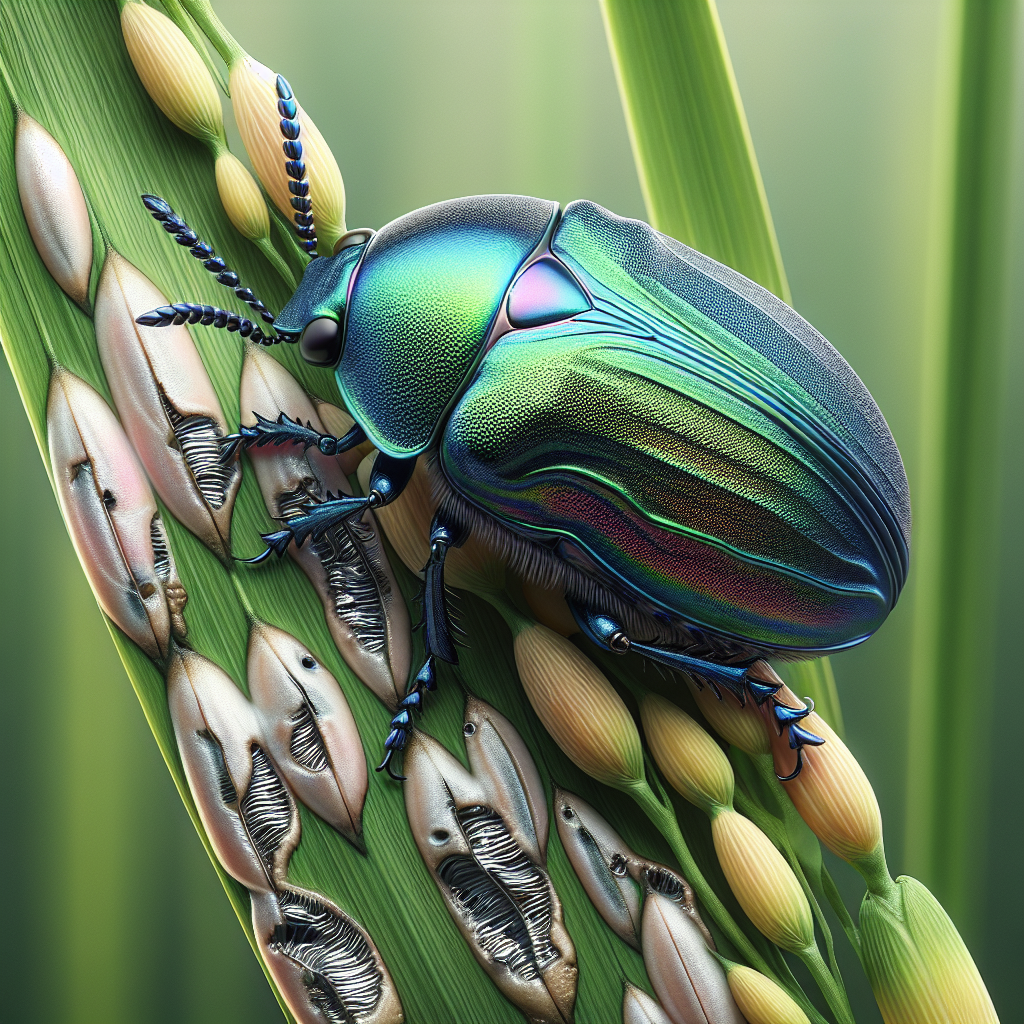
Introduction to rice hispa
Rice hispa, scientifically known as Dicladispa armigera (Chrysomelidae family), stands as one of the most notorious pests in rice cultivation, particularly in Asia, Africa, and parts of Australia. This iridescent beetle, often metallic blue or green, infests rice paddies during critical growth stages, leading to defoliation and reduced photosynthesis. Farmers face annual economic losses exceeding millions due to its rapid population build-up under favorable conditions. Understanding its biology and implementing integrated pest management (IPM) is crucial for minimizing damage. This guide provides comprehensive diagnostics, lifecycle insights, and proven organic strategies to combat rice hispa effectively, ensuring healthier crops and higher yields.
The pest's impact is amplified in monsoon-fed and irrigated rice systems where high humidity prevails. Early detection and intervention can prevent outbreaks, safeguarding food security in rice-dependent regions. By focusing on sustainable practices, growers can reduce reliance on synthetic pesticides, promoting eco-friendly agriculture.
Identifying Symptoms & Damage
Rice hispa damage manifests distinctly across plant growth stages, making visual scouting essential. Adult beetles feed on leaf blades, creating longitudinal slits or scraping the epidermis, resulting in a characteristic 'windowing' effect where only leaf veins remain. This skeletonization appears as silvery-white patches on foliage, severely impairing photosynthetic capacity.
Larvae, hidden within leaf mines, create narrow, winding galleries filled with frass, leading to necrotic spots. Severe infestations cause complete leaf defoliation, stunting tillers and panicles. On seedlings, feeding leads to wilting and yellowing, mimicking nutrient deficiencies or leaf spot diseases. Differentiate by checking for beetle presence and mining trails.
Damage escalates during tillering and panicle initiation, potentially reducing grain fill by 20-50%. Yield losses correlate with infestation levels: light (10-20% leaf damage) causes minimal impact, while heavy (>50%) can halve harvests. Monitor fields weekly, focusing on field edges and water-stressed areas. Use sticky traps or sweep nets for adult counts; thresholds include 5-10 adults per 10 hills. Associated symptoms include sooty mold from honeydew-like excretions, though less common than in aphids.
Lifecycle and Progression of rice hispa
Rice hispa completes its lifecycle in 20-30 days, with 4-6 overlapping generations per season, thriving in warm, humid climates. Adults (4-5 mm long, shiny blue-green) emerge from pupae in soil, live 15-30 days, and lay 20-50 eggs singly or in clusters on leaf undersides. Eggs hatch in 3-5 days into pale yellow larvae that mine leaves for 8-12 days, passing through three instars.
Mature larvae exit mines, bore into leaf sheaths or drop to soil, forming pupal cells. Pupation lasts 5-7 days, yielding new adults. Peak activity aligns with rice vegetative phases, with diapause in dry seasons. Overwintering occurs as adults in crop residues or soil.
Progression: Eggs (tiny, orange-red); larvae (slug-like, leaf miners); pupae (in soil cocoons); adults (active fliers, rapid dispersers). Generations sync with rice age: first on seedlings, subsequent on tillers. Disrupt lifecycle by destroying residues post-harvest to break pupal dormancy.
Environmental Triggers & Risk Factors
Rice hispa thrives at 25-35°C and 70-90% relative humidity, common in tropical wet seasons. Monsoon rains and standing water in paddies trigger egg-laying and larval survival. Risk factors include dense planting, excessive nitrogen fertilizers promoting lush foliage, and continuous rice monocropping without rotation.
Alternate hosts like maize, sorghum, and wild grasses serve as reservoirs. Poor field drainage and shaded, humid microclimates exacerbate outbreaks. Climate change extends growing seasons, boosting generations. High-risk zones: riverine floodplains, coastal areas. Scout after transplants during warm spells; avoid over-fertilization to reduce susceptibility.
Organic Control & Treatment Plans
Organic management emphasizes IPM, integrating multiple tactics for sustainable control. Cultural Controls: Practice early transplanting (15-20 days old seedlings) to evade peak adult activity. Maintain optimal spacing (20x15 cm) for ventilation. Destroy volunteer rice and weeds. Post-harvest, deep plow fields to expose pupae to predators and sun.
Biological Controls: Encourage natural enemies like spiders, predatory beetles, and parasitic wasps (e.g., Tetrastichus spp.). Release neem-based biopesticides or Bacillus thuringiensis (Bt) var. israelensis targeting larvae. For adults, apply neem oil (5 ml/L) or azadirachtin (0.03%) at 7-day intervals during scouting thresholds.
Mechanical Methods: Use light traps (mercury vapor) at night to capture adults. Handpick and crush egg clusters/larvae from borders. Install bird perches for granivorous birds preying on pupae.
Treatment Plans:
- Early Infestation (Seedling Stage): Clip and burn affected leaves; spray garlic-chili extract (50g garlic + 50g chili in 1L water).
- Tillering Stage: Apply Beauveria bassiana (spore formulation) or Metarhizium anisopliae at 10^12 spores/ha.
- Panicle Stage: Foliar spray of cow urine (1:10 dilution) or jaggery-trap molasses for mass trapping.
Monitor efficacy; rotate botanicals to prevent resistance. For severe cases, integrate with resistant varieties like Sahbhagi Dhan. Read our Spring Pest Patrol: Organic AI Strategies to Shield Your Crops from Common Invaders for tech-enhanced scouting. Check stem borers for co-infestations.
Preventing rice hispa in the Future
Prevention hinges on proactive farm practices. Select resistant varieties (e.g., IR36, TN1 hybrids) with pubescent leaves deterring oviposition. Implement crop rotation with wheat, legumes, or fallow periods to disrupt lifecycles. Time planting to avoid peak monsoon hispa flights (June-August in India).
Sanitize fields: flood and dry cycles kill soil pupae. Use certified seeds free of eggs. Apply prophylactic neem seed kernel extract (NSKE 5%) at transplanting. Enhance biodiversity with border crops like mustard or marigold repelling beetles. Regular monitoring via pheromone traps (under development) predicts outbreaks.
Soil solarization pre-season kills overwintering stages. Promote beneficial insects via flowering hedges (thai basil). Long-term: balanced nutrition reduces lush growth attractiveness. Record infestation data for predictive modeling, minimizing future risks.
Crops Most Affected by rice hispa
Primarily rice (Oryza sativa), including Basmati, Jasmine, and local cultivars, suffers 90% of attacks. Minor hosts: wild rice, maize (corn), sorghum (sorghum), wheat (wheat), and grasses. In polycultures, rice dominates damage. No significant impact on legumes or vegetables, but proximity increases spillover. Focus protections on paddy fields.