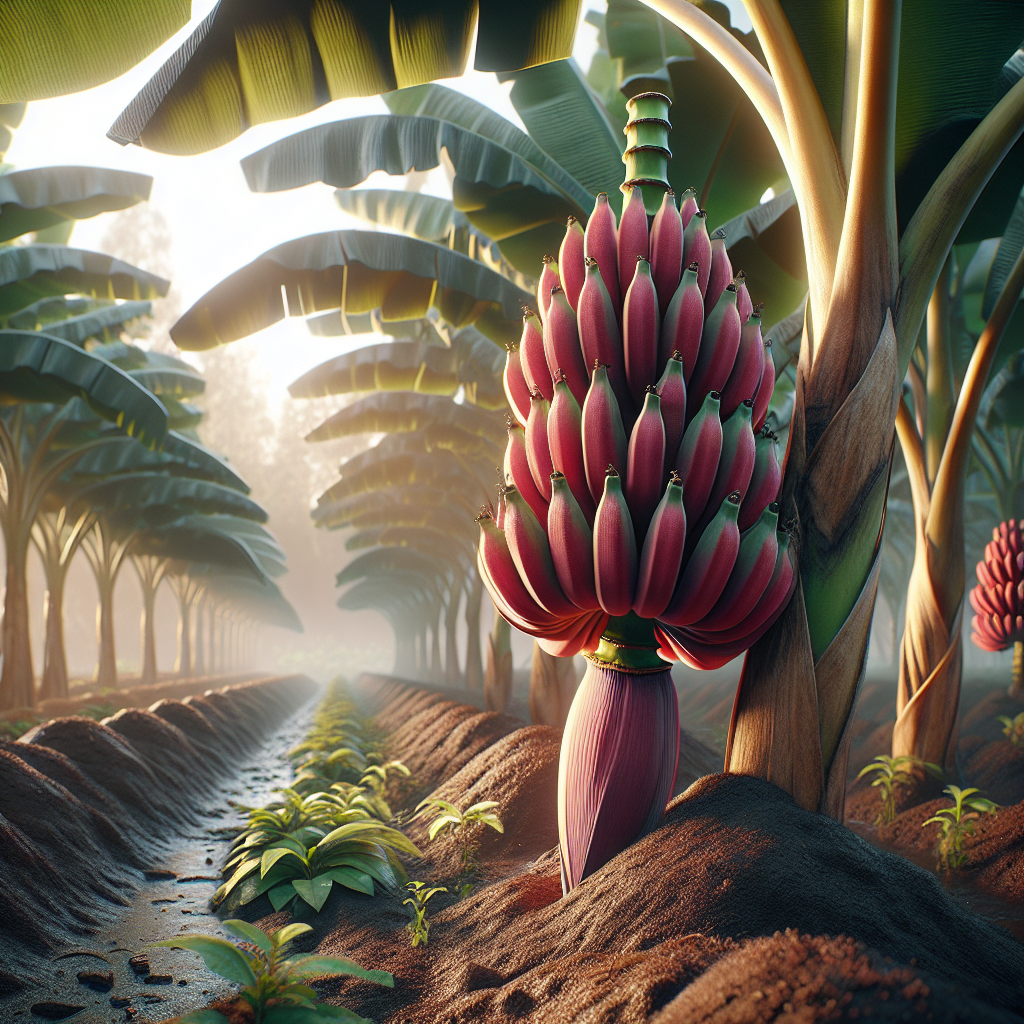
Introduction to Red Banana
Red banana refers to a group of dessert bananas with red to maroon peel coloration, shorter and thicker fingers than many Cavendish types, and a rich, aromatic flesh that can range from cream to light pink or orange-tinted. In commercial and smallholder systems, red bananas are valued for premium market appeal, good eating quality, and cultural importance across parts of South and Southeast Asia, the Caribbean, Central America, and tropical Africa. Although often discussed as if they are a single cultivar, the name usually covers several closely related red-skinned selections within Musa acuminata-dominant dessert bananas.
Compared with standard yellow market bananas, red bananas typically grow more slowly, often need slightly longer to fill their bunches, and can be more sensitive to cold injury and poor drainage. Their fruit quality depends heavily on uninterrupted growth: any stall caused by drought, nutrient shortage, waterlogging, or wind damage can result in narrow fingers, poor peel color, reduced sweetness, and uneven ripening. For growers aiming at premium fruit, management precision matters more than with many lower-value banana types.
If you already grow or understand Banana, think of red banana as a higher-value specialty type that rewards closer attention to fertility, bunch protection, and harvest timing. For broader soil-building ideas that directly improve banana performance, see soil health tips.
Botanical Profile of Red Banana
Red banana is a giant perennial herb rather than a true tree. The apparent trunk is a pseudostem formed by tightly wrapped leaf sheaths. Beneath the soil sits the corm, which is the plant's true stem base and the source of roots and suckers. Like other bananas, each pseudostem flowers and fruits only once; after harvest, that stem is cut back and replaced by selected daughter suckers.
Typical plants reach about 2.5-4.5 meters in height depending on cultivar, soil fertility, water availability, and wind exposure. Leaves are broad, thin, and highly susceptible to tearing in exposed sites. While tearing does not always reduce yield severely, excessive wind shredding reduces photosynthetic area and slows bunch filling. Red banana pseudostems may show green, bronze, or reddish tints, but the most obvious varietal feature is the mature fruit peel, which develops a reddish-maroon to deep burgundy hue under good nutrition and warm light conditions.
The inflorescence emerges from the center of the pseudostem and hangs downward. Female flowers appear first and develop into the edible fruit hands, followed by neutral and then male flowers. In most cultivated dessert bananas, fruit development is parthenocarpic, meaning fruit forms without pollination and is usually seedless. Commercial propagation is therefore vegetative, by sword suckers, peepers, corm bits, or tissue culture.
Red bananas are often grouped among AAA dessert bananas in many production contexts, though exact genetic classification varies by selection and region. Fruit are usually shorter, plumper, and more angular when immature than Cavendish types. When ripe, the flesh becomes soft, fragrant, and sweet with subtle raspberry or mango-like notes. Good red banana fruit should have a smooth peel, evenly filled fingers, and no pronounced necking or thin tips.
Soil, pH, and Climate Requirements for Red Banana
Red banana performs best in deep, friable, organically rich loam or sandy loam with strong moisture-holding capacity and rapid internal drainage. The ideal rooting depth is at least 60-90 cm, because bananas are heavy feeders with a shallow but extensive root system that benefits from a wide volume of aerated soil. Compacted subsoil, hardpan, or perched water tables will sharply reduce vigor.
The optimal soil pH is generally 5.5-7.0, with best nutrient balance often observed around 6.0-6.8. Below pH 5.3, aluminum and manganese issues may limit root growth and phosphorus availability may decline. Above pH 7.2, iron, zinc, and manganese deficiencies become more common, especially on calcareous soils, leading to pale new leaves, slow growth, and poor bunch size. If pH is too low, apply agricultural lime several months before planting based on soil test recommendations. If pH is high, incorporate large volumes of compost, use acid-forming fertilizers judiciously, and monitor micronutrient status closely.
Bananas demand constant moisture but not stagnant wetness. A practical target is soil moisture near field capacity in the active root zone without prolonged saturation. In professional terms, you want the top 20-30 cm of soil to remain evenly moist, not alternately dusty and muddy. Overwatering signs include a sour smell in the planting basin, persistent sogginess 24-48 hours after irrigation, reduced leaf emergence, yellowing lower leaves despite adequate fertility, weak anchorage, and higher incidence of root rot or pseudostem base decay. Underwatering signs include leaf folding during mid-morning, bluish-green dull foliage, marginal scorch, narrow emerging leaves, slow sucker development, and fruit fingers that remain thin and poorly filled.
Climatically, red banana prefers true tropical to warm subtropical conditions: daytime temperatures of 26-32°C, night temperatures of 20-24°C, relative humidity above 60%, and frost-free conditions year-round. Growth slows markedly below 16°C. Leaf injury can occur near 10-12°C, and chilling can delay flowering, distort bunches, and dull peel color. At 0°C or below, severe tissue death is likely. In dry tropical areas, irrigation is essential. In very wet regions, drainage engineering becomes the key limiting factor.
Annual rainfall of about 1200-2500 mm is suitable if it is well distributed or supplemented by irrigation during dry months. Wind is a major production risk. Sustained winds tear leaves; strong gusts snap pseudostems or topple fruiting plants. Windbreaks, staggered planting, and propping are especially important for red banana because premium fruit quality suffers when bunches are bruised or plants are stressed late in the cycle.
Step-by-Step Planting & Propagation
Start with clean, vigorous planting material. The best field establishment usually comes from disease-free sword suckers weighing roughly 1.5-3 kg, or certified tissue-culture plants that have been properly hardened off. Sword suckers are preferred over water suckers because they have a narrow, sword-like juvenile leaf shape and a stronger corm-to-root balance, leading to better early vigor. Avoid planting material from mats showing wilt, borer damage, Nematodes, or viral symptoms such as mosaic or streaking.
- Select the site. Choose full sun, protection from prevailing wind, and land with no standing water after rain. Avoid low depressions unless you can plant on raised beds or mounds.
- Test and prepare the soil. Incorporate 10-20 kg of well-rotted compost or manure per planting hole if the soil is poor. Deep ripping or subsoiling before planting helps where compaction exists.
- Mark spacing. A typical spacing is 2.5 x 2.5 m to 3 x 3 m depending on vigor, irrigation, and fertility. Tighter spacing increases humidity and disease pressure; wider spacing improves air movement and bunch size.
- Prepare the hole. Dig holes around 45 x 45 x 45 cm to 60 x 60 x 60 cm. Mix topsoil with compost and, where needed, phosphate and potassium according to soil test.
- Sanitize suckers. Trim roots and pare away damaged corm tissue. In traditional systems, corms are often hot-water treated or dipped in biological or approved organic protectants to reduce Nematodes and fungal carryover.
- Plant at correct depth. Set the corm so the soil line covers it firmly but does not bury the growing point too deeply. Planting too deep encourages rot; too shallow exposes roots and weakens anchorage.
- Irrigate immediately. Water thoroughly to settle the soil around the corm and remove air pockets.
- Mulch widely. Apply 8-15 cm of coarse organic mulch, keeping a small gap around the pseudostem base to prevent rot.
For tissue-culture plants, harden them in 40-60% shade before field planting, then gradually expose them to full sun over 1-2 weeks. Young tissue-culture plants often need more careful irrigation because their root systems are smaller initially. They should never be allowed to dry out completely during establishment.
Mat management begins at planting. A productive red banana mat should typically carry one mother plant, one follower, and one peeper or young sucker at different ages. Allowing too many suckers creates crowding, small bunches, and nutrient competition.
Care & Maintenance regimes for Red Banana
Irrigation should be frequent and adjusted to soil type and weather. On sandy loams in hot weather, mature plants may require irrigation 2-4 times per week; on heavier loams, once or twice may suffice if applied deeply. Drip irrigation is preferred for water efficiency and disease reduction. As a working benchmark, mature actively growing plants often need the equivalent of 25-50 liters of water per plant per day in hot dry periods, though real need depends heavily on canopy size, soil texture, mulch depth, and evapotranspiration. The goal is to keep root-zone moisture consistent. Extreme moisture fluctuation causes fruit splitting, poor filling, and irregular ripening.
Mulching is one of the most important cultural practices. Use chopped banana leaves, straw, dried grass, composted husks, or other clean organic matter in a broad circle extending at least 60-90 cm from the plant. Mulch moderates soil temperature, reduces evaporation, feeds soil biology, and suppresses weeds. In tropical heat, mulch can reduce irrigation demand substantially while improving bunch weight.
Red banana is a heavy feeder and responds strongly to potassium. Nitrogen drives leaf production and canopy size, phosphorus supports rooting and establishment, while potassium is crucial for bunch filling, fruit size, peel quality, sugar movement, and stress tolerance. A professional fertility program should be soil-test based, but broadly speaking, bananas benefit from split applications throughout the year rather than large, infrequent doses. Young plants should receive smaller, more frequent feedings. Once rapid vegetative growth begins, increase nitrogen and potassium. As flowering approaches and after bunch emergence, maintain strong potassium supply and avoid severe nitrogen deficiency, but do not force excessively lush growth that invites soft tissue and wind damage.
Common nutrient deficiency signs include: pale overall growth and reduced leaf size from nitrogen shortage; weak roots and slow establishment from phosphorus deficiency; marginal leaf scorch, weak stems, and poor fruit filling from potassium deficiency; interveinal chlorosis on older leaves from magnesium shortage; distorted or chlorotic young leaves from zinc or iron problems. Red banana often shows fruit quality decline before growers realize potassium is inadequate.
Desuckering is essential. Remove excess suckers regularly and retain only the best-positioned follower. Cut unwanted suckers at ground level and destroy the growing point to prevent regrowth. This channels carbohydrates and nutrients into the bearing stem and next cycle.
Weed control should be shallow and non-destructive because banana roots occupy the upper soil layers. Hoeing too deeply can prune roots and reduce yield. Thick mulch, hand weeding, and careful cover management are preferable. Living groundcovers can help if they do not compete heavily for water.
As bunches develop, remove dead leaves but avoid over-pruning healthy foliage. Bananas need a large functional leaf area to fill fruit. In many systems, maintaining at least 8-10 healthy leaves at flowering supports good bunch development. Support fruiting plants with bamboo poles, forked props, or twine systems to prevent lodging. Bunch covering with perforated sleeves or breathable protective bags can improve peel finish, reduce insect scarring, and buffer sunburn, especially in premium fresh-market production.
In cooler subtropical regions, planting on north-facing slopes in the Northern Hemisphere or south-facing slopes in the Southern Hemisphere helps maximize heat accumulation. Where cold snaps occur, heavy mulch, wind protection, and water management that avoids cold, saturated soil become even more important.
Pests, Diseases & Organic Management
Red banana faces many of the same constraints as other dessert bananas, but premium fruit destined for fresh sale must be especially clean and blemish-free.
Banana weevil borer is among the most damaging pests. Larvae tunnel into the corm and lower pseudostem, weakening anchorage and reducing nutrient flow. Symptoms include poor vigor, yellowing, snapping, and reduced bunch size. Organic management relies on clean planting material, removal of old harvest residues, pseudostem trapping, field sanitation, and biological control where available.
Nematodes, particularly burrowing and lesion types, damage roots and predispose plants to toppling. Infested fields show stunting, poor nutrient uptake, and weak root systems. Prevention is far more effective than cure: plant only clean material, rotate out of infested ground where possible, add high-organic-matter amendments, and suppress populations with clean fallows or antagonistic companion species such as Marigold where locally appropriate.
Aphids are important not only for sap feeding but also as vectors of Banana bunchy top virus in regions where the disease occurs. Viral symptoms may include erect, narrow leaves, dark green streaking, and severe stunting. There is no curative treatment; rogue infected plants immediately and control vector populations. Start with certified clean plants.
Thrips and Scarring insects can mark the peel, reducing market value. Bagging bunches, maintaining field sanitation, and encouraging beneficial insects are effective non-chemical strategies. Mealybugs and Scale may also appear in stressed or overcrowded mats.
Among diseases, Panama disease caused by Fusarium oxysporum f. sp. cubense is a major long-term soilborne threat in many banana-growing regions. It causes yellowing, wilting, vascular discoloration, and eventual plant collapse. Once established, it is very difficult to eradicate. Strict sanitation, clean planting stock, water movement control, and exclusion are critical. Sigatoka leaf spot diseases reduce photosynthetic area and can severely affect bunch filling and premature ripening. Good spacing, airflow, sanitation, and balanced nutrition help. In organic systems, repeated protective programs may include approved biologicals or mineral-based products depending on local regulations.
Bacterial soft rots and Crown rots are encouraged by waterlogging, wounding, and poor drainage. That is why irrigation discipline matters so much. If the base of the plant remains continuously wet and anaerobic, root decline and secondary infections escalate quickly.
The best organic management strategy is ecological prevention: clean propagules, excellent drainage, thick mulch that feeds soil biology without burying the stem, regular desuckering, removal of infected residues, diversified field edges, and consistent potassium nutrition. Stressed banana mats invite both pests and disease.
Harvesting, Curing & Optimal Storage
Red banana should be harvested at full physiological maturity but before full eating ripeness. Depending on climate and cultivar, this is often 90-150 days after flowering. Harvest timing is judged by fruit fullness rather than peel color alone. Mature fingers become more rounded, the sharp angular edges soften, and the floral ends dry. Immature harvest leads to poor flavor, uneven ripening, dull color, and rubbery texture.
For local markets, fruit can be cut at a more advanced maturity stage. For distant transport, harvest slightly earlier but never too green. Use a two-person method where possible: one supports the bunch while the other cuts the pseudostem or bunch stalk carefully to avoid impact bruising. Red banana peel marks easily, and cosmetic damage lowers premium value.
After cutting, keep bunches shaded and cool. Do not drag them on the ground. Wash only if necessary and use clean water to reduce latex staining and surface contamination. In more formal packing systems, hands are separated, graded, cleaned, and air-dried before packing.
Unlike some root and bulb crops, bananas are not "cured" in the classic sense, but they do benefit from a short postharvest stabilization period in shade with good ventilation so field heat dissipates and latex flow subsides. Avoid direct sun immediately after harvest, as peel scald and rapid moisture loss can occur.
For ripening, red bananas perform best at around 14-18°C before the ripening trigger and about 16-20°C during ripening, with high relative humidity around 90-95% to reduce shrivel. Temperatures below about 13°C can cause chilling injury: dull peel color, poor softening, uneven ripening, and off-flavors. Fully ripe fruit should be sold or consumed quickly, as shelf life is shorter than many thick-skinned commercial Cavendish lines.
In simple farm storage, keep harvested bunches in a clean, shaded, well-ventilated room away from ethylene-sensitive produce. If coordinated ripening is desired, exposure to ethylene in controlled conditions improves uniformity. Never store red bananas in cold refrigeration intended for temperate fruits, as chilling damage is common.
Companion Planting for Red Banana
Companion planting around red banana works best when the goal is to support soil cover, suppress weeds, cycle nutrients, and reduce pest pressure without competing aggressively for water and potassium. Because banana roots occupy the upper soil profile, companions must be selected and placed thoughtfully.
Thai Basil is useful at the outer edge of the banana mulch ring or along adjacent rows. Its aromatic canopy can help diversify the habitat for beneficial insects, and its shallow growth habit makes it manageable in mixed tropical gardens. Ginger is another strong companion in humid tropical systems, especially where filtered light exists beneath wider banana spacing; it helps convert underutilized space into a productive understory while benefiting from similar moisture conditions. Turmeric performs similarly and can act as a profitable intercrop in young banana plantations before full canopy closure. Clover can serve as a low-growing living cover in suitable climates, helping reduce erosion and soften soil surface compaction, though it must be managed so it does not become too competitive in dry periods.
Keep all companions at enough distance from the pseudostem base to avoid trapping moisture directly against the plant. Maintain a clean, open collar around each mat. Heavy-feeding annual vegetables planted too close often compete more than they help. The best banana companions are those that improve the soil ecosystem, occupy spare light niches, and do not interfere with harvesting or desuckering operations.