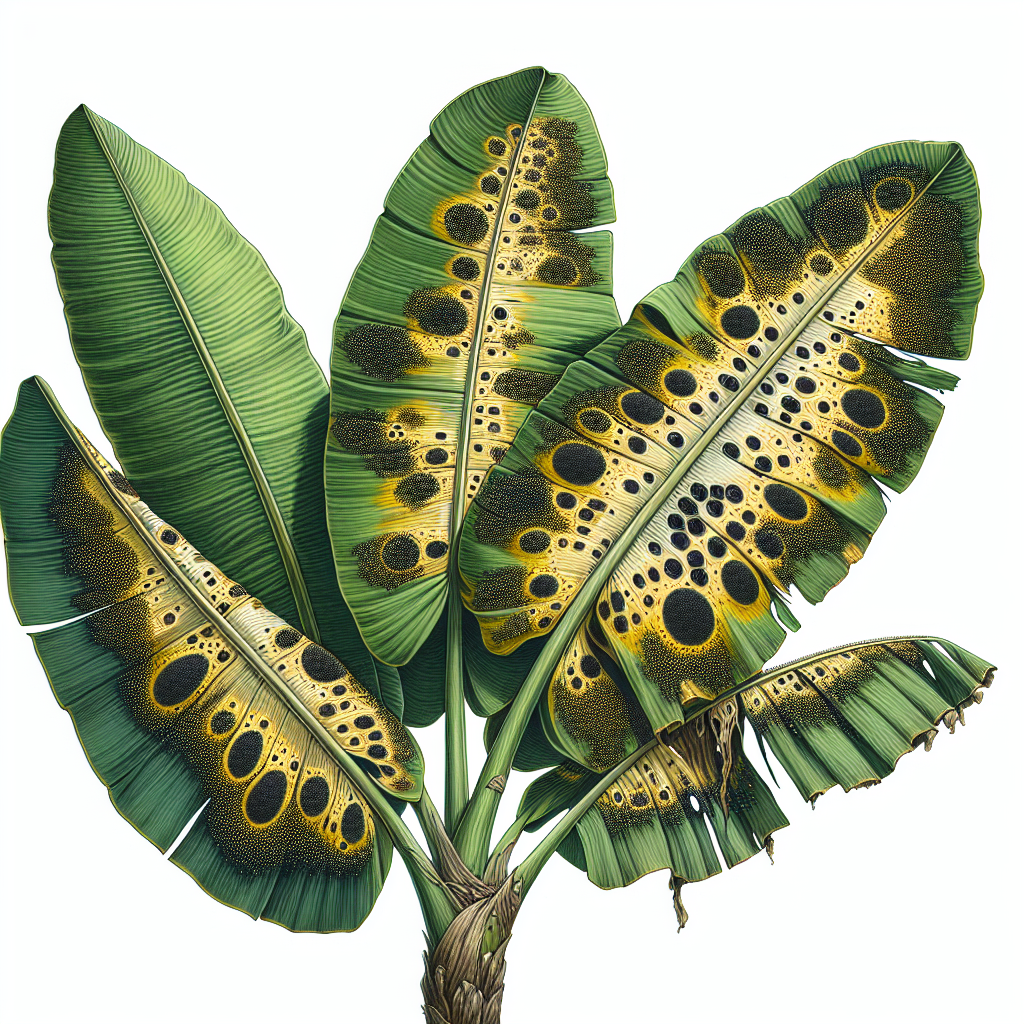
Introduction to Sigatoka leaf spot diseases
Sigatoka leaf spot diseases represent one of the most destructive foliar pathogens affecting banana and plantain crops globally, posing severe threats to commercial production and smallholder farms alike. Primarily caused by two fungal species—Mycosphaerella fijiensis (black Sigatoka or black leaf streak) and Mycosphaerella musicola (yellow Sigatoka)—these diseases originated in Southeast Asia and have spread to major banana-growing regions including Latin America, the Caribbean, Africa, and the Pacific. First identified in Fiji in the 1960s for yellow Sigatoka and later for the more virulent black form in 1973, Sigatoka has become a top priority for the global banana industry, which produces over 150 million tons annually, with banana cultivars like Cavendish dominating exports.
The economic impact is staggering: untreated infections can slash yields by 30-50%, reduce bunch size by up to 40%, and shorten fruit shelf life, costing producers billions in losses and control measures. Black Sigatoka, now prevalent in over 80 countries, is particularly aggressive, producing more spores and resisting older fungicides more effectively than yellow Sigatoka. For small farms, as highlighted in Why 80% of Small Farms Battle Weather Disasters - And How Hyper-Local AI Forecasts Can Save Your Harvest, humid conditions exacerbate spread, making early detection and management critical. This guide provides definitive diagnostics, lifecycle insights, and practical organic strategies to safeguard your crops.
Identifying Symptoms & Damage
Early identification is key to limiting Sigatoka's spread. Symptoms begin on the lower leaf surfaces (abaxial side) of younger leaves, typically 10-20 days after emergence. For yellow Sigatoka, initial signs are pale yellow to greenish streaks or spots (1-5 mm), evolving into diamond-shaped lesions with grayish-white centers and dark brown borders, often with a yellow halo on the upper surface. Mature lesions (up to 2 cm) feature thin black lines radiating outward—a diagnostic hallmark.
Black Sigatoka presents more aggressively: spots start as reddish-brown flecks, rapidly expanding into larger (1-2 cm) necrotic lesions with dark brown to black centers and wide yellow halos. Unlike yellow Sigatoka, black lesions lack striping but develop acervuli (spore-producing structures) under humid conditions, visible as tiny black dots. Severe infections cause coalescing lesions, leading to leaf necrosis from tips inward, reducing functional leaf area by 50-70%. Damage manifests as premature leaf drop, stunted bunches, and small, ripened fruits with latex scarring, cutting marketable yield by 20-50%.
Differentiate from similar issues like Cordana leaf spot (larger, oval spots without halos) or nutrient deficiencies (uniform yellowing). Use a 10x hand lens to spot conidia: banana-shaped for yellow, sigmoidal for black. On Dwarf Cavendish banana, symptoms appear faster due to susceptibility. Monitor weekly, scoring leaves on a 1-6 scale (1=healthy, 6=dead) where >25% severity warrants action.
Lifecycle and Progression of Sigatoka leaf spot diseases
Sigatoka fungi are hemibiotrophic, with complex polycyclic lifecycles driven by asexual conidia and sexual ascospores. Conidia (asexual spores) form on lesions under wet conditions (>95% RH, 24-30°C optimal), dispersing via wind and rain splatter up to 500m. Germination occurs within 4-6 hours on wet leaves, penetrating via stomata. The pathogen lives symptomlessly (biotrophic phase) for 15-25 days before switching to necrotrophic, killing tissue and producing new conidia.
Sexual phase involves pseudothecia in dead tissue, releasing ascospores during dry periods for long-distance spread. A single lesion produces 10,000+ conidia daily for weeks, enabling 20-30 infection cycles per season. Progression accelerates in rainy seasons: latent period 18-28 days (black) vs. 25-35 (yellow), with black Sigatoka's shorter cycle (21 days) explaining dominance. In Cavendish banana fields, disease migrates upward as leaves senesce, but spores infect all ages. Lifecycle ties to microclimate—leaf wetness >8 hours triggers epidemics. For deeper insights, see black Sigatoka and yellow Sigatoka.
Environmental Triggers & Risk Factors
Sigatoka thrives in warm, humid tropics (25-30°C, >80% RH), with optima at 28°C and 12-20 hours leaf wetness. High rainfall (>2500mm/year), poor airflow from dense planting, and overhead irrigation splash spores, creating microclimates for epidemics. Risk spikes during wet seasons or in valleys with fog. Susceptible varieties like Grande Naine Cavendish face 50%+ losses; plantains vary in tolerance.
Other factors: high nitrogen promotes lush leaves ideal for infection; dense canopies (>2500 plants/ha) trap humidity; nearby wild Musa or heliconius butterflies vector spores. Soil with poor drainage fosters root stress, indirectly worsening foliar susceptibility. Climate change extends wet periods, intensifying outbreaks. For plantain, coastal humidity amplifies risks. Mitigate by site selection: elevate fields, space 2.5x3m, prune for ventilation.
Organic Control & Treatment Plans
Organic management integrates sanitation, biology, and approved fungicides for sustainable control. Sanitation (foundation): De-sucker aggressively, leaving 2-3 healthy followers; remove infected leaves weekly (chop into <30cm pieces, spread under canopy for rapid decomposition). Leaf trash mulching reduces inoculum by 70%.
Biologicals: Apply Trichoderma asperellum or Bacillus subtilis (e.g., Serenade) every 14 days post-rain; potassium bicarbonate or sodium bicarbonate sprays (1-2%) suppress sporulation. Neem oil (2%) + soap disrupts spore germination.
Approved organics: Copper hydroxide (e.g., Kocide, 1.5-2kg/ha) or Bordeaux mixture every 14-21 days, rotating with powdery mildew controls like sulfur. For small farms, backpack sprayers with fine mist ensure underleaf coverage—critical as 90% spores land abaxially.
IPM Plan: Scout weekly; act at 5-10% severity. Calendar sprays during wet peaks, gap sprays in dry. Test resistant hybrids like FHIA-21. Companion with marigold for airflow. Yields recover 20-30% with compliance. Avoid resistance by rotating modes.
Preventing Sigatoka leaf spot diseases in the Future
Prevention hinges on exclusion, resistance, and cultural resilience. Quarantine new plant material; hot-water treat suckers (53°C/20min). Plant resistant varieties: FHIA hybrids or Goldfinger (Goldfinger banana) tolerate 50% less fungicide. Optimize spacing (2-3m), windbreaks for dry air, and drainage.
Routine: Prophylactic leaf pruning, mulching residues, intercropping thai-basil for ventilation. Monitor with traps for spore counts. Build soil health via compost, reducing stress—see Soil Health Mastery. Educate workers on hygiene. Long-term: Breed for polygenic resistance; diversify beyond Cavendish. Zero-tolerance quarantine in disease-free zones like Australia sustains exports.
Crops Most Affected by Sigatoka leaf spot diseases
Primarily banana (Musa spp.), especially export Cavendish group AAA, with 90% plantations threatened. Plantains (AAB) suffer similarly, impacting food security in Africa/Asia. Minor hosts: Heliconia, other Musa ornamentals. No reports on mango or pineapple. Global hotspots: Ecuador, Colombia, Philippines produce 70% Cavendish, losing $1B+/year. Smallholders in Uganda/Cameroon face 40% losses on cooking bananas.