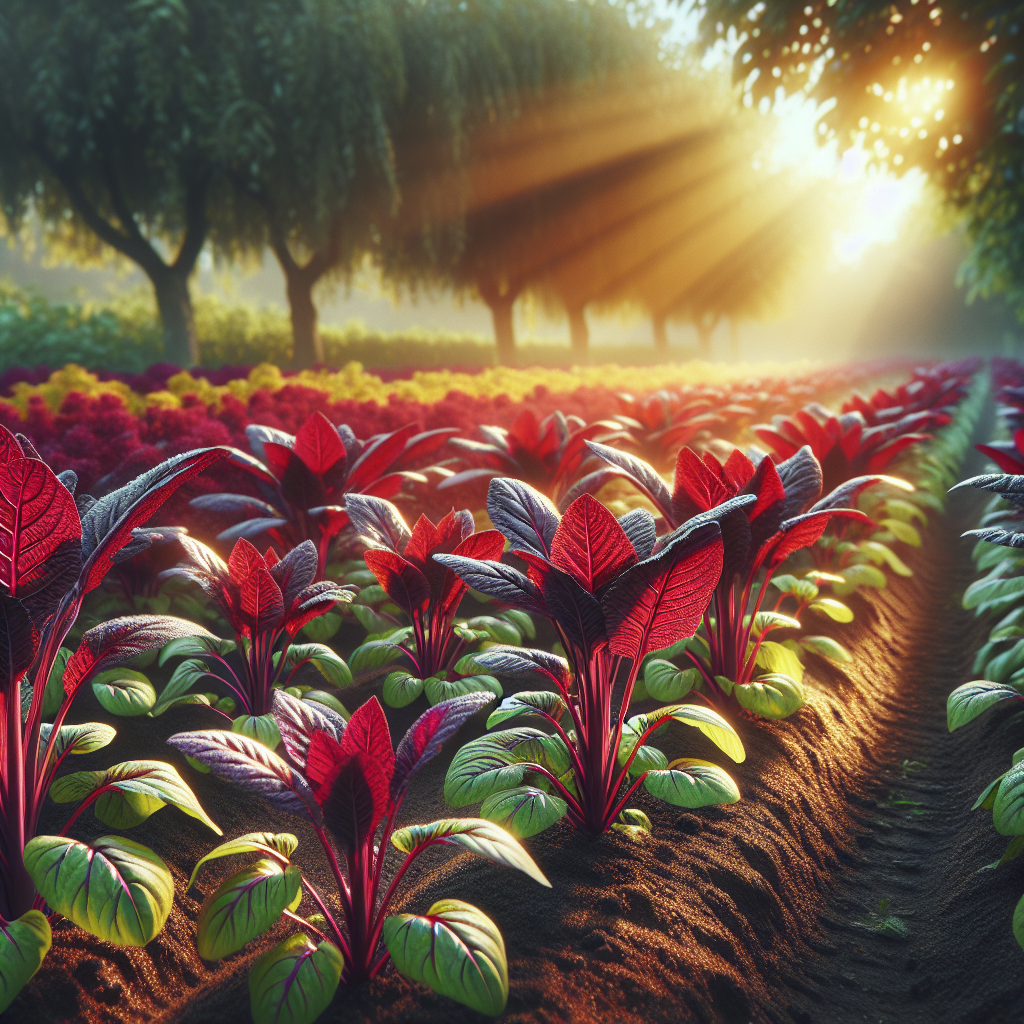
Introduction to Red Amaranth
A striking leafy vegetable with deep red to purple foliage, this crop is valued both for ornamental beauty and serious food production. It is most commonly grown as a leaf amaranth rather than a grain type, and in many regions it is harvested repeatedly as a cut-and-come-again green.
Red amaranth has a long cultivation history across Asia, Africa, and Central America, where different amaranths have served as staple greens, pseudo-cereals, and culturally important plants. In culinary use, the leaves are mild, earthy, and slightly mineral, with the red pigmentation coming from betalain compounds rather than anthocyanins, a botanical distinction that also links amaranths with beets. For growers, its biggest advantages are speed, resilience in hot weather, and the ability to produce marketable greens when cool-season crops such as lettuce and spinach struggle. If you want a dependable summer leafy crop, compare its heat performance with Spinach.
Most growers use the name “red amaranth” broadly for red-leaved forms of leafy amaranth, especially Amaranthus tricolor, though some regional landraces may include related species or mixed selections. Because seed strains vary, plant height, leaf width, branching habit, and depth of red color can differ noticeably. Professional growers should therefore evaluate local seed lots for leaf tenderness, bolting speed, and uniformity before committing to larger acreage.
Botanical Profile of Red Amaranth
This plant belongs to the Amaranthaceae family. As a cultivated leafy type, it is usually classified as Amaranthus tricolor, though some red-leaved vegetable amaranths may overlap with other amaranth species. It is an annual broadleaf plant that completes its life cycle quickly, often reaching first harvest in 20 to 35 days for baby leaf and 35 to 50 days for bunching greens.
Morphologically, seedlings emerge with small rounded cotyledons followed by broader true leaves that may be oval, lanceolate, or slightly elongated depending on cultivar. The stems are often green flushed with red, or fully reddish. Mature plants can range from 25 cm to over 100 cm tall, but leaf production is best when plants are harvested young and managed to remain vegetative. Once day length, heat, plant stress, or age trigger flowering, the stems toughen, leaves become smaller, and market quality drops.
Red coloration varies from bright crimson to maroon, sometimes concentrated in the leaf center or veins and sometimes covering the whole blade. This pigment intensity depends on genetics, sunlight, and temperature. High light usually deepens color, while excessive nitrogen or shade can increase green growth at the expense of red expression.
The root system is relatively shallow but efficient, usually concentrated in the top 15 to 25 cm of soil, which explains why the crop responds strongly to frequent light irrigation and organic matter in the upper root zone. The flowers are small, inconspicuous, and borne in clusters or terminal inflorescences. Leafy growers generally try to delay flowering through dense planting, regular harvest, and steady moisture.
Soil, pH, and Climate Requirements for Red Amaranth
This crop performs best in loose, fertile, well-drained soil rich in organic matter. Sandy loam to silty loam is ideal, but it can also do well in clay loam if drainage is improved and the soil does not crust after irrigation. The main physical requirement is a friable topsoil that allows tiny seed to germinate evenly and shallow roots to expand without waterlogging.
The preferred pH range is about 6.0 to 7.5, with an optimum near 6.3 to 6.8. It tolerates mild acidity better than many leafy vegetables, but strongly acidic soil below pH 5.8 can reduce nutrient availability, especially calcium and magnesium, and may increase manganese toxicity. In alkaline soils above pH 7.8, iron deficiency chlorosis can appear as yellowing between veins on newer leaves, especially where organic matter is low.
For commercial-quality leaf production, target a soil organic matter level above 3%. Before planting, incorporate 2 to 5 kg of mature compost per square meter or the field equivalent, especially in light soils that dry quickly. A pre-plant nutrient benchmark for leafy production is moderate nitrogen, adequate phosphorus, and strong potassium availability. Excess nitrogen creates lush but watery tissue that is more attractive to sap-feeding pests and more prone to lodging or postharvest collapse.
Red amaranth is a true warm-season crop. Optimal germination typically occurs between 20 and 30°C, and the best vegetative growth generally falls between 24 and 35°C. It tolerates high summer temperatures remarkably well if moisture is steady. Below about 15°C, growth slows significantly. Frost kills it, and even cool nights can stunt early seedlings.
Relative humidity is less critical than soil drainage and air movement, but constantly wet foliage in dense plantings increases disease pressure. In monsoon climates, raised beds are strongly recommended. Beds 10 to 20 cm high improve drainage, reduce stem rot risk, and make harvest cleaner.
Sunlight needs depend on climate intensity. Full sun gives the strongest color and fastest growth in most regions, but in extremely hot, arid zones with temperatures above 38°C, light afternoon shade can reduce leaf scorch and preserve tenderness. In low light, plants stretch, leaves thin out, and pigmentation fades.
Step-by-Step Planting & Propagation
This crop is almost always propagated by seed. Because the seed is very small, success depends more on seedbed quality and moisture management than on deep fertilization.
Prepare a fine, level seedbed. Remove clods, stones, and undecomposed residue. The top 2 to 3 cm should be crumbly and even so seed can contact moist soil without getting buried too deeply.
Incorporate compost and, if needed, a balanced base fertilizer before final raking. Avoid fresh manure immediately before sowing because it can increase weed pressure and cause uneven nutrient release.
Sow directly where the crop will grow. Direct seeding is preferred because the plant establishes quickly and transplants may pause after root disturbance. Broadcast sowing works for baby leaf production, while line sowing is better for bunching and repeat harvest.
Sow shallowly. Cover seed with only 0.5 to 1 cm of fine soil, compost, or sand. Deeper sowing often leads to patchy emergence.
Irrigate gently. Use a fine rose watering can, mist, or low-pressure sprinkler so seed is not displaced. The top 1 cm of soil should remain consistently moist until emergence. If that surface dries even briefly in hot weather, germination can become irregular.
Thin early. Once seedlings have 2 to 3 true leaves, thin according to production goal. For baby leaf, 5 to 8 cm spacing is acceptable. For bunching greens, use 15 to 20 cm between plants and 20 to 30 cm between rows. For larger individual plants, allow 25 to 30 cm.
Begin first harvest on schedule. Baby leaves can be cut when plants are 10 to 15 cm tall. For repeated picking, wait until plants reach 20 to 25 cm and remove outer leaves or cut stems above a healthy node.
Seeding rates vary by system. Dense market beds may use roughly 1 to 2 g seed per square meter, while row production uses less once thinning is factored in. Mixing seed with dry sand helps distribute it evenly.
In nursery systems, seedlings can be started in plug trays and transplanted at the 3- to 4-leaf stage, but this is mainly used where weed pressure is severe or protected cultivation is practiced. Handle seedlings carefully because stem bruising and root damage can reduce uniformity.
Succession sowing every 10 to 14 days keeps harvest continuous. Because this crop grows so quickly, staggered planting is far more effective than sowing a large block all at once.
Care & Maintenance regimes for Red Amaranth
Water management is the key operational skill. The root zone should remain evenly moist but never stagnant. In practical terms, the top 5 to 10 cm of soil should feel cool and slightly moist to the touch, not powder-dry and not sticky-saturated. During seedling establishment, moisture should be maintained near field capacity in the upper soil layer. Mature stands tolerate short dry intervals, but repeated drought stress causes bitterness, smaller leaves, early flowering, and fibrous stems.
For beds in warm weather, a common pattern is light irrigation daily or every other day during germination, then deeper watering 2 to 4 times weekly depending on soil type. Sandy soils may need irrigation whenever the upper 3 to 4 cm dries out. Heavier soils may only need water when the upper 5 cm becomes dry. A useful field sign of proper moisture is upright leaves by morning and mild natural relaxation by afternoon without collapse. Persistent midday wilting that does not recover by evening indicates water stress. Overwatering shows up as yellow lower leaves, slowed growth despite wet soil, stem softness, algae on the bed surface, or a sour smell from the soil.
Mulching with fine compost, leaf mold, or straw between rows helps maintain moisture and suppress weeds, but keep mulch slightly away from the stems in humid conditions to reduce rot risk.
Nutritionally, the crop responds well to steady, moderate feeding. A side-dressing of nitrogen 10 to 14 days after emergence supports rapid leaf expansion. Organic growers often use diluted fish emulsion, compost tea from finished compost, or blood-meal-based amendments in modest amounts. Avoid heavy late nitrogen, which can create excessively succulent tissue and increase nitrate accumulation under low light.
Weed control is most important in the first 3 weeks. Because seedlings are small, early weed competition can overwhelm the crop. Use shallow hand weeding or wheel hoeing; do not cultivate deeply because roots are near the surface. Once the canopy closes, red amaranth competes better.
Harvest management strongly influences total yield. For cut-and-come-again production, cut 7 to 10 cm above the soil line, leaving several nodes intact so regrowth is vigorous. If cut too low, recovery is weaker. Typically, 2 to 4 harvests are realistic from one sowing, depending on fertility, temperature, and cultivar.
In protected systems or high-density production, ensure airflow. Dense stands with constant overhead watering invite foliar disease. Drip irrigation is preferable when feasible. For general soil-building principles that benefit leafy crops, see soil health tips.
Pests, Diseases & Organic Management
This crop is comparatively resilient, but fast tender growth can attract several common pests. Flea beetles chew small shot-holes in young leaves, especially during hot dry weather. Leaf miners create winding tunnels between leaf surfaces. Aphids cluster on tender stems and leaf undersides, sucking sap and distorting growth. Caterpillars, including Armyworms and various Leaf feeders, can skeletonize foliage quickly if left unchecked.
Organic control starts with crop timing and hygiene. Rapid growth means short exposure time, so well-fed, unstressed plants often outgrow minor pest injury. Use insect netting or floating row covers immediately after sowing in high-pressure areas, especially for baby leaf production where cosmetic damage matters. Remove weed hosts from bed edges, especially pigweed relatives, which can harbor pests and diseases.
For Aphids, a sharp water spray early in the day can physically reduce colonies. If needed, apply insecticidal soap, ensuring contact with leaf undersides. For Caterpillars, Bacillus thuringiensis works best on young larvae and should be used before serious feeding damage develops. Neem-based products may suppress sap feeders and some chewing pests, but avoid spraying in strong sun and always test on a small area first because tender leaves can mark.
Disease issues usually arise from excessive moisture, poor spacing, or contaminated soil. Damping-off can kill seedlings in cool wet seedbeds. Root and Stem rots occur in waterlogged ground. Leaf spots caused by fungal or bacterial pathogens may appear as brown, black, or tan lesions, sometimes with yellow halos. Downy-type issues can occur under humid, crowded conditions.
To prevent disease, rotate away from other amaranths and related broadleaf hosts for at least 2 to 3 seasons where problems are recurrent. Use clean seed, avoid overhead irrigation late in the day, and harvest promptly rather than letting overmature plants stand in humid conditions. Remove heavily infected plants rather than composting them unless your compost reaches sanitizing temperatures.
Nutritional disorders can be confused with disease. Nitrogen deficiency causes pale green to yellow older leaves and reduced leaf size. Potassium deficiency may show as edge scorch on older leaves. Iron deficiency usually appears on newer leaves in high-pH soils. Diagnose soil and irrigation patterns before treating for pathogens.
Harvesting, Curing & Optimal Storage
Leaf harvest timing depends on market purpose. For baby leaf, harvest when leaves are 5 to 10 cm long and still very tender. For bunching, cut entire young plants at 20 to 30 cm tall before stem fibers become noticeable. For repeated harvest, pick outer leaves or cut stems while the crown remains active.
The best harvest window is early morning, when plants are fully hydrated and field heat is low. Avoid harvesting during the hottest part of the day because leaves respire rapidly and wilt faster. Use a clean, sharp knife or harvest sickle to minimize bruising. Damaged leaves darken quickly and lose shelf life.
Unlike grain amaranth, leafy red amaranth is not cured in the traditional dry-storage sense. Instead, it should be field-sorted, shaded immediately, and cooled as soon as possible. Remove yellow, insect-damaged, or diseased leaves. Wash only if your market requires it and if you can dry surface moisture quickly; wet packed leaves deteriorate faster.
For best postharvest handling, hydro-cool or rinse in cold clean water, drain thoroughly, and pack in perforated bags or lined crates with good airflow. Ideal storage is around 0 to 5°C with high relative humidity, roughly 95%. Under those conditions, quality may hold for 5 to 10 days depending on leaf maturity and handling. Warmer storage dramatically shortens shelf life and causes wilting, pigment dulling, and sliminess.
If bunching for sale, align stems neatly and avoid compressing bundles too tightly, as pressure bruises the succulent tissue. For home use, store unwashed leaves in a breathable bag in the refrigerator crisper and use promptly.
Companion Planting for Red Amaranth
This crop benefits most from companions that either deter pests, improve spatial efficiency, or avoid heavy direct competition in the same root zone. Aromatic herbs and flowers are especially useful around bed edges, while quick root crops can share nearby space if harvest timing is coordinated.
Onion is one of the most practical partners because its upright habit does not heavily shade the foliage and its scent may help confuse some insect pests. Garlic plays a similar role and fits well on bed margins or in alternating rows in small gardens. Radish works as a fast intercrop because it matures quickly before red amaranth reaches full canopy. Nasturtium is valuable nearby as a trap and pollinator-support plant, and it can help diversify the insect ecology around intensive beds.
Avoid placing red amaranth immediately beside very aggressive feeders or sprawling crops that shade it heavily at a young stage. Large cucurbits, dense corn blocks, or overgrown okra can reduce light and airflow. Also avoid allowing wild pigweed relatives to remain near production beds, as they compete strongly and can host shared pests.
In diversified systems, red amaranth fits well after short-duration crops or in summer gaps where cool-season greens have been removed. Its rapid turnover also makes it useful in relay planting and market-garden succession schedules.