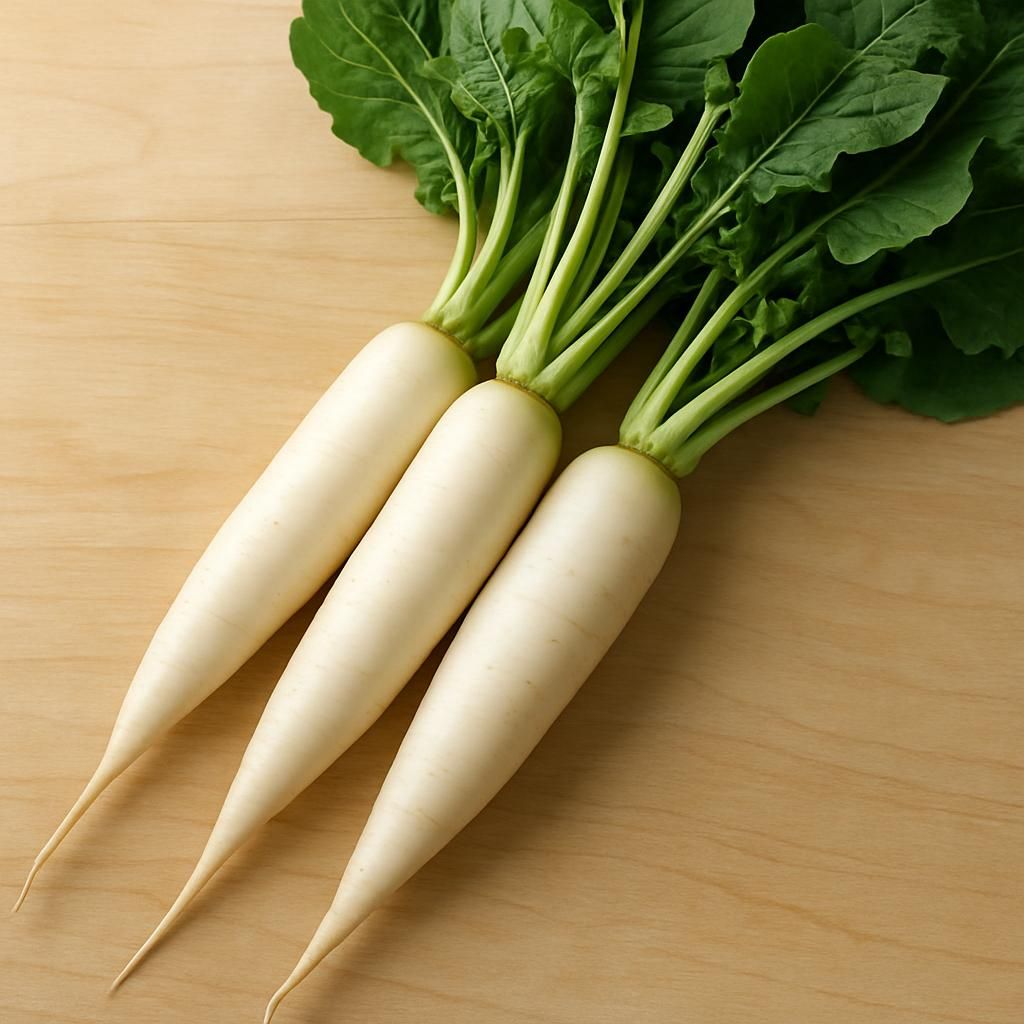
Introduction to Radish (Daikon - Miyashige)
Miyashige daikon (Raphanus sativus var. longipinnatus 'Miyashige') is a classic Japanese winter radish known for its long, cylindrical white roots that reach 12–18 inches in length and 2–3 inches in diameter. Developed for reliable performance in both home gardens and commercial fields, it offers a mild, slightly sweet flavor with crisp texture that holds up well in fresh salads, stir-fries, and traditional Japanese pickles such as takuan. Unlike smaller spring radishes, Miyashige daikon tolerates light frost and can be grown as a fall or overwinter crop in many temperate regions.
Commercial producers appreciate its uniform shape, high market demand, and excellent storage life when properly cured. Home gardeners value the variety for its rapid growth, soil-improving taproot, and ability to break up compacted beds. When grown correctly, Miyashige daikon delivers high yields with minimal inputs, making it an efficient cool-season crop for both small farms and large-scale operations.
Botanical Profile of Radish (Daikon - Miyashige)
Miyashige daikon belongs to the Brassicaceae family and is a biennial grown as an annual for its edible root. The plant develops a long, tapered taproot with smooth white skin and firm, juicy white flesh. Leaves are deeply lobed, dark green, and grow in a basal rosette that can reach 18–24 inches tall. Flowers are small, four-petaled, and typically white to pale lavender, appearing only if plants are allowed to bolt in their second year.
The variety is selected for its resistance to pithiness and hollow centers, traits that make it superior for both fresh market and processing. Root growth is rapid once seedlings establish, with the majority of biomass allocated below ground after the first three weeks. Miyashige daikon stores well because of its low respiration rate and thick skin that resists desiccation during curing and cold storage.
Soil, pH, and Climate Requirements for Radish (Daikon - Miyashige)
Miyashige daikon performs best in deep, loose, well-drained soils free of stones and compaction that could cause forking or misshapen roots. The crop prefers cool temperatures between 50–65 °F (10–18 °C) during root development and can tolerate light frost down to 28 °F (-2 °C). Heavy clay or poorly drained soils increase the risk of root rot and should be amended with organic matter or grown in raised beds.
| Parameter | Ideal Range | Notes |
|---|---|---|
| Soil Type | Sandy loam to loam | Deep, friable, stone-free for straight roots |
| Soil pH | 6.0–7.0 | Slightly acidic to neutral; avoid <5.8 |
| Soil Temperature | 50–65 °F (10–18 °C) | Optimal for rapid, uniform germination |
| Air Temperature | 50–70 °F (10–21 °C) day / 40–55 °F night | Cool conditions prevent bolting and pithiness |
| Moisture | Consistent 1 inch/week | Avoid water stress during root enlargement |
| Organic Matter | 3–5% | Improves drainage and nutrient retention |
| Salinity Tolerance | Low | Sensitive to high salt levels |
Step-by-Step Planting & Propagation
Site Selection & Preparation: Choose a location with full sun (minimum 6 hours) and deep, loose soil. Remove stones and break up any hardpan to at least 18 inches. Incorporate 2–3 inches of well-rotted compost or aged manure two weeks before planting.
Timing: Direct sow in early spring for a summer harvest or 60–70 days before first fall frost for winter storage. In mild winter areas, sow from late summer through early winter.
Seed Treatment: Use fresh seed; germination drops sharply after two years. Optional: soak seeds in water for 4–6 hours to speed emergence.
Sowing Method: Sow seeds ½ inch deep in rows 12–18 inches apart. Thin seedlings to 4–6 inches apart once true leaves appear. For square-foot or intensive beds, space plants on a 4-inch grid.
Succession Planting: Sow every 2–3 weeks during the cool season for continuous harvest. Stop sowing when daytime temperatures consistently exceed 75 °F to avoid bolting.
Transplanting: Although direct seeding is preferred, 3-week-old seedlings can be transplanted if handled carefully to avoid root disturbance.
Care & Maintenance regimes for Radish (Daikon - Miyashige)
Consistent moisture and balanced fertility are critical for straight, mild-flavored roots. Over-fertilization with nitrogen produces excessive foliage at the expense of root quality. Mulch with 2–3 inches of straw or shredded leaves to maintain soil moisture and suppress weeds.
| Growth Stage | Watering Schedule | Fertilizer Application | Pruning / Thinning |
|---|---|---|---|
| Germination (0–10 days) | Keep surface moist; light daily mist | None; pre-plant compost sufficient | None |
| Seedling (10–21 days) | 0.5 inch every 3 days | Side-dress with ½ rate balanced organic fertilizer (5-5-5) at 2 weeks | Thin to 4–6 inches when 2–3 true leaves appear |
| Vegetative (3–5 weeks) | 1 inch per week | Light compost tea or fish emulsion every 10–14 days | Remove any yellow or damaged leaves |
| Root Development (5–8 weeks) | 1–1.5 inches per week; deep watering | Avoid excess nitrogen; apply potassium-rich amendment if soil test indicates deficiency | None |
| Pre-Harvest (last 2 weeks) | Maintain even moisture | Cease fertilization 14 days before harvest | None |
Pests, Diseases & Organic Management
Common pests of daikon include flea beetles, aphids, cutworms, and root-knot nematodes. Flea beetles create small holes in leaves; floating row covers provide effective exclusion. Aphids cluster on new growth and can be controlled with insecticidal soap or strong water sprays. Cutworms sever seedlings at soil level; collars made from cardboard or foil prevent damage.
Major diseases include Alternaria leaf spot, downy mildew, clubroot, and Rhizoctonia root rot. Practice 3–4 year crop rotation with non-brassica crops. Maintain soil pH above 6.2 to suppress clubroot. Improve air circulation and avoid overhead irrigation to reduce foliar diseases. Use certified disease-free seed and remove crop debris after harvest.
Harvesting, Curing & Optimal Storage
Miyashige daikon is ready for harvest when roots reach 12–18 inches and shoulders are 2–3 inches wide, typically 50–70 days after sowing. Gently loosen soil with a fork and lift roots by the shoulders to avoid breakage. Trim tops to 1 inch and roots to ½ inch.
Cure harvested roots in a shaded, well-ventilated area at 50–60 °F for 3–5 days to allow skins to dry and minor wounds to heal. Store at 32–38 °F with 90–95% relative humidity for up to 3–4 months. Do not wash before storage; brush off loose soil. For longer preservation, slice and ferment into traditional Japanese pickles.
Companion Planting for Radish (Daikon - Miyashige)
Daikon benefits from association with nitrogen-fixing legumes such as peas and clover, which improve soil fertility. Aromatic herbs including thyme and rosemary help deter flea beetles. Avoid planting near other brassicas to reduce shared pest and disease pressure.
Fast-growing companions such as lettuce and spinach can be interplanted between daikon rows for efficient space use. Marigold and nasturtium provide additional pest-repellent properties. After harvest, allow daikon foliage to decompose in place or chop and drop as a green manure to return nutrients to the soil.