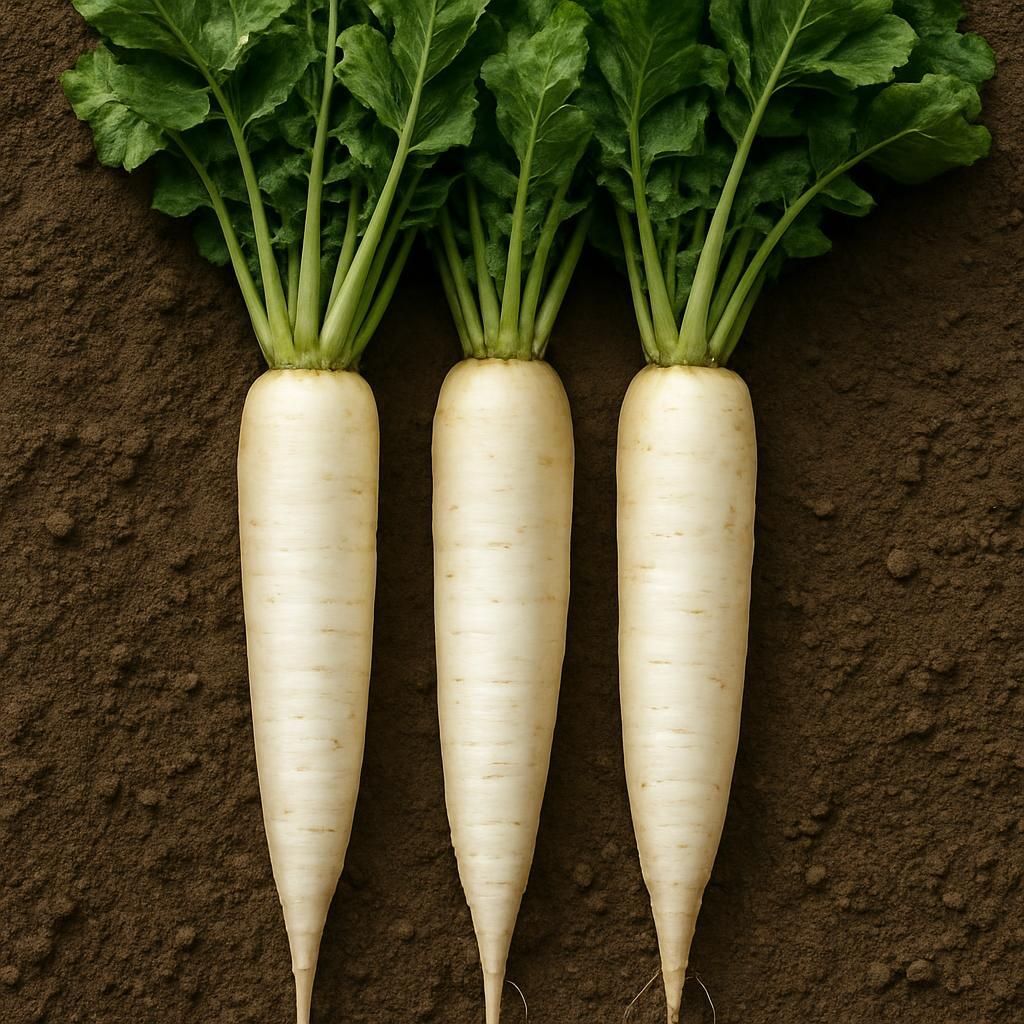
Introduction to Radish (Daikon - Minowase)
Minowase daikon is a Japanese heirloom variety of Daikon Radish renowned for producing long, cylindrical white roots with crisp, juicy flesh and a mild, slightly sweet flavor. Developed for commercial production, this variety matures in 55–65 days and can reach lengths of 14–18 inches with diameters of 2.5–3 inches under ideal conditions. Its rapid growth cycle and tolerance to moderate heat make it a favorite among market gardeners seeking reliable, high-yield winter radishes.
Unlike smaller European radishes, Minowase daikon stores exceptionally well and maintains quality for weeks when properly harvested and cured. The roots are excellent for fresh eating, pickling, and traditional Japanese dishes such as takuan. Commercial growers appreciate its uniformity and market appeal, while home gardeners value its ability to break up compacted soil and add organic matter when used as a cover crop.
Botanical Profile of Radish (Daikon - Minowase)
Minowase daikon belongs to the Brassicaceae family and is botanically classified as Raphanus sativus var. longipinnatus 'Minowase'. The plant produces a long taproot that stores carbohydrates and develops a smooth, white exterior with occasional green shoulders when exposed to sunlight. The flesh is white, firm, and low in pungency compared to many other radish types.
The plant forms a rosette of deeply lobed, dark green leaves that can reach 18–24 inches in height. Flowers are typically white with four petals and appear if the plant is allowed to bolt. Seeds are small, round, and brown, developing in siliques after pollination. The variety is an annual that completes its life cycle in one growing season when grown for roots.
Soil, pH, and Climate Requirements for Radish (Daikon - Minowase)
Minowase daikon performs best in deep, loose, well-drained sandy loam soils that allow unrestricted root development. Heavy clay soils should be amended with organic matter or grown in raised beds to prevent forking and stunting. Consistent moisture is essential throughout the growing period to avoid woody or pithy roots.
| Parameter | Ideal Range | Notes |
|---|---|---|
| Soil Type | Sandy loam to loam | Deep, friable structure prevents forking |
| Soil pH | 6.0–7.0 | Slightly acidic to neutral; avoid alkaline |
| Temperature (Day) | 15–22°C (59–72°F) | Optimal root development |
| Temperature (Night) | 7–13°C (45–55°F) | Prevents bolting |
| Soil Temperature | 10–18°C (50–65°F) | For direct seeding |
| Spacing (Row) | 30–45 cm (12–18 in) | Allows root expansion |
| Spacing (In-row) | 8–15 cm (3–6 in) | Thinning critical for large roots |
| Depth | Seed at 1–2 cm (0.5–0.75 in) | Light cover; keep moist until emergence |
Step-by-Step Planting & Propagation
- Select a site with full sun and prepare the bed by incorporating well-rotted compost or aged manure to a depth of at least 30 cm (12 in).
- Test soil pH and adjust to 6.0–7.0 using lime if necessary; avoid fresh manure which can cause root forking.
- Sow seeds directly 1–2 cm deep in rows spaced 30–45 cm apart when soil temperature reaches 10°C (50°F).
- Maintain consistent moisture; seeds typically germinate in 4–7 days.
- Thin seedlings to 8–15 cm spacing once they have 2–3 true leaves to allow proper root development.
- For succession planting, sow every 2–3 weeks until 6–8 weeks before first expected frost.
Care & Maintenance regimes for Radish (Daikon - Minowase)
Consistent care ensures straight, tender roots. Mulching helps retain moisture and suppress weeds. Side-dress with nitrogen if leaves appear pale, but avoid excess which promotes leafy growth at the expense of roots.
| Task | Frequency | Details |
|---|---|---|
| Watering | 2–3 times per week | 2.5–4 cm (1–1.5 in) per week; keep even |
| Fertilizer (N-P-K) | At planting and 3 weeks later | 10-10-10 or balanced organic at 1–2 kg/100 m² |
| Mulching | After thinning | 5–7 cm organic mulch to retain moisture |
| Weeding | Weekly until canopy closes | Shallow cultivation to avoid root damage |
| Thinning | Once at 2–3 true leaves | Maintain 8–15 cm spacing |
Pests, Diseases & Organic Management
Common pests include flea beetles, cutworms, and root-knot nematodes. Row covers effectively exclude flea beetles during early growth. Aphids may colonize leaf undersides; control with insecticidal soap or neem oil. Slugs can damage young seedlings in moist conditions.
Diseases such as Alternaria leaf spot, clubroot, and downy mildew can affect daikon. Practice crop rotation with non-brassica crops every 3–4 years. Ensure good air circulation and avoid overhead watering to reduce foliar disease pressure. Soil solarization or biofumigation with mustard cover crops helps manage soil-borne pathogens.
Harvesting, Curing & Optimal Storage
Harvest Minowase daikon when roots reach desired size, typically 55–65 days after sowing. Gently loosen soil around the root with a fork before pulling to avoid breakage. Trim leaves to 2–5 cm above the crown immediately after harvest.
Cure roots by allowing them to air-dry in a shaded, well-ventilated area for 1–2 hours. Store at 0–2°C (32–36°F) with 95–100% relative humidity for up to 2–3 months. Avoid washing until ready to use; remove any damaged roots before storage to prevent rot spread.
Companion Planting for Radish (Daikon - Minowase)
Minowase daikon benefits from association with Nasturtium, Marigold, and aromatic herbs such as Thyme which deter pests. It pairs well with Lettuce and Spinach for efficient space use. Avoid planting near other brassicas to reduce disease buildup. Clover as a living mulch improves soil nitrogen and suppresses weeds around daikon rows.