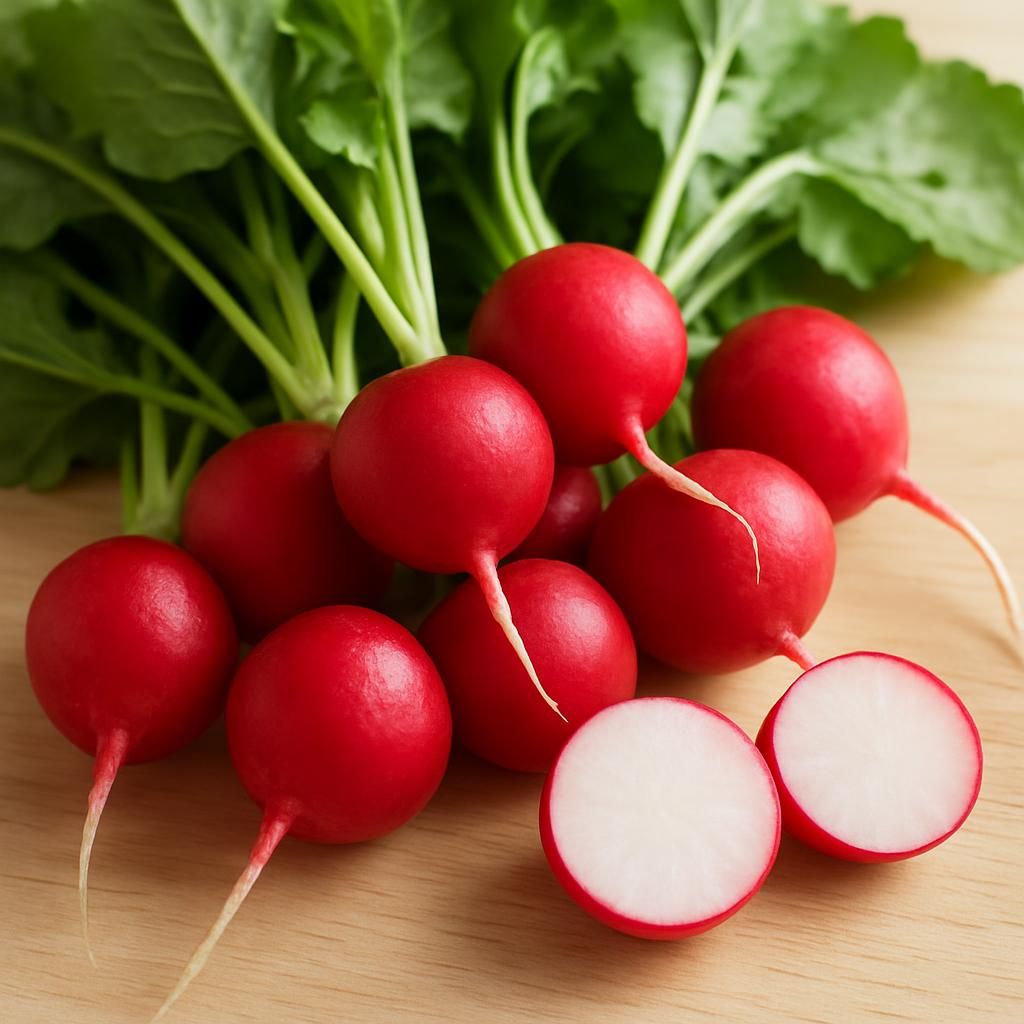
Introduction to Radish (Cherry Belle)
Cherry Belle radish is a classic cool-season root vegetable belonging to the Brassicaceae family. Developed for uniform shape and rapid maturity, it typically reaches harvest readiness in 22–30 days, making it an ideal choice for succession planting and intensive cropping systems. Its mild, slightly sweet flavor and crunchy texture have made it a staple in salads, garnishes, and fresh market bundles worldwide.
Professional growers value Cherry Belle for its consistent globe shape, smooth red skin, and resistance to pithiness when harvested on time. The variety performs well in both open-field and protected-culture systems, providing high turnover and excellent market appeal.
Botanical Profile of Radish (Cherry Belle)
Cherry Belle produces a small, round taproot averaging 2.5–4 cm in diameter with bright scarlet-red skin and crisp white interior. The plant forms a compact rosette of deeply lobed, dark-green leaves that rarely exceed 15 cm in height. As a biennial grown as an annual, it flowers and sets seed only after vernalization, though commercial production focuses exclusively on the edible root stage.
The root system is shallow and fibrous, making timely harvest critical to prevent woodiness or internal voids. Flowers are typically white to pale lavender and attract various pollinators when allowed to bolt.
Soil, pH, and Climate Requirements for Radish (Cherry Belle)
Cherry Belle thrives in loose, well-drained soils rich in organic matter. Heavy clay or compacted soils lead to misshapen roots and increased disease pressure. Aim for consistent moisture without waterlogging to support rapid, even growth.
| Parameter | Ideal Range | Notes |
|---|---|---|
| Soil Type | Sandy loam to loam | Avoid compacted or stony soils |
| Soil pH | 6.0–7.0 | Slightly acidic to neutral |
| Temperature (Day) | 15–20 °C | Optimal for root development |
| Temperature (Night) | 7–12 °C | Prevents bolting |
| Soil Temperature | 10–18 °C | Minimum for germination |
| Spacing | 2–3 cm between plants | Rows 20–30 cm apart |
| Sunlight | Full sun (6+ hours) | Tolerates light afternoon shade in heat |
Step-by-Step Planting & Propagation
Site Selection & Preparation: Choose a location with full sun and good drainage. Remove weeds and incorporate 5–7 cm of well-rotted compost or aged manure. Perform a soil test and correct pH if below 6.0.
Sowing: Direct-seed 1 cm deep in moist soil. Space seeds 2–3 cm apart in rows 20–30 cm wide. For continuous harvest, sow every 7–10 days.
Germination: Maintain soil moisture; seedlings emerge in 3–7 days at 10–18 °C. Thin to final spacing once true leaves appear.
Transplanting: Not recommended; radishes resent root disturbance. Direct seeding is preferred.
Succession & Interplanting: Use wide-row or intensive bed systems. Interplant with slower crops such as Lettuce or Carrot for efficient space use.
Care & Maintenance regimes for Radish (Cherry Belle)
Consistent moisture is critical—fluctuations cause cracking or pithy roots. Apply a light mulch layer to retain moisture and suppress weeds. Avoid high-nitrogen fertilizers after initial growth to prevent excessive foliage at the expense of roots.
| Growth Stage | Watering Schedule | Fertilizer Application | Pruning/Thinning |
|---|---|---|---|
| Germination (Days 0–7) | Keep top 2 cm moist daily | None; use starter compost | None |
| Seedling (Days 8–14) | 1–2 cm every 2–3 days | Side-dress with balanced organic 5-5-5 | Thin to 2–3 cm spacing |
| Vegetative (Days 15–22) | 2–3 cm twice weekly | Light compost tea every 10 days | Remove yellow or damaged leaves |
| Root Swell (Days 23–30) | Maintain even moisture | Stop nitrogen; potassium boost optional | Harvest promptly at maturity |
Pests, Diseases & Organic Management
Common pests include flea beetles, cutworms, and root-knot nematodes. Use floating row covers immediately after sowing to exclude flea beetles. Hand-pick cutworms at dusk and apply beneficial nematodes for soil-dwelling larvae.
Diseases such as Alternaria leaf spot, damping-off, and clubroot can occur in poorly drained or acidic soils. Practice strict crop rotation (minimum 3 years) and solarize beds between plantings. Improve drainage and maintain neutral pH to reduce clubroot risk.
Harvesting, Curing & Optimal Storage
Harvest when roots reach 2.5–4 cm diameter and before internal pithiness develops. Pull gently and remove tops immediately. Rinse under cool water, pat dry, and store in perforated plastic bags at 0–2 °C with 95 % humidity for up to 3 weeks.
For longer storage, pack roots in damp sand or sawdust in a root cellar at 1–4 °C. Do not wash until ready to use to minimize rot.
Companion Planting for Radish (Cherry Belle)
Cherry Belle pairs well with Lettuce, Spinach, Peas, and aromatic herbs such as Nasturtium. These companions provide shade, deter pests, and improve space efficiency. Avoid planting near Potato as both compete for similar nutrients and may share disease issues.
Radishes also benefit from being sown between rows of slower-maturing crops such as Cabbage or Broccoli, utilizing the space before brassicas reach full size.