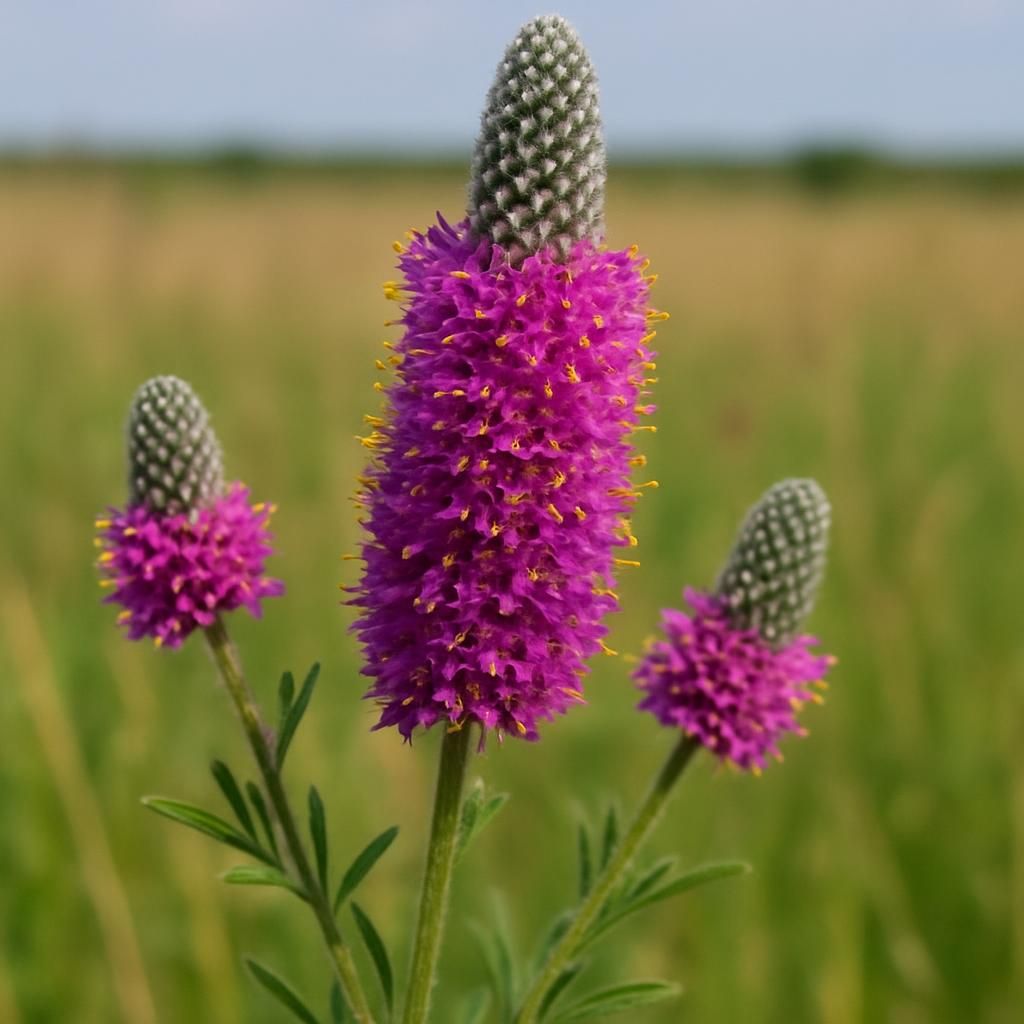
Introduction to purple prairie clover
Purple prairie clover (Dalea purpurea) is a deep-rooted perennial legume native to the Great Plains and central North America. It produces dense spikes of vibrant magenta-purple flowers from June through August that attract native bees, butterflies, and beneficial insects. Beyond its ornamental and ecological value, the species improves soil fertility through symbiotic nitrogen fixation and contributes high-quality forage for livestock and wildlife. Because it tolerates drought, poor soils, and cold winters, purple prairie clover has become a cornerstone species in prairie restoration, conservation plantings, and low-input grazing systems.
Botanical Profile of purple prairie clover
Dalea purpurea belongs to the Fabaceae family. Mature plants reach 12–30 inches (30–76 cm) in height with multiple erect or ascending stems arising from a woody taproot. Leaves are pinnately compound with 3–9 narrow, linear leaflets that are gray-green and slightly pubescent. The inflorescence consists of a dense, cylindrical spike 1–2 inches (2.5–5 cm) long containing numerous small, pea-like flowers. Each flower has five petals; the banner is bright purple while the wings and keel are paler. After pollination, the plant produces small, one-seeded pods that dehisce at maturity. The extensive taproot system can penetrate 4–6 feet (1.2–1.8 m) into the soil profile, conferring exceptional drought tolerance and soil-stabilizing capacity.
Soil, pH, and Climate Requirements for purple prairie clover (MUST INCLUDE A MARKDOWN TABLE OF IDEAL CONDITIONS)
Purple prairie clover performs best on coarse- to medium-textured, well-drained soils. It tolerates low fertility and low organic matter but declines in heavy clay or poorly drained sites. Optimal soil pH ranges from slightly acidic to mildly alkaline. The species is winter-hardy to USDA zone 3 and thrives in continental climates with cold winters and warm summers. It requires full sun (minimum 6–8 hours daily) and performs poorly under shade. Annual precipitation of 12–30 inches (305–762 mm) is ideal; supplemental irrigation is rarely needed once established.
| Parameter | Ideal Range | Notes |
|---|---|---|
| Soil Texture | Sandy loam to loam | Avoid heavy clay and compacted soils |
| Soil pH | 6.0–8.0 | Tolerates 5.5–8.5; neutral preferred |
| Drainage | Excellent | Standing water for >24 h causes root rot |
| USDA Hardiness Zones | 3–8 | Cold hardy to –40 °F (–40 °C) |
| Temperature Range | 60–85 °F (15–29 °C) daytime | Flowering reduced above 95 °F (35 °C) |
| Annual Precipitation | 12–30 in (305–762 mm) | Drought tolerant once established |
| Light Requirement | Full sun (≥6 h direct) | Shade reduces flowering and vigor |
Step-by-Step Planting & Propagation
Site Preparation
Select a site with full sun and well-drained soil. Conduct a soil test and amend pH if below 5.8 with agricultural lime. Remove existing vegetation and lightly till or use a no-till drill to create a firm seedbed. Purple prairie clover establishes slowly; weed control during the first season is critical.
Seed Treatment & Sowing
Purple prairie clover seed exhibits physical dormancy. Scarify by mechanical abrasion or a 5–10 minute soak in concentrated sulfuric acid followed by thorough rinsing. Inoculate with the appropriate rhizobial strain (Rhizobium spp. specific to Dalea) immediately before planting. Sow in early spring (soil temperature ≥55 °F / 13 °C) or late fall for natural stratification. Use a seeding rate of 4–6 lb/acre (4.5–6.7 kg/ha) pure live seed when drilled at ¼–½ inch (6–13 mm) depth. Broadcast seeding requires a higher rate (8–10 lb/acre) and subsequent light harrowing or rolling.
Vegetative Propagation
Although seed is the standard method, division of mature clumps in early spring can be used for small-scale plantings. Ensure each division contains at least one bud and a portion of the taproot. Transplant immediately and water to settle soil around roots.
Care & Maintenance regimes for purple prairie clover (MUST INCLUDE A MARKDOWN TABLE OF WATER, FERTILIZER, AND PRUNING SCHEDULES)
Once established, purple prairie clover is low-maintenance. The first growing season requires the most attention to weed competition and moisture. Mature stands benefit from periodic mowing or grazing to stimulate regrowth and reduce thatch.
| Season | Watering Schedule | Fertilizer Application | Pruning / Mowing Schedule |
|---|---|---|---|
| Establishment (Year 1) | 0.5–0.75 in (13–19 mm) weekly if rainfall <0.5 in | None; inoculant supplies N | Mow weeds at 4–6 in (10–15 cm) height; do not cut plants below 3 in |
| Spring (Years 2+) | None unless drought exceeds 4 weeks | None required; soil test every 3–4 years | Remove winter residue by mowing to 4 in (10 cm) in late March |
| Summer | None; deep taproot provides drought tolerance | None; excess N reduces nodulation | Optional mid-season graze or mow to 6–8 in (15–20 cm) after bloom |
| Fall | None | None | Mow to 4–6 in (10–15 cm) after seed set to manage thatch |
| Winter | None | None | Leave standing residue for wildlife cover |
Pests, Diseases & Organic Management
Purple prairie clover is relatively pest- and disease-resistant. Occasional pressure from grasshoppers, aphids, and cutworms may occur during establishment. Fungal issues such as powdery mildew or root rot are rare on well-drained sites. Organic management emphasizes cultural practices: maintain plant spacing for airflow, avoid overhead irrigation, and encourage beneficial insects. For grasshopper outbreaks, apply organic-approved baits containing Nosema locustae or use floating row covers on young seedlings. Monitor for spider mites during hot, dry spells; release predatory mites if populations exceed 10 mites per leaflet.
Harvesting, Curing & Optimal Storage
Forage Harvest
Cut at early bloom (10–20 % flowering) for highest protein content. Leave a 4-inch (10 cm) stubble to promote rapid regrowth. Field-dry to 15–18 % moisture before baling. Store bales under cover at <65 % relative humidity.
Seed Harvest
Monitor pods when they turn tan and begin to rattle. Combine or swath when 70–80 % of spikes are mature. Thresh immediately and air-dry seed to 10–12 % moisture. Clean with air-screen equipment and store in cool (40–50 °F / 4–10 °C), dry conditions. Viability remains >80 % for 3–5 years under proper storage.
Companion Planting for purple prairie clover
Purple prairie clover integrates well with other native prairie species. Pair with warm-season grasses such as big bluestem and little bluestem for balanced forage and erosion control. In pollinator mixes, combine with coneflower, black-eyed Susan, and bee balm to extend bloom periods. In vegetable systems, interplant with tomato or pepper rows to attract beneficial insects and improve soil nitrogen. Avoid planting near heavy feeders that may outcompete slow-establishing seedlings. In restoration projects, include cool-season legumes such as Canada milkvetch to diversify nitrogen-fixation timing.