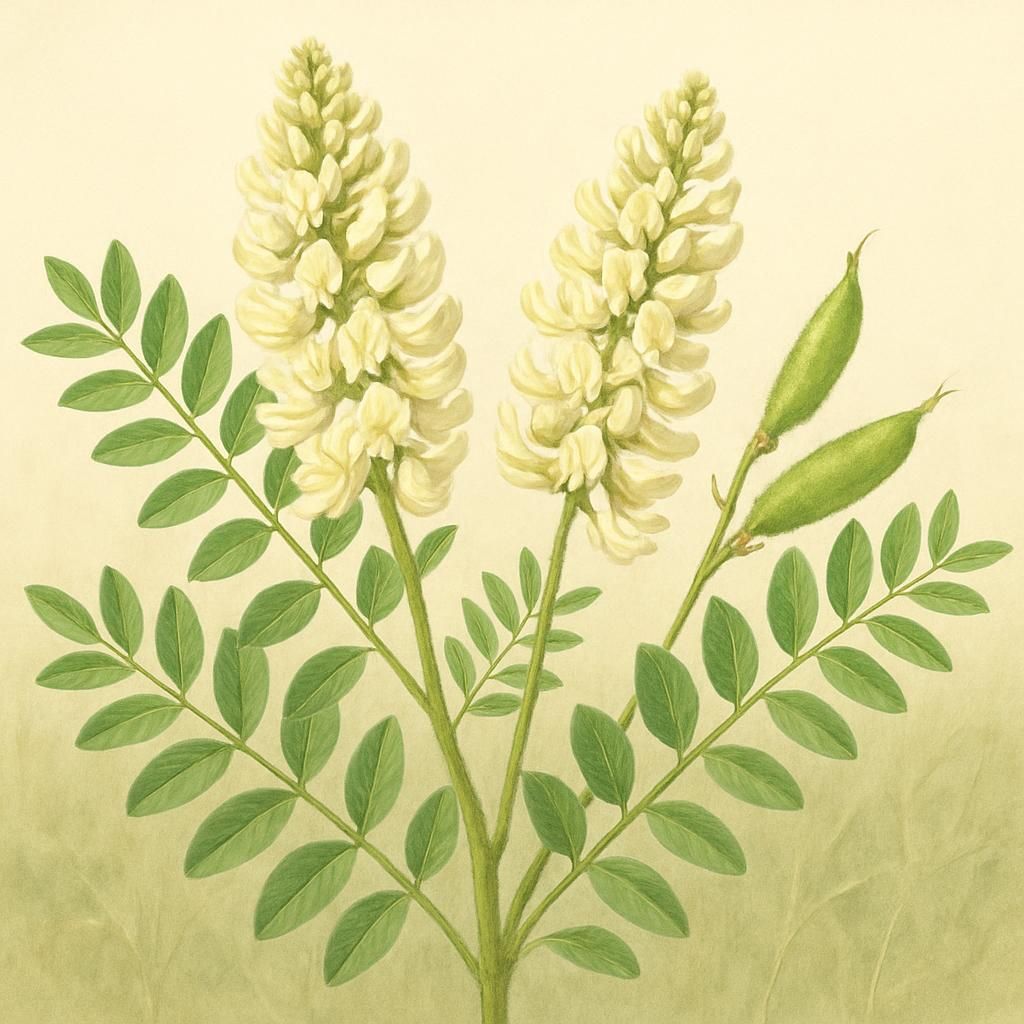
Introduction to Canada milkvetch
Canada milkvetch (Astragalus canadensis) is a hardy native legume that supports soil health, provides high-quality forage, and serves as an excellent nectar source for native bees. Its deep taproot improves soil structure while fixing atmospheric nitrogen, making it a strategic choice for pasture renovation, conservation plantings, and low-input forage systems. Farmers and land managers across the northern United States and southern Canada rely on this species for its drought tolerance and persistence in mixed stands.
Botanical Profile of Canada milkvetch
Astragalus canadensis belongs to the Fabaceae family and produces upright to ascending stems 30–90 cm tall. Leaves are pinnately compound with 15–29 leaflets, and the plant bears dense racemes of creamy-white to pale yellow flowers from June through August. Seed pods are inflated, two-celled legumes containing 10–20 seeds each. The species spreads slowly via short rhizomes and develops a deep taproot that accesses moisture and nutrients unavailable to shallow-rooted grasses.
Soil, pH, and Climate Requirements for Canada milkvetch (MUST INCLUDE A MARKDOWN TABLE OF IDEAL CONDITIONS)
Canada milkvetch performs best on well-drained loams and sandy loams but tolerates clay soils provided drainage is adequate. It prefers neutral to slightly alkaline conditions and is adapted to USDA zones 3–7.
| Parameter | Ideal Range | Notes |
|---|---|---|
| Soil Type | Loam to sandy loam | Avoid waterlogged sites |
| Soil pH | 6.5 – 8.0 | Tolerates 6.0–8.5 |
| Temperature | 15–27 °C daytime | Cold hardy to –34 °C |
| Annual Rainfall | 400–900 mm | Drought tolerant once established |
| Elevation | 0–2,000 m | Performs well on upland and prairie sites |
Step-by-Step Planting & Propagation
- Site selection: Choose full sun with good drainage; avoid areas with standing water.
- Soil test and amend: Target pH 6.5–8.0; inoculate seed with Astragalus-specific rhizobia if planting on new ground.
- Seedbed preparation: Till or use no-till drill to create firm, weed-free seedbed.
- Seeding rate: 8–12 kg/ha pure live seed (PLS) drilled 6–12 mm deep; broadcast at 10–15 kg/ha followed by light harrowing.
- Timing: Spring (April–May) or dormant fall (October–November) plantings are most reliable.
- Inoculation: Mix seed with appropriate rhizobial inoculant immediately before planting.
- Weed control: Use pre-emergent herbicides or mechanical cultivation during the first 60 days.
Care & Maintenance regimes for Canada milkvetch (MUST INCLUDE A MARKDOWN TABLE OF WATER, FERTILIZER, AND PRUNING SCHEDULES)
Established stands require minimal inputs. Monitor for nutrient deficiencies in year two and beyond.
| Operation | Timing | Rate / Method | Notes |
|---|---|---|---|
| Irrigation | Establishment only | 25 mm/week for first 6 weeks | Reduce after taproot develops |
| Fertilizer | Pre-plant & Year 2 | 20 kg P/ha if soil test <15 ppm | Avoid high nitrogen; use starter P/K |
| Mowing / Grazing | Post-bloom or 15 cm regrowth | Remove 50–60 % canopy height | Allow seed set every 3–4 years |
Pests, Diseases & Organic Management
Canada milkvetch is relatively pest-resistant but may host Aphids and Spider mites during hot, dry periods. Root and crown rots caused by Rhizoctonia and Fusarium can occur in poorly drained soils. Cultural controls include crop rotation, maintaining plant vigor through proper fertility, and encouraging beneficial insects. Organic options include insecticidal soaps for aphids and improved drainage plus compost teas for fungal suppression.
Harvesting, Curing & Optimal Storage
Forage is typically harvested at early bloom for maximum protein (18–22 %). Cut with a mower-conditioner, wilt to 40–50 % moisture, then bale or ensile. Seed harvest occurs when pods turn tan and rattle; direct combine at 12–15 % seed moisture or windrow and thresh after 3–5 days. Store seed at 10–12 % moisture in cool, dry conditions for up to five years with minimal viability loss.
Companion Planting for Canada milkvetch
Canada milkvetch pairs well with cool-season grasses such as Wheat and Barley in pasture mixes. It also benefits from association with Clover and Sunflower for increased pollinator diversity. Avoid planting near Potato or Tomato to reduce shared disease pressure from soil-borne pathogens.