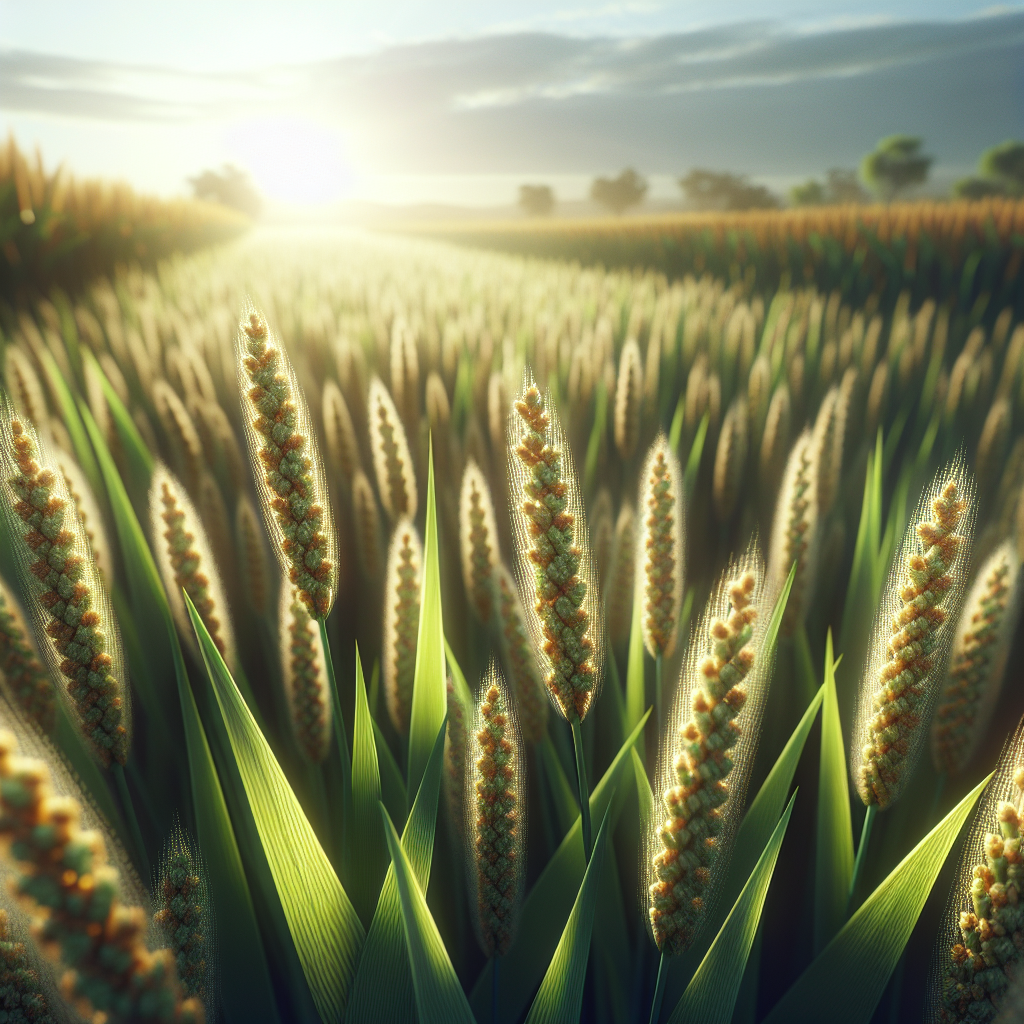
Introduction to Proso Millet
One of the oldest domesticated cereals, this warm-season annual has been cultivated across Central and East Asia for thousands of years before spreading into Europe, the Middle East, and North America. It is especially valued where rainfall is limited or the growing season is short, because many cultivars reach maturity in roughly 60 to 100 days, far faster than many other grain crops.
Agronomically, it fills an important niche as a “catch crop” after failed spring plantings, a rotational grain in semi-arid systems, or a dependable option in regions too dry for more water-demanding cereals. Compared with Rice, it thrives under far lower moisture inputs and is much less tolerant of waterlogging. It is also widely used in gluten-free grain markets, livestock feed blends, Birdseed production, and wildlife food plots.
Its value goes beyond grain. The crop produces a fibrous root system that helps stabilize soil, suppresses some summer weeds through rapid canopy formation when well established, and can leave a manageable residue for the following crop. For growers seeking resilience, speed, and flexibility, few grains are as useful.
Botanical Profile of Proso Millet
This species belongs to the grass family, Poaceae, and is classified botanically as Panicum miliaceum. It is a true annual cereal grass with an erect to somewhat tufted growth habit, typically reaching 30 to 120 cm in height depending on cultivar, fertility, moisture, and planting density.
The root system is relatively shallow compared with deep-rooted sorghums, but it is efficient at extracting moisture from the upper soil profile. Leaves are linear, smooth to slightly hairy, and arise alternately along the culm. Stems are generally slender but can tiller under lower plant populations and adequate fertility. The inflorescence is a loose to compact panicle, often drooping at maturity. Seed color varies by cultivar and market class and may be white, cream, yellow, red, or brown.
Botanically, one nuance that matters in the field is its sensitivity during early establishment. While mature plants are notably drought tolerant, seedlings are less competitive and can be set back by crusted soils, heavy weed pressure, or prolonged saturation. Flowering and grain fill also respond strongly to heat and moisture balance. Excess nitrogen can produce overly lush vegetative growth, weaker stems, delayed maturity, and lodging risk.
Cultivars are often grouped by maturity class, plant height, and grain color. White-seeded types are often preferred for some food and Birdseed markets, while red or darker-seeded forms may be grown for feed or regional preferences. Short-season cultivars are especially useful in northern temperate zones and in double-cropping systems.
Soil, pH, and Climate Requirements for Proso Millet
This crop performs best in well-drained loam, sandy loam, or silt loam soils, but one of its greatest advantages is its ability to produce acceptable yields on lighter, less fertile ground where other cereals struggle. The key requirement is drainage. Standing water for even a few days during seedling establishment can sharply reduce stand density and invite root stress.
Ideal soil pH ranges from about 6.0 to 7.5, though it tolerates roughly 5.5 to 8.0 better than many grains. In acidic soils below pH 5.5, nutrient availability becomes less balanced and root vigor often declines. In highly alkaline soils, micronutrient issues such as zinc deficiency may appear, especially in low-organic-matter fields. A pre-plant soil test is strongly advised because this crop responds better to balanced fertility than to blanket fertilizer use. For broader fertility planning, see soil health strategies.
Climate-wise, it is best suited to temperate, semi-arid, and continental growing regions with warm summers and relatively low to moderate rainfall. Optimal germination usually occurs when soil temperatures are at least 15 to 18°C. Growth is most efficient in daytime temperatures around 24 to 32°C. It tolerates heat well, but prolonged extreme heat above about 35°C during flowering can reduce pollination success and grain set, especially when paired with drought stress.
It is not frost tolerant. Young plants can be badly damaged by even light frost, and mature grain can be harmed if late-season freezes occur before physiological maturity. In practical terms, sow only after danger of frost has passed and the seedbed has warmed consistently.
Moisture demand is relatively low. Seasonal water use may be approximately 250 to 400 mm depending on cultivar length, planting date, and evaporative demand. The most critical moisture windows are germination, early establishment, heading, and grain fill. The crop can survive dry spells, but severe moisture shortage during heading often leads to poor seed set and lighter grain.
If irrigating, aim to keep the top 5 to 8 cm of soil evenly moist during emergence, then allow the surface to dry slightly between irrigations while maintaining moisture deeper in the root zone. A good field target is moist but friable soil, not sticky or anaerobic. Overwatered stands often show pale green leaves, reduced vigor, shallow rooting, and increased weed pressure. In heavier soils, persistent wetness can also trigger patchy yellowing and stunting that mimics nutrient deficiency.
Step-by-Step Planting & Propagation
Propagation is by seed, and direct sowing is the standard method. Transplanting is not economical or agronomically sensible for grain production.
Select the right field. Choose a clean field with low perennial weed pressure and good drainage. Avoid compacted depressions or low spots that stay wet after rain.
Prepare a fine, firm seedbed. Because seeds are small, uniform emergence depends on close seed-to-soil contact. A cloddy seedbed creates erratic depth placement and uneven stands. The ideal surface is fine enough for shallow planting but firm enough that a boot heel leaves only a slight impression.
Time sowing carefully. Plant once soils are warm and stable, generally late spring to early summer in temperate climates. In double-crop systems, it can be sown after an early-harvested crop provided there are enough frost-free days remaining.
Use appropriate seeding depth. Plant about 1.25 to 2.5 cm deep in most soils. In moisture-limited sandy ground, depth can be pushed slightly deeper if needed to reach moisture, but avoid going beyond about 3.8 cm because emergence weakens rapidly.
Adjust seeding rate to purpose. For grain, common field rates are roughly 8 to 15 kg/ha under drilled conditions, with the higher end used for poorer seedbeds, drier climates, or aggressive weed suppression. Broadcast plantings generally require more seed than drilled plantings. In small plots, this translates to a moderately dense stand rather than widely spaced clumps.
Set row spacing by weed pressure and equipment. Narrow rows, such as 15 to 25 cm, usually close canopy faster and suppress weeds better. Wider rows may be used where mechanical cultivation is planned, but yield may dip if spacing becomes too broad.
Inoculation is not required. Unlike legumes, this cereal does not need rhizobial inoculants.
Monitor emergence within the first 7 to 14 days. Rapid, even emergence is a strong predictor of success. If seedlings are missing in patches, investigate crusting, seed placement, bird feeding, or pre-emergent damping-off.
For organic systems, stale seedbed preparation can be highly effective. Irrigate or wait for a light rain to flush weeds, then lightly cultivate before sowing. Because the crop is somewhat weak against weeds early on, this step often improves final stand performance.
Care & Maintenance regimes for Proso Millet
This is often described as a low-input grain, but high-performing stands are not neglected stands. Good management is mostly about getting the first month right.
Water management: During the first two weeks after sowing, the seed zone should remain consistently moist but not saturated. If you squeeze soil from 2 to 5 cm depth, it should hold together lightly but break apart with a tap. If it forms a sticky ribbon or smells sour, it is too wet. After establishment, irrigate less often but more deeply when rainfall is insufficient. The crop should not wilt repeatedly before heading; recurring midday leaf rolling followed by dull bluish-green foliage can indicate meaningful moisture stress rather than harmless heat response.
A practical irrigation schedule in dryland-support systems is to prioritize one irrigation at establishment and another near boot to early heading if rainfall is lacking. If only one irrigation is possible, flowering to early grain fill is often the most yield-sensitive stage. Reduce irrigation as grain approaches hard dough to avoid delayed drying and uneven maturity.
Nutrient management: Proso millet is efficient with modest fertility, but it still removes nutrients in harvested grain. Nitrogen is the main driver of yield response, yet overapplication is one of the most common mistakes. Many growers do well with a moderate nitrogen program based on soil test and yield goal, often in the range of 30 to 70 kg N/ha total available nitrogen. On residual-fertility fields following manure or legumes such as Cowpeas, rates may be reduced.
Too little nitrogen causes pale foliage, reduced tillering, short plants, and small panicles. Too much causes lush soft growth, delayed maturity, and lodging. Phosphorus supports early root growth and stand establishment, especially in cool starts, while potassium helps water regulation and stalk strength. Sulfur and zinc may matter in sandy, low-organic-matter, or high-pH soils.
Weed control: The crop is most vulnerable from emergence until canopy closure. Once well rooted and actively growing, it becomes more competitive. Use a clean field, proper seeding density, and timely shallow cultivation if rows allow. Avoid deep cultivation that prunes roots and stimulates new weed flushes. Organic mulch is generally impractical for field-scale grain but can help in demonstration or garden-scale patches.
Lodging prevention: Excessive nitrogen, overly dense stands, wind exposure, and late irrigation can all increase lodging. Choose shorter cultivars where storms are common, avoid pushing fertility past realistic moisture availability, and do not overwater near maturity.
Rotation role: It works well after legumes, fallow, or failed early crops. Avoid repeated grass-on-grass sequences when possible, as these can build residue-borne disease and grassy weed pressure. In cereal rotations, alternating with broadleaf crops improves field hygiene and nutrient cycling. Growers comparing warm-season cereals often also review Sorghum for similar drought-resilient rotation planning.
Pests, Diseases & Organic Management
In many regions, this crop has fewer severe pest issues than maize or some other cereals, but problems can still develop, especially in stressed stands.
Birds: Perhaps the most notorious issue, especially in small fields and at grain fill. Flocks can strip panicles quickly once seed hardens. Use reflective tape, scare devices, netting in small plots, and synchronized planting over larger acreage to reduce concentrated feeding.
Grasshoppers and Caterpillars: Defoliation is usually most damaging in young stands. Scout field margins first, as infestations often begin there. Encourage habitat for predatory insects and Birds, mow weedy borders before populations build, and use approved biological controls where thresholds justify intervention.
Armyworms and Head-feeding insects: These can clip foliage or damage panicles. Inspect during warm humid periods and after storm fronts. Panicle feeding near heading can directly reduce grain yield.
Aphids: Usually secondary pests, but heavy populations can stress plants and sometimes vector viruses. Avoid excessive nitrogen that encourages soft tissue. Strong beneficial insect populations often keep Aphids below damaging levels.
Root and seedling diseases: Poor emergence may result from seed rot or damping-off in cold, wet, compacted soils. Prevention is mainly cultural: warm seedbeds, clean seed, shallow proper planting, and good drainage.
Leaf spots and Blights: These are more likely in dense, lush stands with prolonged leaf wetness. Symptoms include elongated lesions, tip burn, or irregular necrotic spotting. Improve air movement through sensible fertility and avoid unnecessary overhead irrigation late in the day.
Smuts and Grain molds: Seedborne or humidity-driven issues can affect head quality. Use certified seed, rotate crops, and harvest promptly once mature rather than leaving panicles exposed through repeated dew and rain cycles.
Organic management framework: Start with resistant or locally adapted cultivars, use crop rotation, maintain balanced fertility, and avoid stress. Healthy, steadily growing plants resist opportunistic pest and disease pressure better than those weakened by waterlogging, nutrient imbalance, or weed competition. Field scouting should be weekly from emergence to grain fill, with extra checks after storms or heat stress.
Harvesting, Curing & Optimal Storage
Maturity is reached when panicles turn their mature color, seeds become hard, and most foliage begins to dry down. Because flowering and seed set can be somewhat uneven across tillers, do not judge readiness by a few green heads or late tillers. Instead, assess the main stand: if the majority of seeds are firm and no longer dent easily under thumbnail pressure, harvest is close.
For combine harvest, target grain moisture commonly around 14% or slightly lower, though some growers may begin a bit higher and then dry mechanically. Waiting too long can increase shattering, bird loss, lodging, and weather staining. Harvest too early and grain will be soft, difficult to thresh cleanly, and more vulnerable in storage.
In small plots, panicles may be cut by hand and dried on tarps, screens, or in bundles under cover. Good airflow is essential. Avoid thick piles, which trap heat and moisture and encourage molds. Curing areas should be shaded, dry, and protected from rain and Birds.
After threshing, clean grain thoroughly. Chaff, broken seeds, and weed seeds raise storage risk because they hold moisture unevenly and restrict airflow. For long-term storage, dry grain to about 12% moisture or lower; in warm climates or for extended holding, 10 to 11% is safer. Grain that is truly dry feels hard and slick rather than leathery, and a bitten kernel fractures rather than crushes.
Store in cool, dark, dry conditions in sealed bins, food-safe drums, or pest-proof sacks placed off the floor. Ideal storage temperatures are low and stable. Warm grain breathes more actively and attracts insects. Check bins regularly for condensation, caking, off-odors, webbing, or hot spots. A musty smell indicates moisture trouble; sweet heating odors suggest active spoilage. Once storage heating begins, grain quality can deteriorate quickly.
Straw and residue can be baled lightly for rough forage if harvested clean and dry, though feed value is modest compared with high-quality hay. Residue may also be incorporated or left as surface cover depending on the following crop and moisture strategy.
Companion Planting for Proso Millet
In broadacre grain production, companion planting usually functions more as strip-cropping, border planting, rotational pairing, or beneficial insect support than classic garden interplanting. The goal is to improve soil function, pollinator habitat nearby, nitrogen carryover from previous crops, or pest disruption without creating excessive competition.
A useful partner is Clover, usually not sown densely into the standing millet itself in dry regions, but used before or after the crop, along margins, or as a frost-seeded understory where moisture permits. It contributes organic matter, supports beneficial insects, and can improve nitrogen availability for following crops.
Sunflower can serve as a border or strip crop, helping diversify field structure and attract pollinators and beneficial insects. It should not be so close or dense that it shades the millet during early establishment.
Chickpeas are valuable more as a rotation companion than as a simultaneous intercrop in most dryland systems. As a preceding broadleaf legume, they can reduce grass-disease carryover and leave the field in cleaner condition for the next grain cycle.
Buckwheat is another practical companion species in diversified farms, especially as a quick flowering strip nearby rather than a direct in-row intercrop. It attracts beneficial insects, covers bare ground fast, and can fit before or after this grain in tight seasonal windows.
For best results, avoid pairing it closely with aggressive tall feeders that outcompete seedlings for light and moisture. Companion planning works best when the crop still retains full sun, clean row space during establishment, and modest nutrient competition.