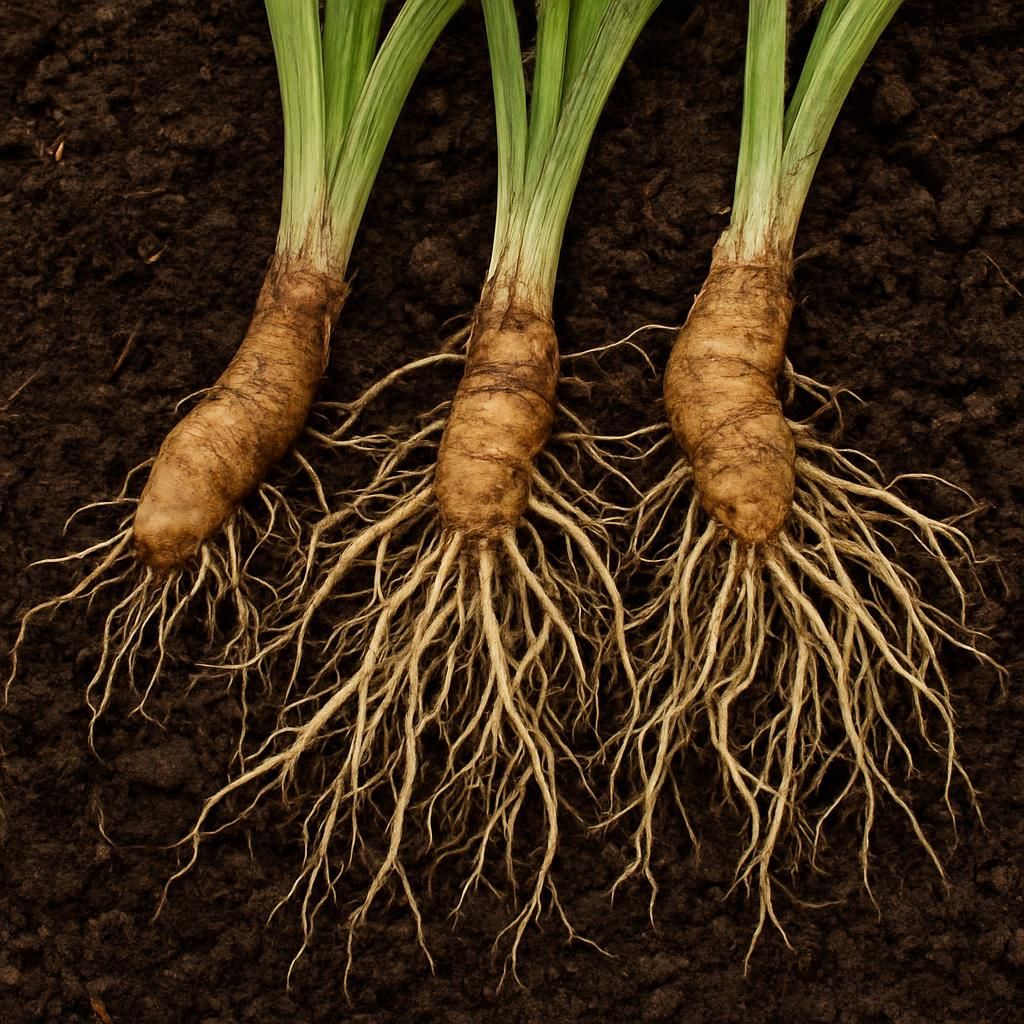
Introduction to Plantain Root
Plantain (Musa paradisiaca) is a perennial herbaceous plant whose starchy fruits and underground corms serve as a dietary staple across tropical and subtropical regions. The term "Plantain Root" specifically highlights the robust rhizome and fibrous root network that anchors the plant, absorbs water and nutrients, and stores carbohydrates for successive ratoon crops. Unlike dessert bananas, plantains require higher starch content and longer maturation, making root health critical for sustained productivity and disease resistance.
Successful cultivation begins with understanding the crop's botanical requirements and matching them to local conditions. Because the root system is shallow yet extensive, proper soil structure, consistent moisture, and balanced fertility directly influence bunch size, fruit quality, and ratoon longevity. This guide synthesizes decades of agronomic research into actionable steps for both new and experienced growers.
Botanical Profile of Plantain Root
Plantains belong to the Musaceae family and are classified as giant herbs rather than trees. The "root" consists of a thickened, underground stem (rhizome or corm) from which adventitious roots radiate. These roots typically extend 1.5–2 meters laterally but remain concentrated in the upper 30–40 cm of soil. The corm stores starch and produces suckers (daughter plants) that form the next generation.
The pseudostem, formed by tightly packed leaf sheaths, can reach 3–5 meters in height. Leaves are large, oblong, and arranged spirally. Inflorescences emerge from the center of the pseudostem, developing into heavy bunches of starchy fruits. Because the plant is seed-sterile, all propagation occurs vegetatively through corm division or tissue culture.
Soil, pH, and Climate Requirements for Plantain Root (MUST INCLUDE A MARKDOWN TABLE OF IDEAL CONDITIONS)
Plantains thrive in deep, well-drained loamy soils with high organic matter. Heavy clays restrict root development while sandy soils demand frequent irrigation and fertilization. The ideal pH range is slightly acidic to neutral, allowing optimal nutrient uptake especially for potassium and magnesium.
Temperature and rainfall patterns strongly influence growth cycles. Consistent warmth above 20 °C promotes rapid vegetative growth, while temperatures below 15 °C slow metabolism and increase susceptibility to Fusarium wilt. Annual rainfall of 1500–2500 mm, supplemented by irrigation during dry spells, supports continuous production.
| Parameter | Ideal Range/Value | Notes |
|---|---|---|
| Soil Type | Deep sandy loam to clay loam | >1 m depth preferred |
| Soil pH | 5.5–7.0 | Maintain with lime or sulfur adjustments |
| Organic Matter | 3–5 % | Incorporate compost or cover crops |
| Temperature (day) | 25–32 °C | Optimal photosynthesis and fruit fill |
| Temperature (night) | 18–24 °C | Avoid prolonged exposure below 15 °C |
| Annual Rainfall | 1500–2500 mm | Even distribution or supplemental irrigation |
| Altitude | 0–1200 m | Higher altitudes may extend cycle time |
| Drainage | Excellent | Raised beds or ridges in heavy soils |
Step-by-Step Planting & Propagation
Site Selection: Choose flat to gently sloping land with full sun and protection from strong winds. Clear vegetation and remove perennial weeds.
Soil Preparation: Conduct soil tests and amend to reach target pH and nutrient levels. Incorporate 20–30 tons/ha of well-rotted manure or compost. Form raised beds or ridges 30–40 cm high and 1.5–2 m wide.
Propagation Material: Use healthy sword suckers (30–45 cm tall with narrow leaves) or bits of corm weighing 1–2 kg. Tissue-cultured plantlets offer disease-free starts. Avoid corms showing symptoms of nematodes or Fusarium wilt.
Planting Time: In rain-fed systems, plant at the onset of rains. Irrigated plantations allow year-round planting with attention to temperature.
Spacing: Use 2 m × 2 m or 2.5 m × 2 m triangular patterns for 2000–2500 plants/ha. Wider spacing improves airflow and reduces black Sigatoka pressure.
Planting Depth: Set corms so the top is level with or slightly below the soil surface. Firm soil around roots and water thoroughly.
Initial Irrigation: Provide 10–15 L per plant immediately after planting and maintain field capacity for the first 4–6 weeks.
Care & Maintenance regimes for Plantain Root (MUST INCLUDE A MARKDOWN TABLE OF WATER, FERTILIZER, AND PRUNING SCHEDULES)
Consistent care ensures strong pseudostems and large bunches. Desuckering, leaf pruning, and nutrient management are performed on a calendar basis. Mulching with 10–15 cm of organic material conserves moisture and suppresses weeds.
| Growth Stage | Watering Schedule | Fertilizer Application | Pruning / Desuckering Schedule |
|---|---|---|---|
| Establishment (0–3 mo) | 15–20 L/plant, 2–3× weekly | 50 g NPK 15-15-15 + 5 kg compost per plant at planting | Remove all suckers except one follower |
| Vegetative (3–6 mo) | 25–30 L/plant, weekly or as needed | 100 g NPK 15-15-15 + 50 g K₂SO₄ every 6 weeks | Maintain 1–2 healthy suckers; remove diseased leaves |
| Flowering (6–9 mo) | 30–40 L/plant, maintain even moisture | 150 g NPK 12-6-22 + 100 g MgSO₄ | Cut male bud 2 weeks after last hand; desucker weekly |
| Fruit Fill (9–12 mo) | 30 L/plant; reduce 2 weeks before harvest | 100 g K₂SO₄ only | Remove 1–2 oldest leaves; keep 8–10 functional leaves |
| Ratoon Cycle | Resume full schedule after harvest | Repeat vegetative program | Select strongest sucker; remove others |
Pests, Diseases & Organic Management
Major threats include black Sigatoka, Fusarium wilt, plant-parasitic nematodes, and banana weevil. Cultural practices such as resistant cultivars, clean planting material, and field sanitation form the foundation of organic management.
- Black Sigatoka: Remove and destroy infected leaves weekly; apply neem oil or Bacillus subtilis sprays every 10–14 days during wet periods.
- Fusarium wilt: Use resistant varieties; avoid moving soil between fields; solarize beds before replanting.
- Nematodes: Rotate with Cassava or Sorghum; apply 2 tons/ha of neem cake at planting; maintain organic mulch.
- Banana weevil: Trap adults with pseudostem discs; apply entomopathogenic nematodes (Heterorhabditis spp.) around the corm.
- Aphids and thrips: Encourage natural enemies with flowering borders; use insecticidal soap when thresholds are exceeded.
Harvesting, Curing & Optimal Storage
Harvest when fingers are full and angular but before yellowing begins. Cut the entire bunch with 1 m of stalk and hang in a shaded, well-ventilated area. Allow 5–7 days for natural ripening at 18–22 °C. For longer storage, hold green fruit at 13–15 °C and 85–90 % relative humidity for up to three weeks.
Corms intended for propagation should be harvested, cleaned, and treated with 1 % bleach solution for 5 minutes before storage in cool, dry conditions. Avoid stacking to prevent bruising and rot.
Companion Planting for Plantain Root
Strategic companions improve biodiversity and reduce pest pressure. Marigold borders repel nematodes while Gliricidia provides nitrogen-rich mulch and wind protection. Interplanting with Coconut or Cacao creates multi-story systems that optimize light and nutrient use.
Avoid planting with Potato or Tomato because of shared susceptibility to Phytophthora. Leguminous cover crops such as Pigeon pea between rows fix nitrogen and improve soil structure for subsequent ratoons.
For more on building resilient small-farm systems, read The Truth About Weather Patterns and Small Farm Resilience.